




Minister's book sheds light on '98 currency controls
Economic adviser turned finance minister Nor Mohamed Yakcop made public today unpublished notes relating to policy dialogues between him and former prime minister Mahathir Mohamad.
Economic adviser turned finance minister Nor Mohamed Yakcop made public today unpublished notes relating to policy dialogues between him and former prime minister Mahathir Mohamad.
Nor Mohamed's writings at the peak of the Asian Financial Crisis in 1997 were launched as ‘ Notes to the Prime Minister: The Untold Story of How Malaysia Beat the Currency Speculator, ' including the 234 pages of notes he had given to Mahathir to explain the then on-going crisis.
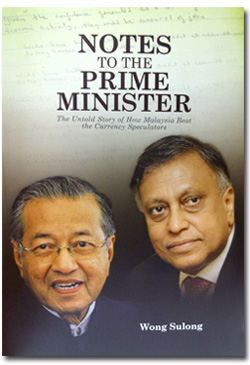 "These notes which were written in 1997/1998, contributed to the implementation of what came to be termed as the unorthodox measures," said Nor Mohamed in his keynote address.
The notes, he said, were among the reasons Mahathir had taken an unconventional approach to impose exchange controls and peg the Malaysian Ringgit in 1998 to beat currency speculation.
The 487-page book, edited by veteran journalist Wong Sulong, described more than just the measures taken to cushion the economy, but how both minds found ways to resolve the impact of the financial crisis in taking a leap of faith.
The notes were a detail collection of methodologies mainly on how the foreign currency trading worked and step-by-step solutions on how to tackle the problem.
Nor Mohamed, who is currently the Minister in Prime Minister’s Department in charge of the Economic Planning Unit, said he had put the notes together after briefing Mahathir on how the foreign exchange currency (forex) market worked.
45 sheets of notes
In one of the first notes he wrote on Oct 3, 1997, which marked the turning point of the financial meltdown, Nor Mohamed indicated a new strategy that would eventually become the backbone of the country’s economy.
He stressed that Malaysia needed to come back with its guns blazing to prop up the Ringgit from depreciating further.
 The strategy hinged on the country going on giving, which meant the country would pump money into the market.
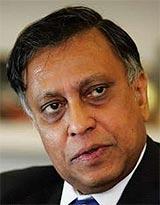
“Fear and greed started to feed on each other, and in the process the Ringgit has weakened to 3.36,” Nor Mohamed ( right ) explained.
“On the basis of market psychology, market timing and market positioning, we are set to see the Ringgit strengthening back to the 2.80-2.90 level relatively quickly.
“All we need is a small nudge from the export earning government linked companies (EEGLCs) to sell USD for Ringgit using the ‘giving’ method,” wrote Nor Mohamed, in order to break the ‘fear and greed factors’.
With that he had compiled 44 crucial notes, which he had preserved for the last 13 years and decided to publish upon coercion of friends to explain the “intellectual aspect” of the measures imposed during the two-year crisis.
The book also included Nor Mohamed’s effort to transform the GLCs during the Asian financial crisis, where many were mired in debt and rudderless.
The book which written mostly in a journalistic manner with several chapters in a question and answer format among others, is now on sale at RM69 at all major bookstores.


Are you sure you want to delete this comment?
This action cannot be undone.