




Judge: No to accused 'rotting in jail'
A Sessions Court Judge in Kota Kinabalu has conditionally discharged a suspected drug peddler on remand for nearly 30 months, after the prosecution failed to sustain its case despite winning several postponements until it was ready for court.
A Sessions Court Judge in Kota Kinabalu has conditionally discharged a suspected drug peddler on remand for nearly 30 months, after the prosecution failed to sustain its case despite winning several postponements until it was ready for court.
The prosecution's 22nd and key final witness, a Junaide Tamin from Tawau, could not be located despite a state-wide hunt following a warrant of arrest.
The defence pleaded for "justice for the accused as well" since he doesn't have the benefit of bail after being arrested and placed under remand since February, 2009.
Sessions Court judge M Rajalingam, in ordering that the accused Ampas Rahman, a Bugis, be given a discharge not amounting to an acquittal disagreed with the prosecution , saying that the courts must be seen as being the protector and guarantor of fundamental rights.
"The court is of the considered opinion that it's unlikely that this case can be prosecuted expeditiously in the short future," said Judge Rajalingam on Thursday.
Under the circumstances, the judge stressed that the court had no alternative but to take into consideration that "the accused shall not be allowed to suffer from the dilatoriness of the prosecution by being left with the charge hanging over his head indefinitely".
The court cannot consistently with the responsibility so laid upon it, continued the judge, refuse to entertain the application seeking protection against infringement of fundamental rights.
Averting lack of faith in judiciary
"Failure of the court to do so - entertain application seeking protection - would create social anarchy and disinterestedness in judicial process," said judge Rajalingam. "This will finally lead the public to have no faith in the administration of justice."
The court, stressed the judge, is the supreme arbitrator of what is right and wrong and that "any public decision maker is subject to judicial scrutiny".
He added that he was not casting any aspersions on the office of the public prosecutor.
"Ordinarily, a challenge on the decision of any public decision maker is done by way of proper application within the concept of judicial review.
"That does not necessarily mean that the court has no power or jurisdiction at any time to exercise its prerogative powers, when justice demands," he said.
The judge hastened to add that ‘such prerogative powers" will only be exercised in an extreme situation when it is necessary and essential to protect and safeguard the federal constitution and/or where the spirit and intent of the charter is violently breached by the public decision maker.
The courts will rarely intervene in the decision-making process of the public prosecutor to maintain law and order, conceded the judge, "unless the public interest compels the court to do so".
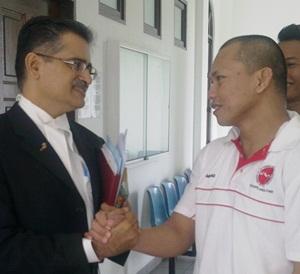 Defence counsel Rakhbir Singh (
right shaking hands with
client
), erring on the side of caution, was earlier apparently constrained to press for Ampas's freedom.
Defence counsel Rakhbir Singh (
right shaking hands with
client
), erring on the side of caution, was earlier apparently constrained to press for Ampas's freedom.
Instead, he was ready for the prosecution to close its case and make submissions.
The counsel, caught in a legal twilight zone, had resigned himself to the possibility of the discharge not amounting to acquittal being the less likely of two options for his client in the face of anticipated objections from the prosecution.
Fear of continued incarceration
The court had nearly an hour earlier, taken note of Rakhbir's reminder of its own ruling from three dates ago, and directed the prosecution to close its case and make submissions.
He submitted that the court had the inherent power to decide within its jurisdiction. Rakhbir feared that his client would otherwise continue to be incarcerated indefinitely without the possibility of being convicted in the near future.
The court agreed that the accused cannot be allowed to rot in custody, indefinitely, "until the said Junaide emerges in this court".
Nevertheless, the court also granted that the prosecution and the police have made genuine attempts to locate the missing witness but to no avail.
The surprise verdict to free Ampas came after the prosecution pressed for yet another postponement to obtain more time to locate Junaide.
DPP Effizah Erine Idris, however, left it to the discretion of the court but not without cautioning that the attorney general, under the federal constitution, had the sole power to institute, conduct or discontinue a case against an accused and that "the court had no power to intervene".
She cited 145(3) of the Federal Constitution and Section 376 of the Criminal Procedure Code.
The key final witness had gone missing without completing his examination-in-chief.
The other 21 witnesses included a chemist, four others from Kampung Sri Pandan Putatan in Penampang, and 16 police witnesses.
Ampas, an electrician, was picked up by police on Feb 2, 2009 at approximately 1.30am from the house of a friend, known only as Aling, while playing chess.
He was brought to his house in Kampung Pasir Puteh in Putatan, Kota Kinabalu, where he informed police that a friend, Tom, had kept some packets in a jacket in one of the rooms.
Police later recovered six packets containing some white hard substance believed to be dangerous drugs of the ganja variety.


Are you sure you want to delete this comment?
This action cannot be undone.