




Vatican-KL ties: Prelate's goals lack realism
COMMENT After weeks of silence in which he took a lot of flak for what was perceived as undue coziness with the powers-that-be, the Catholic Archbishop of Kuala Lumpur has issued a statement on the establishment of diplomatic relations between the Vatican and Malaysia.
Couched in the platitudes for which men of the cloth are renowned, the statement by Reverend Murphy Pakiam, given front-page play in today's edition of the Catholic weekly Herald , sets out six steps that he hopes would be facilitated by the establishment of diplomatic relations between the Holy See and Malaysia...
COMMENT After weeks of silence in which he took a lot of flak for what was perceived as undue coziness with the powers-that-be, the Catholic Archbishop of Kuala Lumpur has issued a statement on the establishment of diplomatic relations between the Vatican and Malaysia.
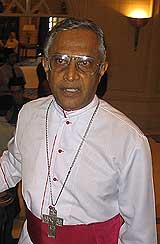 Couched in the platitudes for which men of the cloth are renowned, the statement by Reverend Murphy Pakiam, given front-page play in today's edition of the Catholic weekly
Herald
, sets out six steps that he hopes would be facilitated by the establishment of diplomatic relations between the Holy See and Malaysia.
Couched in the platitudes for which men of the cloth are renowned, the statement by Reverend Murphy Pakiam, given front-page play in today's edition of the Catholic weekly
Herald
, sets out six steps that he hopes would be facilitated by the establishment of diplomatic relations between the Holy See and Malaysia.
There is a lack of realism about the majority of the steps the Archbishop spelt out that is either a commentary on the dangers posed by thinking that revels in platitudes, or it simply reflects imperviousness to what the environment is telling him.
Take, for example, hopes for the establishment of an Inter Religious Council that would include key leaders and representatives of all religious groups.
The operative word here is "key". Muslim supremacy is not going to abide the notion of implied parity to other religions that membership of an inter-faith panel by key Muslim leaders would grant.
 This fact ought to have been plain to non-Muslims a long time ago when Muslim religious leaders declined invitations to join the Christian-mooted Malaysian Consultative Council of Buddhism, Christianity, Hinduism, Sikhism and Taoism formed in the early 1980s.
If it didn't get through in earlier decades, this fact should have last year after no less than the Deputy Prime Minister Muhyiddin Yassin dismissed the composition of the inter-faith panel that the late Ilani Ishak tried to form as "small fry", in an apparent attempt to placate Muslim supremacists who were upset at Muslim participation.
In Muslim-dominated Malaysia, Islamic propriety towards The Other does not disbar cordiality, but it stops short of countenancing the notion of equality.
A ministry on non-Muslim affairs?
Similarly unrealistic is the second step outlined by the Archbishop: the establishment of a ministry and the appointment of a full minister to look into non-Muslim affairs.
Again, this measure would grant parity to other religions and so would be insupportable in a Muslim-run polity.
In its favour, one may argue that there exists such a portfolio in other Muslim dominant countries like Pakistan, for example.
But the powers are severely circumscribed and what's left only serves to emphasise the ‘dhimmi' status of the non-Muslims. (Dhimmi are the non-Muslim subjects under Muslim governance.)
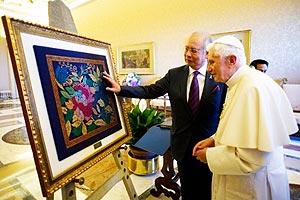 The third step is one that is the most feasible because it does not have any negative repercussions on the special status of Islam in Malaysia.
This step concerns the establishment of dialogue and links between Islamic institutions in Malaysia and the Pontifical Institute for Arabic and Islamic Studies.
But the fourth and fifth steps deepen the unrealism that drapes the whole project of what ties between the Vatican and Malaysia should achieve from the standpoint of the church in Malaysia.
These measures concern education and training. The Archbishop hopes that the government would permit seminaries to resume the training of priests from the region, and that it would promote Christian-Catholic education and training of teachers.
It is not hard to envisage that a Muslim-run government would respond with a flat ‘no' to the first request and a nuanced ‘yes' to the second.
A Muslim government, zealous about its Islamic credentials, would be averse to the idea of Malaysia being a hub for the training of priests from the region.
However, the same government would not be unfriendly to the proposal that Christian principals be appointed to Christian-owned but government-aided educational institutions.
Defence of democratic values
The sixth step concerns the promotion and defence of democratic values and protection of minority groups in Malaysia.
 This step is neither here nor there. Its feasibility depends on who makes the government in Malaysia.
The best way to ensure the realisation of the sixth step is to abet the development of political perspectives in Malaysia that aim to restore the country to the values enshrined in the Merdeka Constitution.
Restoration would foster a climate where the less unrealistic goals outlined by the Archbishop are certain to be realised.
Absent restoration, those goals would be subject to the vagaries of rulers who will treat the Christian vote as a thing to be courted only when their tenancy is imperiled.
TERENCE NETTO has been a journalist for close on four decades. He likes the occupation because it puts him in contact with the eminent without being under the necessity to admire them. It is the ideal occupation for a temperament that finds power fascinating and its exercise abhorrent.


Are you sure you want to delete this comment?
This action cannot be undone.