




More contentious laws to come under review
All contentious laws, including the University and University Colleges Act 1971 (UUCA), Printing Presses and Publications Act 1984 (PPPA), Communications and Multimedia Act 1998 (CMA), Sedition Act 1948, Defamation Act 1957 and the death penalty are to be reviewed by the Attorney-General's Chambers.
All contentious laws, including the University and University Colleges Act 1971 (UUCA), Printing Presses and Publications Act 1984 (PPPA), Communications and Multimedia Act 1998 (CMA), Sedition Act 1948, Defamation Act 1957 and the death penalty are to be reviewed by the Attorney-General's Chambers.
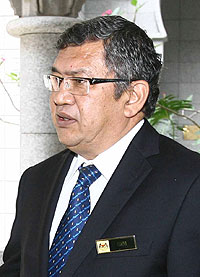
At a press conference after delivering a paper at the Law Faculty of UiTM yesterday, attorney-general Abdul Gani Patail said the law reforms would not stop after the abolition of Internal Security Act (ISA), which is scheduled to be repealed in March.
 Chinese newspaper
Sin Chew Daily
today quoted Gani as saying that his office planned to review these laws from April, as part of the government's law reform roadmap.
Chinese newspaper
Sin Chew Daily
today quoted Gani as saying that his office planned to review these laws from April, as part of the government's law reform roadmap.
However, the chambers has no intention to amend the constitution, as it would be an extraordinary move.
"Compared with constitutional amendments, I prefer to amend the laws because constitutional amendment requires careful handling," the daily quoted him as saying.
During his speech on the eve of Malaysia Day, Prime Minister Najib Abdul Razak announced several law reforms , including the repeal of the ISA, Restricted Residence Act (RRA) and Banishment Act, as well as amendments to Section 27 of the Police Act and the PPPA.
Although the announcement, seen as a move to create a momentum to favour the BN in the next general election, received thumbs up from the public, Najib was urged to extend the reforms to other archaic laws as well, such as Sedition Act.
The Youth wings of both Umno and MCA have urged the government to review the UUCA, which prohibits university students from taking part in political parties.
Also reporting from the UiTM event, national news agency Bernama quoted Gani as calling on the people to give the AG's Chambers a chance to prove itself on the two new legislation to replace the ISA, which he said would stress on the fundamental rights of the people and national security.
One of the new laws would address criminals while the other would target on terrorism and subversive movements, he said.
His office, Gani added, had set up a committee comprising three former chief justices and two lawyers with vast knowledge, and who have worked on these issues, to look into the two new replacement laws.
Foreign law experts to be consulted
The committee was also studying legislation in developed Commonwealth member countries and European countries, such as Denmark, to formulate the new law, he said.
The AG's Chambers would also consult legal experts from the United States who drafted the Patriot Act and lawyers who were practising in the area, besides Queen's Counsel from the United Kingdom.
Apart from the international perspective, he said, the committee would also take into account local views from the Human Rights Commission of Malaysia (Suhakam) and government enforcement agencies, including the police, when drafting the new preventive laws.
The new laws should protect the fundamental rights of not only Malaysian citizens but also the rights of government enforcement agencies overseeing national security.
The other challenge was how to make the law crystal clear and easily understood, both by Malaysian citizens and the government agencies, he said.
"Even to get a suitable definition of terrorism and 'public place' will be a tough job, but it must be addressed to make the law crystal clear for everybody," Gani added.
Related stories
'Hishammuddin deserves credit for law repeal'
Setting a price on civil service votes
Ibrahim Ali explains state of drowsiness
Shadow budget 'not a vote-buying attempt'


Are you sure you want to delete this comment?
This action cannot be undone.