




'Restraints in Section 15 of UUCA reasonable'
Court of Appeal judge Justice Low Hop Bing has found the restrictions in Section 15(5)(a) of the Universities and University Colleges Act to be reasonable and therefore valid.
Court of Appeal judge Justice Low Hop Bing has found the restrictions in Section 15(5)(a) of the Universities and University Colleges Act to be reasonable and therefore valid.
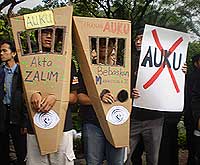 Low, who led a three-member bench in delivering a ruling on the ‘UKM 4' appeal today, also said it is not for the court to determine that the law is “harsh and unjust”.
The sole dissenting judge, he cited the Federal Court case of Loh Kooi Choon vs the Malaysian government in saying that the question of policy is to be debated and decided by Parliament and is not for judicial determination.
“To sustain it would cut very deeply into the very being of Parliament. Our courts ought not to enter this political thicket, even in such a worthwhile cause as the fundamental rights guaranteed by the constitution,” he said.
“Some people may think the policy of the Act unwise and even dangerous to the community. Some may think it at variance with principles which had long been held sacred.
"But a judicial tribunal has nothing to do with the policy of any Act, which it may be called upon to interpret.”
The duty of the court, Justice Low said is to expound the language of the Act in accordance with the settled rules of construction.
 “I answer (to the appeal by the UKM 4) in the negative. The restrictions contained in Section 15(5)(a), being within the bounds of reasonableness, come within the scope of Article 10(1)(a) read with Article 10(2)(a).
“It is therefore constitutional and valid. The instant appeal is dismissed.”
Justice Low said he is of the view that Article 10(1)(a) and Article 10(2)(a) must be generously interpreted.
The other two judges - Justice Mohd Hishamudin Mohd Yunus and Justice Linton Albert - had ruled that Section 15 of the UUCA is unconstitutional .
The four UKM students were represented by lawyers Malik Imtiaz Sarwar, Ashok Kandiah and Jenine Gill.
Separation of powers
Low noted by obiter dictum (a statement made in passing) that Parliament may wish to consider amending Section 15(5) in particular and the whole Act in general.
“This is to bring about a repeal or review thereof (of the UUCA). This measure can only be brought about by legislative acts.
“The making or unmaking of the law is a matter within the exclusive domain of Parliament. The courts are entrusted with the responsibility for interpretation of the law.”
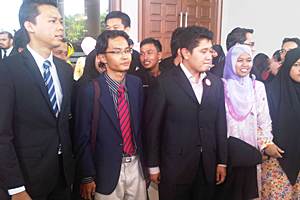 The four students - Mohd Hilman Idham, Ismail Aminuddin, Azlin Shafina Mohamad Adza and Wong King Chai - had been arrested by police during the Hulu Selangor by-election campaign on April 24 last year for taking part in political events.
The political science students were found in possession of paraphernalia supportive of, or sympathetic to a contesting political party.
They then received notices from Universiti Kebangsaan Malaysia's (UKM) chancellor that required them to appear before a disciplinary tribunal on June 3 to answer charges.
The four made a written representation on May 26 denying the allegations.
They then submitted a judicial review application and named the government, the higher education minister and UKM as respondents.
On Sept 28, the Kuala Lumpur High Court ruled that Section 15(5) of the UUCA is constitutional.
At a disciplinary board hearing in July this year, however, the students were found ‘not guilty’ and they graduated last month.
Judgements
Related stories
Section 15 of UUCA unconstitutional, rules court
'Decision a green light for involvement in politics'
Section 15 of UUCA not needed, says MCA Youth


Are you sure you want to delete this comment?
This action cannot be undone.