




Time to bid adieu to capitalism, says PSM
While agreeing that Malaysia has “done well” under capitalism since independence, PSM argues that it is time to shed the system, which it said will doom working class Malaysians should it persist.
While agreeing that Malaysia has “done well” under capitalism since independence, PSM argues that it is time to shed the system, which it said will doom working class Malaysians should it persist.
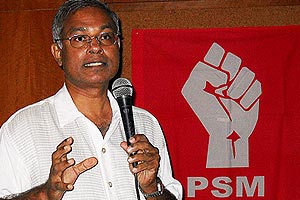 “As a socialist, I believe that capitalism is wrong. Production should be for the people, not for profit,” PSM central committee member D Jeyakumar (
left
) told the Socialism 2011 forum in Kuala Lumpur yesterday.
“As a socialist, I believe that capitalism is wrong. Production should be for the people, not for profit,” PSM central committee member D Jeyakumar (
left
) told the Socialism 2011 forum in Kuala Lumpur yesterday.
However, he agreed that capitalism has to a point made Malaysia more well-off than countries that gained independence concurrently, like Bangladesh and Indonesia.
“There must be a reason why 2.5 million foreigners flock to Malaysia to work. We must have something better to offer then their home country.”
It is also undeniable that since the seventies, official statistics show a reduction in hardcore poverty from fifty percent of households to slightly below four percent in 2010, while the average pay of Malaysians have quadrupled in the same period.
But he argued “doing well” does not mean that Malaysians are prosperous.
“Sixty percent of Malaysians live under the RM3,000 poverty line, enough perhaps to survive and feed the family, but just enough,” said Jeyakumar, who is also Sungai Siput MP.
And things, he warned, are about to get worse as Malaysia no longer have the comparative advantage it once had to sate the profit-hungry international capitalists.
Jeyakumar said that after independence Malaysia did better as we have raw materials that feed into the imperial economic system permeating the commonwealth of the former British empire.
“That is why they built roads and infrastructure, and helped us develop,” he reasoned.
Things, however, are not so rosy for Bangladesh which does not have the land and resources that Malaysia has, nor is it for Indonesia, colonised by the less affluent Dutch.
But the quid pro quo, implied Jeyakumar, is that we plug into the capitalist markets, and do so by providing cheap labour and resources.
Flexible ‘contract labour’ environment
This scenario, he contends, is no longer feasible as surrounding neighbours and nations worldwide have played catch-up and begin to match or even exceed our offerings.
This, he said, forced our government to take desperate measures like “amending labour laws to create a flexible ‘contract labour’ environment”, accepting polluting industries like rare earth plants and aluminium smelters and “reducing corporate tax” as incentives to international capitalists.
He worries that such measures will “sacrifice the workers and the environment”.
The only answer Jeyakuman posits, is “an overthrow of capitalism”.
However, he believes that any implementation of socialism that must replace capitalism must ensure that the rakyat’s concern is safeguarded vis-a-vis the dogmatic state agenda that contributed to the failure of past socialist experiments like the Soviet Union and that democracy must be kept as its core.
While agreeing with Jeyakumar’s diagnosis that Malaysia is not doing too well under the present capitalist economic regime, fellow panel member and private think thank chief executive Wan Saiful Wan Jan prescribed a different cure.
 Wan Saiful (
right
), who heads the Institute for Democracy and Economic Affairs (Ideas), presented a point that Malaysia was never under a true free-market capitalism, but has been labouring under the yoke of “crony-capitalism”, a result of former premier Dr Mahathir Mohamad’s “faux-privatisation”, that engendered corruption and exercised direct government intervention in the economy.
Wan Saiful (
right
), who heads the Institute for Democracy and Economic Affairs (Ideas), presented a point that Malaysia was never under a true free-market capitalism, but has been labouring under the yoke of “crony-capitalism”, a result of former premier Dr Mahathir Mohamad’s “faux-privatisation”, that engendered corruption and exercised direct government intervention in the economy.
As such he believe that the medicine for Malaysia is to return to a free market approach where authorities take a back seat to market forces, after a half century of the failure of government economic intervention.
Concurring with Wan Saiful and Jeyakumar that Malaysia’s prognosis under capitalism is not good, fellow panellist Edmund Terrence Gomez from Universiti Malaya moots a third treatment, prescribing an enforced tripartite of government, labour and owners of capital.
But unlike Wan Saiful’s free market recommendation and Jeyakumar’s unabashed championing of socialism, he is open to any model that can bring about the needed social democratic reforms crucial to mending the untenable state of the current Malaysian economy.
He pointed to the social market economy of Germany which had a mix of capitalist and socialist practices enmeshing owners of capital, government and the workers in a self-checking triumvirate that works for the betterment of all.


Are you sure you want to delete this comment?
This action cannot be undone.