




Taskforce registers 14,882 stateless persons
A government taskforce under the Prime Minister’s Office has registered 14,882 people, predominantly Indian Malaysians, who were previously stateless.
A government taskforce under the Prime Minister’s Office had registered 14,882 people, predominantly Indian Malaysians, who were previously stateless.
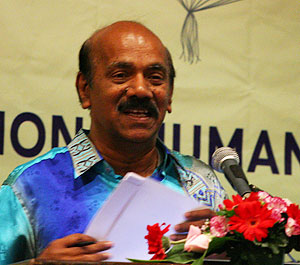 The taskforce’s chief coordinator, N Siva Subramaniam (
left
), showed a purported photograph of a National Registration Department (NRD) office filled to the brim with people participating in a registration programme, chiding, “Originally somebody told me there is no problem in Malaysia.”
The taskforce’s chief coordinator, N Siva Subramaniam (
left
), showed a purported photograph of a National Registration Department (NRD) office filled to the brim with people participating in a registration programme, chiding, “Originally somebody told me there is no problem in Malaysia.”
Subramaniam revealed this at a seminar yesterday organised by the United Nations in conjunction with the upcoming Human Rights Day.
Of those cases received by the Special Implementation Taskforce (Cabinet Committee on the Indian Community), nearly half (7,486) were citizenship issues, which he said would be resolved in the coming months.
Another 6,115 cases involved the lack of either a birth certificate or an identification card, while the remaining 1,281 cases involved changes to existing documents or marriage certificates.
Subramaniam said these issues have already been resolved.
“These are people born in Malaysia, and they have every right to be a citizen of this country,” he stressed.
Subramaniam said the lack of documentation had deprived individuals of education, employment, healthcare and other opportunities.
“If you don’t check this problem at the source and document them, you will face political instability in Malaysia.
“That is because many of the Indian Malaysian youths take to crime because they don’t have documents. They can’t work legally,” he said.
He cited several cases where the taskforce had to intervene to get children back in school or help obtain medical intervention, which had been denied to undocumented persons.
“Without the taskforce’s intervention, she would have died,” he spoke of a woman who needed a heart operation.
Gaps in 70s, 80s rural development
Subramaniam explained that the problem started when rural development programmes in the 1970s and 1980s did not reach these people because many ethnic Indian Malaysians were estate workers and the plantations they lived on were classified as private property.
Hence, they were displaced when the plantations they were dependent on for work, housing and other facilities for generations were later acquired for urban development.
 In addition, he said, the plantation workers’ lack of education led to a low awareness of the importance of identification documents and some had difficulty communicating with government officers, or lacked the initiative to obtain the documents.
Others simply could not afford to pay RM300 for a citizenship application.
Subramaniam also claimed that there were 35 cases where “agents” had offered to withdraw the workers’ Employees Provident Fund (EPF) for a fee, but lost their citizenship in the process.
“So the person withdraws his life’s earnings from the fund and pays the agent a few thousand (Ringgit). He doesn’t go to another country, he cancels his citizenship - that’s one of the conditions - and he stays in Malaysia.”
“This is the very low level that these people are being exploited,” he said.
However, he reminded the audience that the problem cuts across racial lines.
“We have found 1,500 Malay children, especially in Kelantan and Pahang, and with the help of the Education Ministry and the (NRD) we have solved most of the problems in these areas.”
Tip of the iceberg?
In addition to the registration drive, the taskforce has held discussions with the police and weekly meetings with the NRD to ensure these problems were settled.
They also held a series of training sessions to train teachers to negotiate with NRD officers on documentation issues of schoolchildren.
“That is very good because eventually we want to ensure education for all children in Malaysia. We want to bring the missing children back to school. We want to ensure that quality education is given to them, and this can be done only by working together as a group,” Subramaniam said.
Despite the progress, more work needs to be done.
“I sometimes hope that the 6P system would be implemented for them, for these poor people, where you take their particulars and you document them," he said, referring to a programme this year where undocumented foreign workers were registered, and were then either given legal employment or deported without penalty.
“They are all born here, but sometimes they are being treated worse than refugees. At least the refugees are documented,” he lamented.
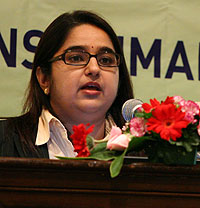 Another panellist representing an NGO that helps undocumented Indian Malaysians and indigenous groups said that the full extent of the problem was not known.
“Many people kept asking: ‘What is the number of stateless people in Malaysia?’ We don’t have accurate data at all because there is no mapping being done," said Nanthini Ramalo ( left ), director for the Women’s Programme at Development of Human Resources in Rural Areas.
“We have conducted many campaigns, mass registrations and all these things, but there is no proper mapping done."


Are you sure you want to delete this comment?
This action cannot be undone.