




Lynas quizzed over alleged 'China standards'
A day after Lynas launched its Facebook campaign dismissing claims it wanted to use ‘China standards’ for its Gebeng rare earth processing plant, Kuantan MP Fuziah Salleh fired the first salvo, accusing Lynas of trying to mislead the public.
A day after Lynas launched its Facebook campaign dismissing claims it wanted to use ‘China standards’ for its Gebeng rare earth processing plant, Kuantan MP Fuziah Salleh fired the first salvo, accusing Lynas of trying to mislead the public.
“They have to adhere to strict international laws only after the International Atomic Energy Agency (IAEA) panel came to Malaysia and gave its recommendations,” she said in a statement today.
 The statement, which was posted by netizens on Lynas'
Facebook
page, referred to a document that Fuziah
(left)
claims to be a 2007 proposal by Lynas, when the project was initially planned for Terengganu.
The statement, which was posted by netizens on Lynas'
Facebook
page, referred to a document that Fuziah
(left)
claims to be a 2007 proposal by Lynas, when the project was initially planned for Terengganu.
The document states: “For Chinese industry, the classification of radioactive waste is defined in the Chinese Standard FB19133-88, which specifies that a solid waste with a specific activity of less than 74Bq/g is classified as non-radioactive solid waste and can therefore be stored in a standard waste solids facility with impermeable lining.”
The proposal adds that both the ore and concentrate it will process are under the levels of 31Bq/g and 61Bq/g, respectively.
In an immediate rebuttal on Facebook , radiation safety officer Nick Tsurikov, who is engaged by Lynas, pointed out that the Radiological Impact Assessment (RIA) has found the Gebeng Lynas Advanced Material Plant (Lamp) to be safe even before the IAEA panel concluded its report.
‘New submission supersedes proposal’
However, when queried by netizens about the proposal extract which indicated Lynas had initially wanted to use China standards, Tsurikov denied knowledge of the document.
“I, honestly, do not know from which document this page is coming from – but it is definitely a very old document, that has been superseded by the latest Lynas submissions.
“I do not have the document that you are quoting - but the text does not look to me as a commitment or a promise to use any standard in practise. This looks to me as more or less a ‘description,’” he says in a Faceboo k posting.
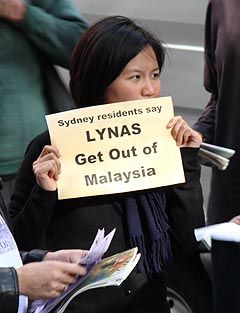 He said that in the Lynas RIA report on regulatory setting, it only cited Malaysian laws and regulations and IAEA documents.
The FB19133-88 standard in the proposal, Tsurikov adds, was replaced by a new version named GB9133-95 in 1996 which does not mention the 74Bq/g benchmark.
Lynas had in a Facebook posting yesterday denied that it wanted to take advantage of weak Malaysian environmental laws by using China standards.
Opponents to the project are concerned over the storage of radioactive Thorium and Uranium-containing slurry, which will be a by product of the plant.


Are you sure you want to delete this comment?
This action cannot be undone.