




Capital flight: 'M'sia fails in war against corruption'
Malaysia is "clearly failing in the war against corruption", DAP lawmaker Charles Santiago says in commenting on a global financial report that highlights illegal money flows out of the country.
Malaysia is "clearly failing in the war against corruption", DAP lawmaker Charles Santiago says in commenting on a global financial report that highlights illegal money flows out of the country.
According to the report published by Washington-based financial watchdog Global Financial Integrity (GFI) yesterday, RM150 billion (US$47 billion) were illegally siphoned out of Malaysia in 2009 alone.
This adds to RM927 billion (US$291 billion) in illicit outflows the watchdog has documented between 2000 and 2008.
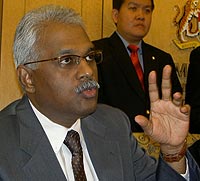 Most illicit capital flows happen by way of transfer pricing, "this is where the bulk of the money goes", said Santiago, (
left
) who is the Member of Parliament for Klang.
Most illicit capital flows happen by way of transfer pricing, "this is where the bulk of the money goes", said Santiago, (
left
) who is the Member of Parliament for Klang.
According to him private companies involved in import and export falsely declare the value of their products at the Customs and can get away with it because of corruption and incompetence there.
"They produce for RM10, they declare RM3, and they have to pay less taxes." This happened, he added, "because Customs officers are not doing their work."
Anti-graft body lacks interest
Asked what Bank Negara should do to tackle the problem, Charles noted that "there is no political will at all to address the problem" in the first place.
As long as the "MACC has no interest at all in resolving it", Malaysia would continue to "clearly fail in the war against corruption," he concluded.
DAP international secretary Liew Chin Tong added that the Customs Department was not the only one to be blamed for the fiasco.
"We should not point at Customs alone, for it is only a small part of the problem."
Liew hinted that the problem was bigger than irregularities at Customs and pointed at corruption and the lack of a transparent regulatory framework.
"Heads must roll... this is not the first time, for the GFI report says it has been going on for at least nine years," said the Bukit Bendera MP.
Prime Minister and Finance Minister Najib Abdul Razak and Bank Negara should take responsibility for not taking the crisis seriously and explain why they are not doing so, Liew added.


Are you sure you want to delete this comment?
This action cannot be undone.