




Teoh Beng Hock's family gets leave to appeal
The Court of Appeal has granted Teoh Beng Hock’s family leave to appeal the Shah Alam High Court decision in December rejecting judicial revision of the open verdict arrived at by the inquest into Beng Hock’s death.
The Court of Appeal has granted Teoh Beng Hock’s family leave to appeal against the Shah Alam High Court decision in December rejecting a judicial revision of the open verdict arrived at by the inquest into the DAP political aide’s death.
“The decision is unanimous. We allow the application for leave to appeal. There is a point of law that can be pursued further,” said Justice Sulaiman Daud, who led the three-member bench.
 The application for leave today was to determine a “guide” for magistrates acting as coroners in an inquest following conflicting past precedents.
The panel came to the decision after the family’s lawyer, Gobind Singh Deo, made submissions on two case laws where he cited the Public Prosecutor vs Shanmugam & Ors (2002) and Loh Kah Keng (1990).
Gobind cited the decision in the Shanmugam matter, where the judge had ruled that “in spite of that clear enunciation a magistrate is not bound by the usual procedure... a magistrate which conducts an inquiry must confine himself to the evidence made available to him”.
However, in Loh’s matter, the presiding judge had said that “[...] in whatever form or manner elicited and whether admissible or not, which could assist her in establishing the cause of death of the deceased, she was perfectly entitled to know and take cognisance of it.
 “The inquiry is to be held by examining witnesses on oath and the magistrate may admit any evidence which she thinks fit, especially hearsay evidence,” the judge had said.
Gobind, in pointing out the differing views, stressed that during the course of Teoh’s inquest facts were established “beyond suspicion alone”.
Going back to the findings of the inquest, he noted among others that Beng Hock could not have possibly been conscious when he fell, and the pre-fall injuries to the neck that suggest that he was subjected to actual physical violence.
Deputy public prosecutor Mohamad Abazafree Mohd Abbas, who represented the Attorney-General’s Chambers, however argued that there were no contradictions in the judgments.
“Hearsay evidence can be heard by the court but the inference drawn from hearsay is the question,” said Mohamad Abazafree.
‘Suspicion alone was not enough’
Shah Alam High Court Judge Abd Rahim Uda, upon dismissing the revision application to set aside the open verdict into Beng Hock’s death, had said while there were suspicious grounds that could lead to a conclusion, but based on the law, suspicion alone was not enough.
According to Abd Rahim, there was insufficient evidence or facts for the coroner to say that Beng Hock’s death was due to suicide.
“We cannot use suspicion and hesitate (in coming to a finding) unless there were testimonies that could prove the suspicion,” he had said.
In January last year, Coroner Azmil Muntapha Abas returned an open verdict, ruling Beng Hock’s death was neither a suicide nor a homicide.
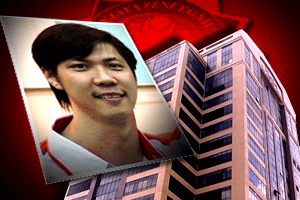 Beng Hock was found dead outside Plaza Masalam in Shah Alam, where the Malaysian Anti-Corruption Commission (MACC) headquarters was located, after he was interrogated overnight on July 16, 2009.
“What we took up today was one related to standard of proof whether or not the learned coroner or the High Court judge in coming to a finding that it was an open verdict,” Gobind told reporters outside the court later.
“We are here to establish whether or not the coroner is bound to follow normal rules of procedure, where the coroner is only allowed to make findings based on facts beyond reasonable doubt or whether he has more latitude and decisions can be made on probabilities as well,” he said, adding that they have 14 days to file a notice of appeal.
The Court of Appeal is the final avenue for Teoh’s family, who have been insistent that Beng Hock’s death was homicide.
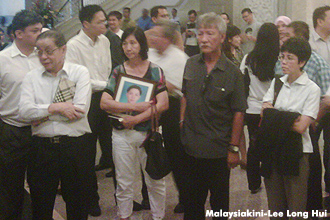
About 50 supporters in T-shirts bearing Beng Hock’s image and calling for justice to be meted out also gathered at the court lobby.
In July last year, a royal commission of inquiry released a 124-page report that said Beng Hock had been driven to commit suicide by aggressive, relentless, oppressive and unscrupulous interrogation by three MACC officers.


Are you sure you want to delete this comment?
This action cannot be undone.