




Awkward start on Twitter, but Najib's now a pro
When Prime Minister Najib Abdul Razak made his foray into Twitter, his postings were awkward by social media standards.
Najib's meeting schedules, said Rembau MP Khairy Jamaluddin, weren't exactly what social media users were looking for.
"When the prime minister first came into social media, his Twitter feed was very simple - 4pm meeting, 5pm meeting with Bosnian president, 6pm meeting with civil servants, 8pm dinner with chamber of commerce...
When Prime Minister Najib Abdul Razak made his foray into Twitter, his postings were awkward by social media standards.
Najib's meeting schedules, said Rembau MP Khairy Jamaluddin, weren't exactly what social media users were looking for.
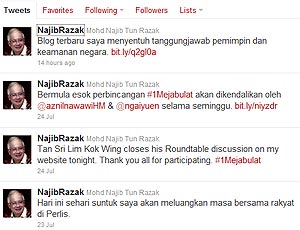 "When the prime minister first came into social media, his Twitter feed was very simple - 4pm meeting, 5pm meeting with Bosnian president, 6pm meeting with civil servants, 8pm dinner with chamber of commerce...
"A lot of us gave feedback to say this was the wrong kind of interaction that social media users wanted to see," said Khairy, who is Umno Youth chief and an avid Twitter user.
The prime minister has since improved by leaps and bounds, after fellow social media users prodded Najib to be more candid, said Khairy, pointing out that Najib today has more than 400,000 followers.
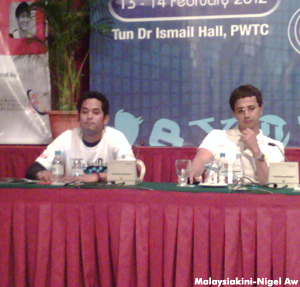 Speaking at a forum on "The Challenges and Impact of Social Media on Malaysian Politics" at the World Bloggers and Social Media Summit in Kuala Lumpur yesterday, Khairy gave pointers to fellow politicians on the proper use of the social media.
"They (social media users) want to know what makes you the person you are, they can sometimes accept that you tweet about campaigning in your constituency, but in the end, they want to know which football team you support, your thinking on issues or about films," he said.
'Social media doesn't wait'
On a serious note, Khairy said the advent of social media also meant that people expected politicians to respond almost immediately.
"Politicians previously sat on issues for up to two or three days, but today, they must respond immediately.
 "Yet, there are some politicians who don't respond within the necessary time in social media, and they pay for it.
"Social media users are saying, ‘we've waited for hours, but the politicians are used to days'," he said.
An example, Khairy said, was when the opposition suggested that RM1.5 billion from the Employees' Provident Fund (EPF) would be loaned directly to 'sub-prime' borrowers.
"If you look at the comments, almost everyone was opposed, but when I explained that the money would be channelled through a government agency and it is completely guaranteed by the government, the issue died down," he said.
Armchair activism
Khairy warned that if politicians and governments were slow in responding in the social media, the views of netizens, based on misconceptions about issues, could hardened.
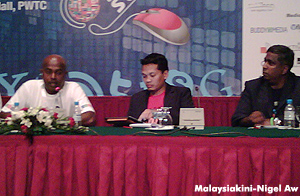 Meanwhile, Seri Setia assemblyperson Nik Nazmi Nik Ahmad said while the social media improved responsiveness, the people should not solely rely on it for activism.
"When I see the younger generation, it is generally positive but there is a tendency for certain segments to think activism is about clicking 'like' on Facebook.
"If you look at the Arab Spring in Egpyt, yes, Facebook and Twitter played a role, but it came after years of work by activists on the ground," Nik Nazmi said.
Also in the panel, which was moderated by USM social science professor Sivamurugan Pandian, were Nas Zubedy, founder of the Zubedy Foundation and Selangor Gerakan Youth deputy secretary-general Stephen Doss.


Are you sure you want to delete this comment?
This action cannot be undone.