




Ah Jib Gor going 'live' again on Chinese media
After two live interviews with local Chinese radio stations in the last 12 months, Prime Minister Najib Abdul Razak will appear again ‘live’ on a local Chinese television news programme on Monday.
After two live interviews with local Chinese radio stations in the last 12 months, Prime Minister Najib Abdul Razak will appear again ‘live’ on a local Chinese television news programme on Monday.
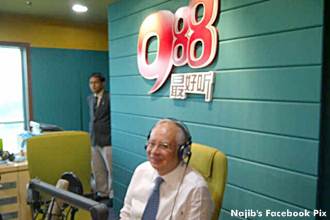 The PM’s live shows are seen as part of a series of moves to shore up the Chinese community’s support for BN in the general election, widely speculated to be held in middle of this year.
The hour-long live interview titled ‘A talk with the prime minister’ will be broadcast on Media Prima-owned ntv7 at 8.30pm on April 9.
Najib will be seen sitting in a newsroom of the TV station, replying to questions from two news anchors, Owen Yap and Lee Siad Huey.
The ntv7 station has already started to publicise the interview through news crawlers on its Chinese programmes, invites viewers to submit questions to Najib by email or SMS.
This is the first time ever a Malaysian prime minister will appear in a local Chinese television news programme.
For Najib though, this will be the second time he will be interviewed live on a local private TV station, the first being on Media Prima-owned TV3's Soal Jawab programme.
Media Prima is a media conglomerate linked to Umno.
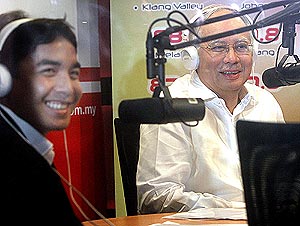 Unlike the country’s previous prime ministers, Najib has been frequently interviewed live on commercial radio stations, including the Chinese One FM and the 988, in the last 12 months.
In One FM’s interview on June 23 last year, which was also broadcast by ntv7, Najib brought along his youngest son Nor Ashman, who has studied Mandarin in the US.
Najib, in the interview , spoke on two major issues affecting urban Chinese youth - housing and education.
In his second interview with 988 on March 22, Najib touched on objections to the setting up of the Lynas rare earths plant in Pahang and the MRT alignment on Jalan Sultan, Kuala Lumpur, assuring that the government would take the people’s interests into account.
Malaysiakini reported last May that with a snap general election looming, Najib’s airwaves blitz is widely seen as an attempt to appear “hip” and reach out to young urban voters who are generally considered to be inclined towards the opposition.


Are you sure you want to delete this comment?
This action cannot be undone.