




'Utusan reports fuelled harsh action on Bersih 2.0'
Predominantly negative coverage of the Bersih 2.0 rally would have justified the severe action police took against the July 9, 2011 protesters, the Malaysian Human Rights Commission (Suhakam) was told today.
Predominantly negative coverage of the Bersih 2.0 rally would have justified the severe action police took against the July 9, 2011 supporters, the Malaysian Human Rights Commission (Suhakam) was told today.
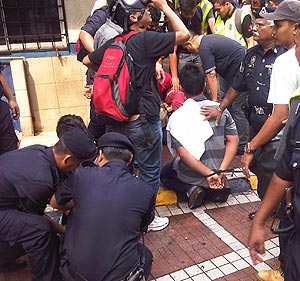
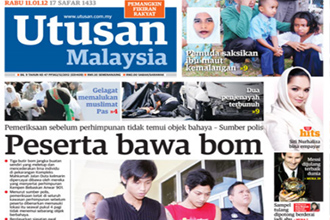
“ Utusan Malaysia ’s coverage would have strengthened the need for the use of violence against rally participants,” Centre for Independent Journalism (CIJ) media monitor Ding Jo Ann said.
 “
Utusan
’s reports, for instance, were overwhelmingly negative, alarmingly so.
“
Utusan
’s reports, for instance, were overwhelmingly negative, alarmingly so.
“There were personal attacks against Ambiga (Sreenevasan), a concerted effort to portray Bersih as evil,” said Ding, citing CIJ’s study on the media coverage of Bersih rally that was conducted from June 25 to July 11 last year.
Ding said the CIJ also studied the reports of three other national dailies - New Straits Times (NST), The Star and The Sun .
Altogether, 771 articles, including news reports and editorials, were assessed on four major aspects: whether Bersih's demands were stated; whether the news reports were positive, negative or neutral towards Bersih; the sources quoted; and the laws cited.
“CIJ found that Bersih 2.0's demands were left out of many of the articles monitored. Many didn’t even refer to Bersih by its full name - the Coalition for Clean and Fair Elections - in the first mention, making it difficult to find out what the rally was about,” said Ding.
 Testifying before Suhakam vice-commissioner Khaw Lake Tee and commissioner Detta Seman, she said
Utusan
only stated nine percent of Bersih’s eight demands for electoral reform in its articles, while
The Sun
scored 32 percent.
Testifying before Suhakam vice-commissioner Khaw Lake Tee and commissioner Detta Seman, she said
Utusan
only stated nine percent of Bersih’s eight demands for electoral reform in its articles, while
The Sun
scored 32 percent.
Even if Bersih’s demands were published, it was often to debunk them and to state how unnecessary the rally was, said Ding.
As to whether the reports on Bersih’s activities were positive, negative or neutral, Ding said: “Items that were recorded negative included pejorative words to describe the rally or its leaders (with) words such as - stubborn, nuisance, illegal, traitors to peace, chaos and anarchy, cowards and evil.”
She added that Utusan ’s coverage was “overwhelmingly negative”, with almost 94 percent of articles recorded being so.
‘Only a single positive article’
“There was only a single positive article out of the 435 articles it published on Bersih during the period,” she noted.
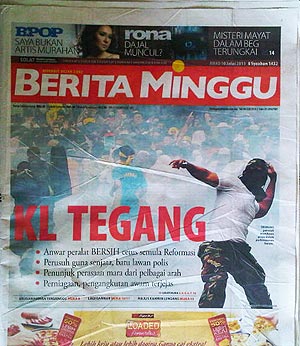
The coverage by NST and The Star were also generally negative, at 75 percent and 66 percent respectively.
 Although
The Sun
reported 62 percent negatively on the Bersih rally, it also recorded 35 percent for the most neutral articles.
Although
The Sun
reported 62 percent negatively on the Bersih rally, it also recorded 35 percent for the most neutral articles.
The Umno-owned Utusan only carried three percent of the statements of the Bersih organisers and quoted a large number of “anonymous” sources in its other daily reports.
“ Utusan even carried reports citing sources alleging that Bersih was funded by foreign organisations and Christian groups,” added Ding.
Khaw, who heads the inquiry panel, asked Ding if the watchdog group had tried to ascertain the credibility of the sources cited, to which she said CIJ was short of resources to conduct research on such a scale.
“A casual reader would have found it difficult to understand the purpose of the rally from these papers... to obtain a complete and accurate information,” she said.
 Wrapping up, Ding said that other studies conducted during the same period showed that many people were no longer reliant on the print media for news.
A study by market researcher Tricia Yeoh, Ding said, found that 263,228 Tweets by nearly 40,000 users of the micro-blogging website used the #bersih hashtag between July 9 and Aug 14.
Suhakam’s public inquiry is into human rights violations during last year's Bersih 2.0 public rally for electoral reform in Kuala Lumpur, which saw 1,667 people arrested.
The Bersih 2.0 steering-committee headed by Ambiga is planning the third chapter of its rally on April 28, following the government’s failure to address all of the coalition’s eight demands in the report submitted by a high-powered parliamentary select panel on electoral reform.


Are you sure you want to delete this comment?
This action cannot be undone.