




Suhakam to flex muscles on new security law
Human Rights Commission (Suhakam) chairperson Hasmy Agam will accept a seat on a committee mooted to oversee implementation of the new security law, provided that Suhakam can play its watchdog role.
Human Rights Commission (Suhakam) chairperson Hasmy Agam will accept a seat on a committee mooted to oversee implementation of the new security law, provided that Suhakam can play its watchdog role.
The creation of the committee is among proposed provisions of the Security Offences (Special Measures) Bill, which is currently being debated in the Dewan Rakyat.
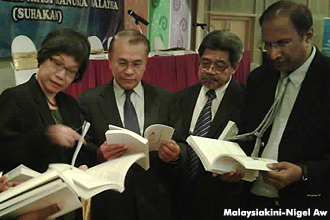 "The attorney-general has proposed that he would like to co-opt the chairperson of Suhakam and I said I'm delighted to (sit on the committee). But we will maintain our role as a watchdog," Hasmy
(second from left)
said at the launch of Suhakam's 2011 annual report in Kuala Lumpur today.
"The attorney-general has proposed that he would like to co-opt the chairperson of Suhakam and I said I'm delighted to (sit on the committee). But we will maintain our role as a watchdog," Hasmy
(second from left)
said at the launch of Suhakam's 2011 annual report in Kuala Lumpur today.
Hasmy said he is prepared to provide constructive input and will evaluate whether the commission's concerns are taken into consideration.
"If we are co-opted and we are not happy with the process, then we will have to review our position," he said.
However, he said this would be a good initial stage, allowing Suhakam to "exert its influence from the inside".
Prime Minister Najib Abdul Razak when tabling the Bill for its second reading in Parliament this morning said the new committee would also have seats for the Bar Council president and other stakeholders.
New law 'needs to be improved
'Commenting on the Bill, Hasmy commended the premier for taking into consideration Suhakam's 2003 report calling for the review of the ISA when drafting the new law.
In a statement, Hasmy said the commission remains concerned about three issues in the Bill:
- Clause 4 does not provide for judicial oversight in the extension of the detention period for up to 28 days.
- Police have powers to deny an arrested person immediate access to legal representation for up to 48 hours.
- Clause 4(6) allows police to intercept communication which may infringe on personal liberty and right to privacy. This power should be exercised by the court.
Hasmy said he hopes the government would continue to engage with Suhakam to “ensure obsolete and irrelevant laws are abolished and replaced by laws that are consistent with universally-accepted human rights principles”.


Are you sure you want to delete this comment?
This action cannot be undone.