




Lynas: Only 0.1 fatal cancer cases per million caused
Even in the worst case scenario, the Lynas Advanced Materials Plant (Lamp) in Gebeng, Pahang, will cause only about 0.1 fatal cancer cases per million persons, the plant's senior management claims.
Even in the worst case scenario, the Lynas Advanced Materials Plant (Lamp) in Gebeng, Pahang, will cause only about 0.1 fatal cancer cases per million persons, the plant's senior management claims.
For comparison, Lynas Malaysia Sdn Bhd's (Lynas) radiological safety adviser Ismail Bahari cited the Ministry of Health's cancer prevalence rate of 720 cases per million, of which - based on the radiological impact assessment (RIA) estimates - 35 cases per million were due to existing background radiation.
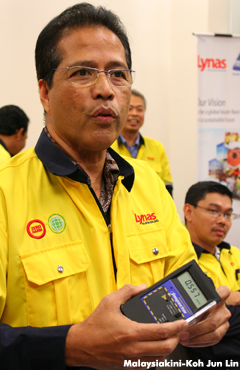 The calculations, Ismail (
left
) said, are based on standards set by the International Commission on Radiation Protection's (ICRP) Publication 60, and assumes an annual public radiological exposure of 0.002 milliSieverts per year.
The calculations, Ismail (
left
) said, are based on standards set by the International Commission on Radiation Protection's (ICRP) Publication 60, and assumes an annual public radiological exposure of 0.002 milliSieverts per year.
Earlier, Lynas managing director Mashal Ahmad told the same press conference that the 0.002 milliSieverts per year figure assumes a total equipment failure, and ‘public' is defined as the area immediately outside the refinery's perimeter.
"You must remember, international and Malaysian laws say for the public (the exposure limit for radiation) is one milliSieverts per year. So we are 500 times lower than what the laws say."
To illustrate, Mashal said, this meant Lynas' radiological emissions would be 10 times less than watching television on an old set for four hours, and even that would not cause any problem.
Television sets of an older generation are based on cathode-ray tube (CRT) technology, which emits a low level of x-ray radiation during its operation.
Mashal, who said he has 31 years of experience in building or operating chemical plants, described Lamp as the "safest and simplest" plant he has ever worked on.
For example, he said, except for a broiler to provide steam, the plant operates at atmospheric pressure, thereby removing any risk of an explosion.
 As for concerns about waste storage on site, Mashal (
right
) said Lamp's Residue Storage Facility had been over-engineered, as if it was meant for permanent storage.
As for concerns about waste storage on site, Mashal (
right
) said Lamp's Residue Storage Facility had been over-engineered, as if it was meant for permanent storage.
In addition, he said, the refinery has the capacity to store about 17 to 18 years' worth of waste, although it only intends to store it for 18 months.
Mashal also said the company had succeeded in making the waste from its water leach purification (WLP) stream, which is classified as a ‘very low level radioactive waste', suitable for road construction.
He said the company had found the way to bring its radioactivity below one Becquerel per gram, and hence beyond the Atomic Energy Licensing Board's (AELB) jurisdiction. In addition, it is non-toxic and does not leach into the environment.
However, the authorities could not be approached to approve the product until Lynas could do the same with waste created from Lamp, instead of the waste from its laboratories.
Lynas ahead in 'green practices'
Both Ismail and Mashal did not answer reporters' questions on whether Lynas was the first rare earth refinery to commercialise its waste, but admitted that while China's rare earth refineries were moving towards ‘green' practices, Lynas was ahead of them.
Asked whether the plant would be safe enough for pregnant women to work in, Ismail did not give a direct response.
Due to time constraints, reporters were unable to ask about the location of Lamp's permanent disposal facility.
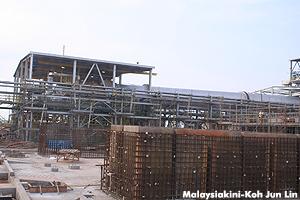 Mashal also debunked claims during the press conference that Lynas had been chased out of Terengganu, China and Australia, saying that it had moved to Gebeng solely due to economic considerations.
He said the Terengganu site had already been approved by AELB and the Department of Environment, but the state government took too long to approve the land needed, thus the company decided to move to Gebeng.
As for China, he said Lynas was put off when China changed regulations such that any changes in export volume would need government approval.
On claims that Australia's environmental laws were too strict for Lamp to operate there, Mashal reiterated that it is actually due the cheaper costs of water, electricity, and chemicals that led Lynas to Malaysia.
To show that Lynas does in fact comply with Australian regulations, copies of a letter dated Jan 20, 2004, purportedly from then West Australian Environmental Minister Judy Edwards were distributed to the press.
The letter is addressed to M Vaisey as Lynas Australia's general manager of process development and technical services, and says that Lynas is "granted an extension of time limit of approval for three years, till May 26, 2007, to substantially commence the project".
The letter referred to Lynas' rare earth mining project in Mt Weld, and "secondary processing" in Meenaar Industrial Park, near the state's capital, Perth.
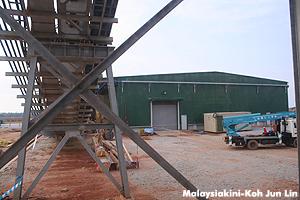 Mashal said the plant then slated to be built there was the "exact plant" that was being built in Gebeng.
He also said the Phase One of the plant was "ready to fire" in about two weeks, but it still needed the temporary operating licence (TOL) from AELB, plus a month to ship the ore from Australia.
Delays in issuing the TOL had affected Lynas "very seriously", Mashal said, including pressure from suppliers, customers and its competitors.
He said all the production due from Phase One of the plant for the next 10 years has already been sold out, while Phase Two of Lamp is still under construction.
"We cannot delay our construction and production because our customers are waiting for our products, and their customers are waiting for their products," he said.
However, he declined to name the customers.
In refuting claims that Lynas brings no benefit to Malaysia, Mashal said, the company would bring RM2.5 billion in foreign direct investment, of which RM1.168 billion were for Malaysian contractors, with Kuantan-based contractors raking in RM513 million of the contracts.


Are you sure you want to delete this comment?
This action cannot be undone.