




Consider human rights in judgments, urges Suhakam
The Human Rights Commission of Malaysia (Suhakam) has urged judges to take into account human rights and international conventions in arriving at decisions, even though this is not expressly laid out in law.
The Human Rights Commission of Malaysia (Suhakam) has urged judges to take into account human rights and international conventions in arriving at decisions, even though this is not expressly laid out in law.
This was among the matters discussed at a two-day colloquium with the country's top judges, uhakam chairperson Hasmy Agam told a press conference in Kuala Lumpur this afternoon.
"The problem is that some laws have not taken into account international conventions such as the Convention on the Rights of the Child and Convention on the Elimination of All Forms of Discrimination Against Women which Malaysia has ratified.
"Many of them are not yet encoded into our legal system so a judge, especially a careful and conservative one, might find it hard to consider this issue unless made into law. This is something we are pushing the government to do," he said.
Hasmy acknowledged that judges had voiced out that they were constrained and could not act beyond what is stipulated in Malaysian law, if it has not been amended to take into account the conventions.
"The judges are a careful group and bound by their tradition and modus operandi, while others countries are open to interpreting international law in court.
"We are hoping, as much as the judges are facing constraints, they should also be able to ensure that (Malaysia) as signatory of international conventions such as the United Nations Declaration of Human Rights and the Charter of United Nations, should take them into account.
"Otherwise, what is the point for Malaysia to ratify these conventions if no attempts are made or taken in account, when dispensing justice," he said.
Hasmy said he hoped judges could be more active in terms of human rights when making their decisions.
'Active judges'
Former Australian Federal Human Rights Commissioner Brian Burdekin who also spoke at the colloquium, shared that such a practice dubbed "judicial activism" was already being carried out by judges in Australia.
"An example concerns a Malaysian family in Australia. The mother was unfortunately dysfunctional and became a drug addict and the father, a migrant worker, broke the law. His work permit had expired.
"I went to our highest court to say yes (his permit had expired) but you cannot deport him to Malaysia because he is the only functioning parent who is going to look after his seven children.
"The ministers and the bureaucrats didn't think about that in making the decision (to deport him) but we have signed a convention to say that in every decision we take, we must take in account the best interests of the children," he said.
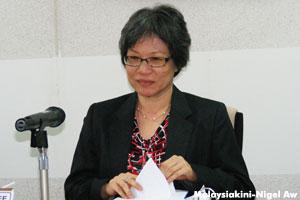 Asked if Malaysia should introduce a sentencing committee after courts had handed out lenient punishments in recent statutory rape cases, Suhakam deputy chairperson Khaw Lake Tee (
right
) said its role would be limited.
Asked if Malaysia should introduce a sentencing committee after courts had handed out lenient punishments in recent statutory rape cases, Suhakam deputy chairperson Khaw Lake Tee (
right
) said its role would be limited.
This, she said, was because the committee is unable to impose on the decision of the court even though it could issue guidelines.
However, Khaw said Suhakam remains concerned that "consent" was used as a mitigating factor in recent statutory rape cases and that the media's reporting of the offender's identity also indirectly exposed the identity of the victim.
On Aug 29, the Penang session court spared a 22-year-old man from a jail sentence in favour of a three-year good behaviour bond, for raping a 12-year-old girl last year.
Bowler Noor Afizal Azizan was on Aug 8 also exempted from a jail sentence for raping a 13-year-old girl in 2009 and was instead handed a five-year bond for good behaviour.


