




Public housing: Developers leap to Penang CM's defence
While the debate on public housing in Penang rages, the question of which authority is responsible for constructing such units has not been properly addressed, according to a trade body for some 70 developers in the state.
While the debate on public housing in Penang rages, the question of which authority is responsible for constructing such units has not been properly addressed, according to a trade body for some 70 developers in the state.
The Penang Real Estate and Housing Developers’ Association (Redha) believes that the responsibility rests on the federal government, as it collects taxes to meet social needs.
 Penang Redha chairperson Jerry Chan said state governments do not collect taxes, which is why they do not build public hospitals and schools. Similarly, they are not responsible for construction of public housing.
Redha also dismissed the view that the duty lies with developers, saying "we too have paid our taxes" to the federal administration.
"It collects taxes from the rich so that it can take care of the poor. When developers are asked to build public housing, house buyers have to bear the cost by paying a much higher price for their units," Chan told Malaysiakini .
"Eventually, the cost is not borne by the developer but passed on to the buyers. That is why prices of homes are increasingly high. Is this the kind of situation we want to see?"
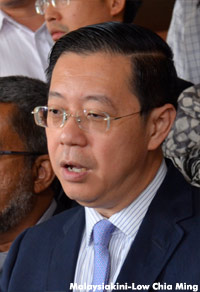 Chan was asked to respond to the ongoing argument that Penang, under Chief Minister Lim Guan Eng
(right)
, has not built any public housing.
Chan was asked to respond to the ongoing argument that Penang, under Chief Minister Lim Guan Eng
(right)
, has not built any public housing.
However, Lim has said that, since 2008, the state is constructing 12,000 units , of which 8,000 will be delivered by the private sector.
With adequate resources, Lim said, his administration has plans to deliver up to 38,000 affordable houses - 20,000 by the private sector and 18,000 by the state government - over the next five years.
NGOs like Hindraf and the Penang Land Rights Defenders Association have noted that the federal Budget 2013 has allocated less than RM3 billion to the Housing and Local Government Ministry.
‘Not right’ to pass the buck
Chan questioned why the federal government is willing to spend money on hospitals and schools, but is not prepared to do so on public housing but has passed the burden to developers “which is not right”.
"For example, if I sell cars, I am not asked to build roads, because road tax is collected for that purpose. If I am a doctor, I serve the government for several years, then I come out and am free to work wherever I want," he said.
"I can work in the private sector, but I am not asked to build hospitals. Likewise, if I sell airbuses, am I asked to build airports? But developers are asked to build public housing or low- and medium- cost homes.
"In the end, those who do not get subsidies have to subsidise the cost and it pushes up the price of houses.”
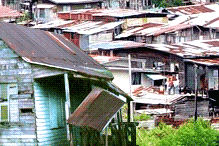 On the issue of eviction, Chan said if the state government is seen as too accommodating and sensitive to demands of squatters then "honestly, it would be taken advantage of".
The state would then be urged to step in and ensure that developers compensate the squatters adequately.
"That is a very dangerous situation. At the end of day, we do not want landowners or developers to be deprived of their rights as they too contribute to the state," he added.
Kampung Buah Pala, Kampung Boundary 5, Kampung Nenas, and villages in Batu Uban and Balik Pulau are among areas where eviction of squatters is likely.


Are you sure you want to delete this comment?
This action cannot be undone.