




Police postal summons to continue alongside AES
The police will continue to use the system of issuing postal summons alongside implementation of the Automatic Enforcement System (AES), in order to reduce the high accident rate.
The police will continue to send summonses to traffic offenders, such as those breaking speed limits, by post alongside the Automated Enforcement System (AES), in order to reduce the high accident rate.
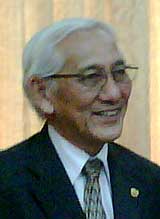 "The police will operate (mobile) cameras, while the new (AES) approach will be operated by the Road Transport Department,” Deputy Home Minister Abu Seman Yusop
(left
)
told the Dewan Rakyat during Question Time today.
"The police will operate (mobile) cameras, while the new (AES) approach will be operated by the Road Transport Department,” Deputy Home Minister Abu Seman Yusop
(left
)
told the Dewan Rakyat during Question Time today.
“As accidents are prevalent. All agencies involved in monitoring traffic offences should continue with their duties.”
Abu Seman was replying to a supplementary question from Mohd Firdaus Jaafar (PAS-Jerai) who asked if both systems would be operated concurrently.
Fong Po Kuan (DAP-Batu Gajah) then stood up, seeking permission to ask an additional supplementary question.
She pointed out that the issue could cause public anger due to the possibility of double jeopardy in the issuance of summonses.
However, her question was rejected.
 Outside the House, Fong
(right)
explained that road users may be issued two summonses, one via AES and another via police speed-trap operations for the same offence.
Outside the House, Fong
(right)
explained that road users may be issued two summonses, one via AES and another via police speed-trap operations for the same offence.
"AES cameras are installed at police-identified (accident) hot spots," she said, noting that this is also where the police would normally deploy mobile cameras.
Replying the original question from Mohd Firdaus, the deputy minister said 61,191 postal summonses had been issued to road users during Ops Selamat conducted during the Hari Raya Aidilfitri holidays.
Abu Seman said the use of the AES and mobile police cameras would help mitigate the accident rate by increasing awareness and the fear of "being caught".
At a press conference in the Parliament lobby later, PAS Pokok Sena MP Mahfuz Omar hit out at the AES again, continuing his crusade against the traffic enforcement system.
Mahfuz who leads the PAS-linked anti-postal summons group Kase, highlighted again that the system was put in place in a slipshod manner and without public consultation.
No 10kmph allowance under AES
This, among the other reasons, should be enough to postpone or scrap the system altogether.
 Another sore point, the PAS leader added, was that the AES cameras do not provide for the 10kmph allowance that is given on along speed limit stretches monitored by the traffic police.
He explained that if the speed limit is 90kmph for example, police give an allowance of 10kmph, and only book a person for driving at more than 100kmph.
This differs from the automated system under which summons will be issued to a vehicle moving at 91kmph.
The controversial AES system has courted public resistance and complaints of its slipshod, problematic and arbitrary implementation from both sides of the parliamentary divide.
Some believe that the AES is just a ploy to enrich cronies of the ruling BN than to help tackle the high traffic accident rate.
Related stories
PKR: AES contractor linked to Johor Umno
AES row not about speed, but about gov't cronies


