




Najib slips up on chance to push Ibrahim over the ledge
COMMENT Prime Minister Najib Abdul Razak missed as good an opportunity as he's likely to get before the general election to put differentiating distance between him and the extremist fringe within the Umno fold at the interfaith Harmony Walk last weekend.
Instead of saying something censorious against the incendiary posturing of Perkasa chief Ibrahim Ali, who had called on Malays to burn Malay-language Bibles that used the term ‘Allah' for God, he opted to spout some mumbo-jumbo about moderation.
His waffling reinforced the disparaging definition of a moderate as someone who is too craven to take his own side in an argument...
COMMENT Prime Minister Najib Abdul Razak missed as good an opportunity as he's likely to get before the general election to put differentiating distance between him and the extremist fringe within the Umno fold at the interfaith Harmony Walk last weekend.
Instead of saying something censorious against the incendiary posturing of Perkasa chief Ibrahim Ali, who had called on Malays to burn Malay-language Bibles that used the term ‘Allah' for God, he opted to spout some mumbo-jumbo about moderation.
 His waffling reinforced the disparaging definition of a moderate as someone who is too craven to take his own side in an argument.
It may be argued that Ibrahim is not a member of Umno, as former prime minister Dr Mahathir Mohamad has pointed out , and therefore is not a spokesperson for some ideological positions within the party.
So why strain to put differentiating distance between the Umno chief and so-called leader of moderates and a seemingly obvious outlier like the Perkasa firebrand?
This is like arguing that during the ascendancy of the Bharatiya Janata Party (BJP) in India's politics in the 1990s, the fact that members of militant Hindu groups were also members of the BJP was of no consequence to the latter simply because the BJP publicly at least did not espouse extremist positions.
This distinction between a public posture of having no truck with extremist ideology while in private there's connivance with the militants was always a spurious one, and it broke down spectacularly in the 2002 Gujarat riots between Hindus and Muslims where state (BJP-led) connivance in the riots was strongly suspected.
No doubt, this is perhaps too extreme an analogy for what obtains in the Malaysian context, but when addressing combustible issues of race and religion, it is better to err on the side of conservatism than of liberalism.
Ibrahim Ali crosses the red line
Suffice, in politics when dealing with an interloper who is playing fast and loose with volatile issues, it is safer to cordon off some areas from trespass by the marauder.
Otherwise he would be led to think that he is safe from interdiction and proceed to breach boundaries hitherto regarded as sacrosanct.
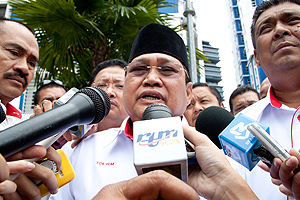 This is what happened to Ibrahim (
right
) who for the last five years was allowed unchecked rein until he uttered the ‘burn' word that in a multi-racial, multi-religious society is code for wholesale abandonment of restraints.
This is what happened to Ibrahim (
right
) who for the last five years was allowed unchecked rein until he uttered the ‘burn' word that in a multi-racial, multi-religious society is code for wholesale abandonment of restraints.
That he crossed a red line with that call prompted even former attorney-general Abu Talib Othman to chastise the incumbent AG for failure to make Ibrahim account for his conduct under our laws on sedition.
Still, public remonstrance by the former AG, who is not a partisan player in our political dramas and therefore cannot be said to be acting from self-interest, wasn't enough of a hint to the PM to break his silence on Ibrahim's crossing of a red line.
Najib's concept of moderation is so supine it is an excuse for inaction.
Contrast this with how both PAS and PKR dealt with comparable behaviour by troublemakers within their fold.
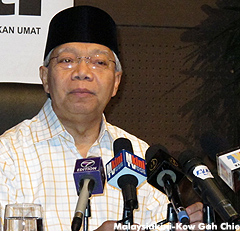 When Hasan Ali (
left
), at the time no less than the PAS Selangor chief, behaved throughout 2011 like a fifth columnist within the party, taking it upon himself to conclude that assorted Christian groups were indeed proselytising Muslims and offering negligible proof in support of the claim, the party's central leadership initially appeared perplexed as to what to do with him.
When Hasan Ali (
left
), at the time no less than the PAS Selangor chief, behaved throughout 2011 like a fifth columnist within the party, taking it upon himself to conclude that assorted Christian groups were indeed proselytising Muslims and offering negligible proof in support of the claim, the party's central leadership initially appeared perplexed as to what to do with him.
Emboldened by their inaction, Hasan persisted in a campaign of fanning fear among Muslims that Christians were poaching among their fold.
Hasan's theatrics posed a danger to PAS' newfangled image as a party for all Malaysians rather than only for Muslims.
He even turned up at a failed mass gathering held in 2011 that was engineered by Ibrahim Ali for the purpose of stoking Muslim fear of Christian proselytisation.
All the time throughout 2011 that PAS seemed to be dithering as to what to do with him, it was actually giving him enough rope to hang himself.
That act of self-immolation arrived in January 2012 when Hasan flagrantly breached party rules by calling upon PAS members not to show support for Pakatan Rakyat supremo Anwar Ibrahim at the handing down of the High Court verdict for his trial for sodomy.
The PAS central leadership summarily expelled Hasan, reducing him from a publicity seeking poseur to a mere cipher in Malaysian politics.
A thorn in the flesh
A similar fate befell Zulkifli Nordin, the MP for Kulim Bandar Baru who was elected on a PKR ticket in 2008.
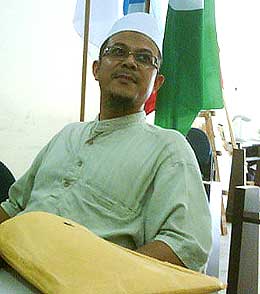 Zulkifli (
left
), like Hasan, a fifth columnist in his party and like the former PAS man a poseur where Islamic religion is concerned, was up for disciplinary action by PKR for barging into a Bar Council-organised seminar in 2008 on the issue of religious conversion.
Zulkifli (
left
), like Hasan, a fifth columnist in his party and like the former PAS man a poseur where Islamic religion is concerned, was up for disciplinary action by PKR for barging into a Bar Council-organised seminar in 2008 on the issue of religious conversion.
PKR kept deferring the need, throughout 2009, to take action against Zulkifli for misconduct and bringing ill-repute to the party.
Their inaction had the effect of stoking the man's bent for histrionics and his fractiousness towards fellow PKR MPs.
In the end, the party had enough of Zulkifli's divisive ways and put him out of his misery in early 2010 by sacking him. A thorn in the flesh was prevented from being anything more troublesome.
The lesson from the Hasan and Zulkifli episodes was that outlier conduct in a political party that is allowed to fester soon becomes a spiraling menace.
A period of dithering is allowed as the menace grows but surgical removal cannot be postponed indefinitely. Shrinking from the need to do so does not make you a moderate; it makes you a tergiversator.
TERENCE NETTO has been a journalist for four decades. He likes the occupation because it puts him in contact with the eminent without being under the necessity to admire them.


