




Taking the shine off Najib's glowing GNI claims
MP SPEAKS The ETP Annual Report for 2012 prepared by Pemandu and launched by Prime Minister Najib Razak with great fanfare is nothing more than a public relations effort.
The report has been written and delivered as part of the electioneering effort mounted by a government desperately attempting to convey to a disbelieving electorate a picture of progress and achievements together with promises of attaining the promised land of a High Income country by 2020.
Taken as a whole, the report is a document that attempts to project illusions, highly massaged selective facts to lull the electorate. The primary objective is to gain a return to power at all costs.
MP SPEAKS The ETP Annual Report for 2012 prepared by Pemandu and launched by Prime Minister Najib Razak with great fanfare is nothing more than a public relations effort.
 The report has been written and delivered as part of the electioneering effort mounted by a government desperately attempting to convey to a disbelieving electorate a picture of progress and achievements together with promises of attaining the promised land of a High Income country by 2020.
Taken as a whole, the report is a document that attempts to project illusions, highly massaged selective facts to lull the electorate. The primary objective is to gain a return to power at all costs.
Some of the report’s claims are addressed below:
1. The claim
We used a credible global yardstick – the World Bank’s approach to define our high income target. The World Bank’s current GNI per capita threshold for a high income economy is US$12,476 (RM38, 850*).
We factored in the World Bank’s published historical global inflation figure of two percent until 2020 to arrive at a high-income threshold of US$15,000.
The facts
Each year on July 1, The World Bank revises the classification of the world’s economies based on estimates of gross national income (GNI) per capita for the previous year. As of 1 July 2012, the World Bank income classifications by GNI per capita are as follows:
Low income: US$1,025 (RM3,200) or less
Lower middle: US$1,026 (RM3,200) to US$4,035 (RM12,600)
Upper middle: US$4,036 (RM12,600) to US$12,475 (RM38,900)
High income: US$12,476 (RM38,900) or more
* based on the exchange rate at press time, rounded up
My comment:
The calculations are done annually and are not comparable from year to year and cannot therefore be projected. Thus the figure of US$15,000 projected by Pemandu is wholly meaningless.
The numbers cited by the prime minister earlier and now repeated in the report are a fabrication and deviate widely from the GNI per capita numbers for Malaysia published by the World Bank on its web site:
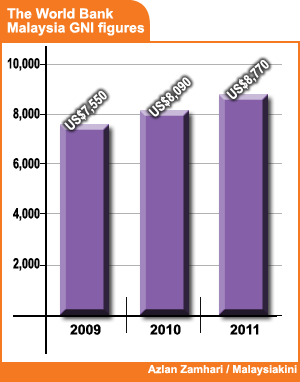 The World Bank website shows that the numbers were as shown in the table (
right
).
The World Bank website shows that the numbers were as shown in the table (
right
).
The World Bank data sets never show growth rates of GNI per capita in US dollars over time in the way Najib and Pemandu have done.
Thus, the 49% figure is based on an inappropriate calculation and the number is pure fabrication and therefore intentionally misleading.
The true measure of a country’s performance is shown by the GDP growth rate expressed in constant prices. On that basis the Malaysian economy grew at approximately 5.0 percent per annum over the three-year time span cited in the report. This is also based on fabricated statistics.
They also deviate from numbers published by Bank Negara Malaysia. The much lower base figure estimated by Pemandu for 2009 enables it to exaggerate its so-called erroneous growth rate.
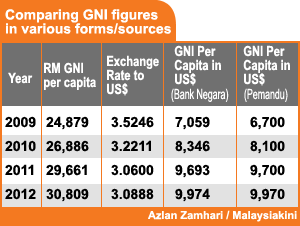 Three claims are being made: namely, that Malaysia had achieved a GNI per capita level of US$ 9,970 in 2011.
This is incorrect. The World Bank reported a figure of US$8,770. The overstatement by almost US$ 1,000 is sizable.
Second, the growth rate based on current price terms (see above) is wholly misleading. Per capita GNI growth in constant price terms was of the order of 3 percent per annum.
Third, implied inter-country comparison of erroneous growth rates is misleading. The bottom line is that the Pemandu report overinflates numbers in a disgraceful manner.
It appears that Pemandu is more interested in serving its client Najib than providing a credible assessment of the Malaysian economy.
2. The claim
By 2020, it is hoped that private investment would make up 92 percent of total investments in the country, with public sector investment to account for the remainder.
The facts
This hope is wishful. The current shares are: public - 43 percent; private - 57 percent. The recent private sector surge has been due to a number of large infrastructure type projects of a lumpy nature and cannot be sustained.
Private investment only grew by 6.7 percent between 2000 and 2010. Much of the growth can be attributed to GLCs and a sizable part of the investment has been overseas. The sad reality is that the investment numbers, too, are a fabrication.
3. The claim
Private consumption on the rise: Domestic private consumption hit 7.7 percent in 2012 compared to 7.1 percent in 2011, reflecting growing consumer confidence in our economic transformation journey
The facts
Private consumption over the period under review was fuelled by cash transfers (BR1M and other handouts), salary increases to 1.4 million public servants, the rapid rise in private household debt to finance over – priced homes, education loans, and over-priced transport equipment.
 The recently released IMF Report, following the annual consultations, pointed with some concern to the rapid increase in loans extended to households by the banking sector.
Thus, sustained growth in private household consumption is unlikely particularly if the government introduces measures to broaden the tax base via the introduction of the GST and the withdrawal of consumer subsidies.
Furthermore, slower growth in global trade will impact incomes of commodity producers. These developments will have a negative overall impact on incomes and consumption. Given, the limited head room, it will be virtually impossible to take counter-cyclical measures.
Pemandu is intentionally ignoring the realities of problems with incomes and consumption and disingenuously crediting their client Najib with consumer confidence that has been politically constructed through his vote buying measures.
Conclusion
The prime minister made a number of unsubstantiated and false claims in his characterization of the economy. His claims concerning per capita GNI levels are pure fabrications drawn from consultants that are more interested in pleasing their client Najib than looking out for Malaysia’s future.
The report has dismally failed to present an objective portrait of achievements, prospects and future policies and misleads the Malaysian people.
The audience is left to drown in a tankful of an alphabet soup. Not only have the prime minister and his minions misled the Malaysian public, this report has provided no indication of any of the policies a BN government under his leadership, if re-elected, would offer.
Thus, the report offers no vision. It gives little confidence that the current government is on top of its job. It fails even as an electioneering document.
LIM KIT SIANG is DAP Parliamentary Leader and MP for Ipoh Timor.


Are you sure you want to delete this comment?
This action cannot be undone.