




1BN plan shows Umno too gone in the tooth to change
COMMENT After years of keeping at the rear of change rather than in advance of it, Umno and parts of BN find themselves - a month after a general election that has confirmed that the political dogmas of the past are inadequate to a transitional present - running on the spot.
Prime Minister Najib Abdul Razak and deputy Muhyiddin Yassin, in remarks made after their initially tentative conclusions about the import of the results of GE13 had mutated to firmer findings, intimated that BN and Umno must change to stay relevant...
COMMENT After years of keeping at the rear of change rather than in advance of it, Umno and parts of BN find themselves - a month after a general election that has confirmed that the political dogmas of the past are inadequate to a transitional present - running on the spot.
Prime Minister Najib Abdul Razak and deputy Muhyiddin Yassin, in remarks made after their initially tentative conclusions about the import of the results of GE13 had mutated to firmer findings, intimated that BN and Umno must change to stay relevant.
Muhyiddin, in particular, went a little further by suggesting a study of the possibility that a single party BN would be the way to proceed in contrast to persisting with the presently multi-component structure that has been in power since 1974 and, before that, holding the reins of government since independence through its precursor, Alliance.
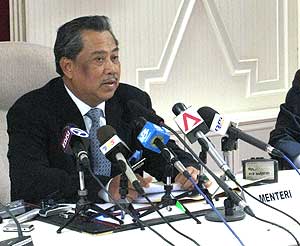 Presumably, Muhyiddin (
left
) was reacting to the phenomena of Malay voters in urban and semi-rural seats marking the ballot for DAP and Chinese all over the country ticking the box for PAS.
Presumably, Muhyiddin (
left
) was reacting to the phenomena of Malay voters in urban and semi-rural seats marking the ballot for DAP and Chinese all over the country ticking the box for PAS.
This factor was behind the opposition Pakatan Rakyat's gains in Selangor where BN had mounted an intense but ultimately fruitless campaign to recover the richest state in the country.
Possibly chastened by this phenomenon, Muhyiddin, hitherto assertive about the immutability of his Malay-ness and its lofty position in the Umno-nurtured racial pecking order of the country, gave vent to an idea that many in Umno would like to be amnesic about: his suggestion that BN could become a single party conglomerate was essentially a variation on a theme aired as early as 1951 by Umno's founder, Onn Jaafar.
Onn had to leave Umno, chagrined by its resistance to an idea whose time had not then come but whose point could only be deferred, not interred.
Six decades later, Muhyiddin, a scion of Johor Umno where the party was birthed, has re-floated what a seer-like Onn had first proposed.
A stillborn idea
However, the reactions from within Umno or from within its extra-territorial fold, Perkasa, to Muhyiddin's idea confirmed what the British historian John Macauley, master of many intricate partisan maneuvers in his historical research, observed to be true about political parties.
Macauley said that it is in the nature of political parties to retain their original enmities far more firmly than their original principles.
Talk of retention of original enmities, shortly after Muhyiddin spoke about a single BN party, Perkasa was on record as warning of grave consequences to those who "erase" Umno.
The responses of other elements in the Umno quarter were less dire though no less inhospitable.
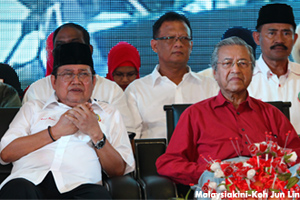 Umno information chief Ahmad Maslan said that conservative Umno Malays would not countenance the idea of a unified BN party; vice-president Ahmad Zahid Hamidi speculated that the idea arose from the desperation felt by BN component parties which had been annihilated at the recent polls; and Umno eminence grise Dr Mahathir Mohamad observed that the idea's time had not yet arrived.
In effect, the reactionaries were saying that what the average voter in the economically leading state of the country was signaling about his political preferences was not what the common Umno member was inclined to go with.
Sure, less economically endowed Malays in the rural parts of the country had voted for Umno, a decision prompted in part, in states like Kedah, by the incompetence of the former menteri besar from PAS, Azizan Abdul Razak, and abetted by the BRIM (1Malaysia cash handouts) payments they received that required of them a reciprocal obligation to vote the hand that fed them.
But this category of voter is not a demographic that is set to stay for long. If anything, it will recede as rural-to-urban migration accelerates, as people age, and as the threat of mounting insolvency incurred by profligate BN governance becomes palpable.
In short, Umno and BN are riding a waning wave of voter preference but its leadership ranks are infested with people who cannot distinguish between their specific career interests and the long-term interests of the coalition of which their party is a dominant part.
Mired in fevered swamps
Too long in thrall to the dogmas of a race-centred worldview, large swatches of Umno and several components of the BN are mired in its fevered swamps, unable to disenthrall and thus renew their party.
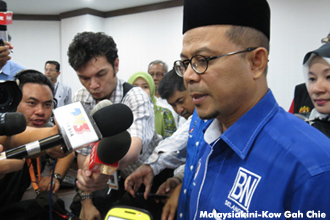 Even the defeat at the polls to politicians like Perkasa firebrand Ibrahim Ali, who lost his Pasir Mas parliamentary seat in Kelantan, and to Zulkifli Noordin (
right
), the religious bigot and agitator, who was dumped with ease in the Shah Alam federal seat, is apparently not sufficient to convince Umno that the party, as presently constituted and led, is on sliding scale on the voter-preference graph.
Even the defeat at the polls to politicians like Perkasa firebrand Ibrahim Ali, who lost his Pasir Mas parliamentary seat in Kelantan, and to Zulkifli Noordin (
right
), the religious bigot and agitator, who was dumped with ease in the Shah Alam federal seat, is apparently not sufficient to convince Umno that the party, as presently constituted and led, is on sliding scale on the voter-preference graph.
Too long a stay in power - this more than a half-century Umno-BN one aided by a rural voter-weightage that's gone off the rails, and abetted by the machinations of an Election Commission that's an adjunct of the government - leaves the anointed with the feeling that come what may, they are ordained to stay.
If it's true that without vision, people perish, as the French philosopher Blaise Pascal held, then it must also be true that without reform and renewal, sclerotic political parties diminish and die.
It's just that some may mistake merely running on the spot as an adequate substitute for R & R.
TERENCE NETTO has been a journalist for four decades. He likes the occupation because it puts him in contact with the eminent without being under the necessity to admire them.


Are you sure you want to delete this comment?
This action cannot be undone.