




'We won't sign TPPA if price of medicine increases'
PARLIAMENT The government is dead set against any extension of intellectual property rights involving medicine in the Trans-Pacific Partnership Agreement (TPPA), which may see the prices of generic medication skyrocket.
PARLIAMENT The Malaysian government is dead set against any extension of intellectual property rights involving medicine in the Trans-Pacific Partnership Agreement (TPPA), which may see the prices of generic medication skyrocket.
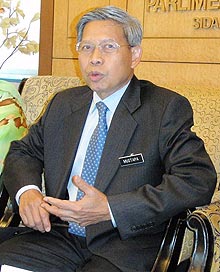 "On patents involving the price of medication... we are adamant, we don't want the current regime to change; we will defend existing policies," International Trade and Industry Minister Mustapa Mohamed (
right
) told the Dewan Rakyat during question time this morning.
"On patents involving the price of medication... we are adamant, we don't want the current regime to change; we will defend existing policies," International Trade and Industry Minister Mustapa Mohamed (
right
) told the Dewan Rakyat during question time this morning.
"If we don't agree, we can choose not to sign. We will protect our national interests. If we don't agree with some of the terms, we will not proceed," the minister pledged.
Mustapa said this in reply to a supplementary question from Anuar Musa (BN-Keterah), after answering the original question from Charles Santiago (DAP-Klang) on concerns about the impact of the TPPA on Malaysia's sovereignty.
On fears that the TPPA framework would allow foreign companies to question the policy decisions of a sovereign government like Malaysia’s, Mustapha gave his assurance that Malaysia's involvement in the agreement would not limit the government from protecting its sovereignty.
'Malaysians firms too can sue foreign governments'
Pointing oput that similar provisions in other free trade agreements were already in force and with no adverse effects, Mustapa argued that such an arrangement worked both ways and Malaysian firms too could sue foreign governments.
The minister also gave his guarantee that the interests of Malaysian small and medium enterprises would also be protected and not squandered in negotiations for the TPPA.
He said the government had met with all stakeholders to get their views and input and he also gave his assurance all that further consultations continue as negotiations for the agreement developed.
 However, Mustapa said it was not necessary to table the entire agreement to Parliament first as he believed past consultations and those planned in the future with stakeholders would provide enough input for the government to gauge and protect the nation’s interests.
However, he admitted that it would be impossible, in a democratic country, to get 100 percent agreement on anything that is done, though he was sure that the government had "majority support" for what it aimed to achieve in the TPPA.
He is appreciative of all criticism and suggestions on the trade pact sent to him as these have helped to strengthen their arguments and widen their scope of discussion.
"What is important is that the benefit are more than the costs involved. All actions have bad and good consequences. That we cannot deny, but the important thing is that it is more good than bad," Mustapa argued.


Are you sure you want to delete this comment?
This action cannot be undone.