




'No faith in gov't promises led to fall in FDI confidence'
A lack of confidence in the government's transformation programmes is ‘strongly correlated' to a drastic drop in foreign direct investment (FDI) confidence, said Petaling Jaya Utara MP Tony Pua.
A lack of confidence in the government's transformation programmes is ‘strongly correlated' to a drastic drop in foreign direct investment (FDI) confidence, said Petaling Jaya Utara MP Tony Pua.
 He was referring to a report in
The Edge Financial Daily
today, quoting the AT Kearney's 2013 FDI Confidence Index report saying that Malaysia's ranking has dropped from 10th last year, to the last position of 25th this year.
He was referring to a report in
The Edge Financial Daily
today, quoting the AT Kearney's 2013 FDI Confidence Index report saying that Malaysia's ranking has dropped from 10th last year, to the last position of 25th this year.
This is despite the international consultancy firm saying that emerging markets are still an attractive FDI destination.
"The drastic fall in Malaysia's FDI confidence has to be strongly corelated with a fall in confidence with the government's ability to deliver its transformation promises, which have been in essence, more form than substance," Pua said in a statement today.
Malaysia was previously ranked 21st in the 2010 AT Kearney FDI Confidence Index, before moving up to the 10th ranking last year, and plummeting to the current 25th position.
It fell just behind Indonesia (24th) and Argentina (23rd), while the United States takes the lead, followed by China (2nd) and Brazil (3rd).
 According to
The Edge
, the report ranks countries based on how political, economic and regulatory changes affect FDI, based on a survey of 300 senior executives in major corporations.
According to
The Edge
, the report ranks countries based on how political, economic and regulatory changes affect FDI, based on a survey of 300 senior executives in major corporations.
It quoted the report saying that the Malaysian economy has boomed due to government infrastructure spending, “solid” lending, and rising consumer demand fuelled by civil servant pay rises and cash handouts.
New level of political uncertainty
However, it warned that the government would be under pressure to balance the budget in the coming years due to declines in oil production and increases in the cost of oil exploration.
“The long-governing BN coalition won a majority of parliamentary seats in early May against the strongest opposition it had ever faced, but its weakened majority and the increasing polarisation revealed could make deeper economic reforms more challenging and introduce a new level of political uncertainty for the future,” the report was quoted saying.
Meanwhile, Pua said the report showed that investors were initially attracted to Prime Minister Najib Abdul Razak’s Economic Transformation Programme (ETP), but that interest has since fizzled out.
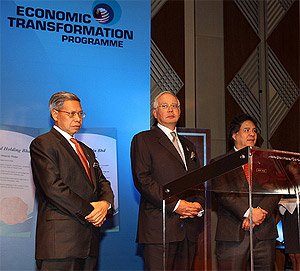 “Despite the much-touted programmes such as the ETP, Government Transformation Programme (GTP) and New Economic Model (NEM), successful implementation of key reforms and projects have been far and few in-between,” he said, pointing out that major projects were still awarded without a competitive, transparent tender system.
In addition, he said the government has failed to tackle corruption, and there has been no attempts to streamline government spending.
“Hence we call upon the government to immediately address these shortcomings in its much-hyped transformation programmes, so as to curb the decline in confidence in FDI into Malaysia.
“Such decline in confidence when translated to actual decline in investments will end up in long-term negative consequences to the country’s economy,” said Pua, who is also the DAP publicity chief.


Are you sure you want to delete this comment?
This action cannot be undone.