




Wanted: Liberalism towards the arts
COMMENT The time has come for the adoption of a more liberal policy on the arts which would preclude the reflexive suspension, censorship or banning of works that do not conform to conventional tastes.
Given the increasing number of instances in recent years when a book, a movie or a play was frowned on by the authorities and sections of the public, the adoption of a more relaxed policy with respect to artistic expression is overdue.
The most recent instance of controversy caused by the advance publicity over the film, ‘The New Village', highlights the need for more liberalism towards the visual and literary arts...
COMMENT The time has come for the adoption of a more liberal policy on the arts which would preclude the reflexive suspension, censorship or banning of works that do not conform to conventional tastes.
Given the increasing number of instances in recent years when a book, a movie or a play was frowned on by the authorities and sections of the public, the adoption of a more relaxed policy with respect to artistic expression is overdue.
The most recent instance of controversy caused by the advance publicity over the film, ‘The New Village', highlights the need for more liberalism towards the visual and literary arts.
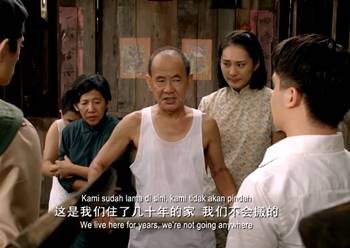 The movie is supposed to have glorified communism. That has prompted non-governmental organisations to exhort through social media that the authorities should take another look at it before it is released for public viewing in cinemas.
Home Minister Zahid Hamidi, presumably moved by this lobbying, was reported by national news agency Bernama as saying the movie which was scheduled to be released next month is being held back for further scrutiny of its plot and message.
Critics of the movie are said to view the release of ‘The New Village' in its present state as indicative of a permissive attitude by the Censorship Board that was unjustifiably withheld from ‘Tanda Putera', a movie on Malaysia's independence scheduled for release earlier this year but postponed several times due to protests from some quarters over its content and message.
Is the public going to be deprived of making their own judgment over such productions as ‘Tanda Putera' and ‘The New Village' simply because aspects of these works do not jibe with the sentiments of a crusading few?
Failure of the ruling class
In matters concerning the arts, if the authorities or a vocal few make all the valuations, this would leave very little room for the common exercise of the sort of appraising imagination the normal man and woman are endowed with.
Everything is then frozen at a certain level, no higher than the imagination of the ruling mediocrities. This is usurpation of the faculties of the ruled by refusing to let them think and discover freely.
Such a society would be sterile and barbarous even if it does not resort to custodial killings and detention without trial.
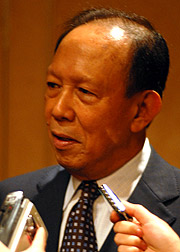 Former deputy prime minister Musa Hitam (
right
),
in an interview
the other day with the
Singapore Straits Times
, adverted to the disjunction in Malaysia between the mindset of the ruling class and an urban middle class that was increasingly educated.
Former deputy prime minister Musa Hitam (
right
),
in an interview
the other day with the
Singapore Straits Times
, adverted to the disjunction in Malaysia between the mindset of the ruling class and an urban middle class that was increasingly educated.
Musa lamented what he saw as the failure of the governing class to even keep up with the aspirations of a middle class that he said is apt to think differently from its predecessors.
"The middle class today thinks very differently, and the challenge for the leadership is that it should be one step ahead but it has not even kept up," Musa told the Singapore daily.
Racial and religious sensitivities
From the standpoint of merely keeping up with this society when it comes to matters having to do with its entertainment and edification, it would require that the authorities adopt an attitude of allowing a hundred flowers to bloom so long as the works do not contain racially and religiously toxic elements.
Sure, to distinguish the toxic from the tepid is not especially easy in a society where racial and religious sensitivities are like spilled pins on a carpet, causing pedestrians to tiptoe rather than traipse.
But it isn't all that difficult either: it isn't hard to see that while literary cognoscenti might think the novel ‘Interlok' a permissible read for the general public, as a text for students offering Malay literature for the SPM it is not recommendable - works that smack of racist stereotyping and reek with mockery of cultural beliefs are not the stuff that can help mould young minds.
Since a large part of the value of the arts in entertaining and stimulating the public derives from its propensity to feuds and follies, there will be debate aplenty on whether some works have flagrantly transgressed the boundaries of taste or have merely emitted subversive ripples.
These days an increasingly educated Joe Public should be allowed the latitude to discern the difference on his own.
TERENCE NETTO has been a journalist for four decades. He likes the occupation because it puts him in contact with the eminent without being under the necessity to admire them.


Are you sure you want to delete this comment?
This action cannot be undone.