




RM13mil paid without green light for MERS '999' project
AUDIT REPORT The committee set up to monitor the Malaysian Emergency Response Services (MERS) 999 project failed to administer the government contract resulting in improper payments amounting to RM13.54 million.
AUDIT REPORT The committee set up to monitor the Malaysian Emergency Response Services (MERS) 999 project failed to administer the government contract resulting in improper payments amounting to RM13.54 million.
The Auditor-General's 2012 Report tabled in Dewan Rakyat yesterday said the project monitoring and evaluation committee (JPPP) had verified RM1.62 million compared to the cost in the Bill of Quantity amounting to RM1.08 million, resulting in an overpayment of RM0.54 million.
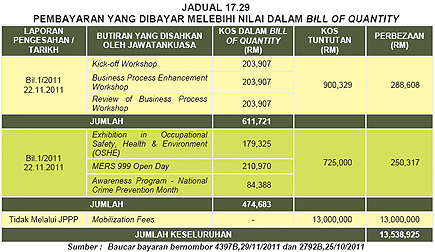
Apart from that, there was also improper payment for Mobilization Fees Capital Expenditure - Phase 2 Capex totalling RM13 million which was made without the approval of the committee.
"The weakness of the project monitoring committee and the negligence of the ministry's officers had caused improper payment amounting to RM13.54 million," the report said.
The audit found the Ministry of Information, Communications and Culture as the implementer which did not give serious attention to the management and administration of the MERS 999 contract.
The report recommended action as provided under the Treasury Directive 167 to be taken against all the committee's members for failing to implement their responsibilities.
To ensure the project expenditure obtained the best value for the government, the report proposed nine actions to be taken by the government.
Among the proposals were to ensure the operation system was according to the schedule set and ensure the problem of non-emergency calls be handled according to the law, including the penalty term should the contractor failed to achieve the quality of service set.
In its reply, the ministry said setting up the committee was appropriate but it was not fully used.
Therefore, the ministry planned to give the committee more roles to ensure the project was implemented effectively and in the interest of the government.
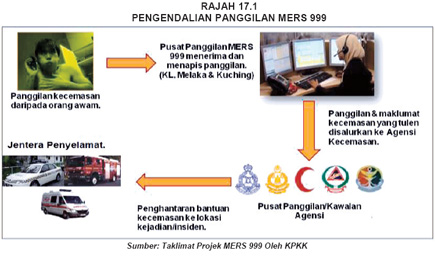
MERS 999 is an emergency call service which received 68 per cent prank calls every day through five emergency agencies such as police, Fire and Rescue Department, Health Ministry, Civil Defence Department as well as the Malaysian Maritime Enforcement Agency.
Meanwhile, the report also revealed that the develoment and installation of MERS 999 facilities at 16 sites were implemented late and 34 sites operated later than the date set.
"The delay was between two to six months and in the auditor-general's opinion, the physical implementation performance of the project was unsatisfactory as the delay affected the project's objective as well as its performance," the report said.
The ministry in its reply to the matter on April 26, 2013, said the delay at the construction sites was due to the contract implementation for 2011/2012 which began in Sept 30, 2011.
The delay of nine months in commencing work was due to a delay in obtaining approval from the central agency causing a change to the completion of the site date.
On the same matter, the report found the organising of a seminar and a visit overseas was not proper as it did not adhere to the terms of the contract apart from the discovery of improper payments.
The report said the ministry needed to collect back from the contractor an expenditure amounting to RM253,813 as it was not reasonable.
The ministry in its reply admitted to weaknesses in the monitoring of payment overseas as it depended fully on TM as well as the agreement of the monitoring committee.
- Bernama


Are you sure you want to delete this comment?
This action cannot be undone.