




Ballooning debt of gov't-linked firms a time bomb
MP SPEAKS The BN government will surely play up the fact that it is a prudent government that is managing its finances well, with its projection in Budget 2014 that the annually growing budget deficit will be reduced to RM37 billion or 3.5% of GDP in 2014.
However, this ignores an extremely worrying problem of a huge increase in the deficit position of the companies that are owned or controlled by the government and statutory bodies - or non-financial public enterprises (NFPEs)...
MP SPEAKS The BN government will surely play up the fact that it is a prudent government that is managing its finances well, with its projection in Budget 2014 that the annually growing budget deficit will be reduced to RM37 billion or 3.5% of GDP in 2014.
However, this ignores an extremely worrying problem of a huge increase in the deficit position of the companies that are owned or controlled by the government and statutory bodies - or non-financial public enterprises (NFPEs).
For 2013, the projected deficit is RM93 billion or a massive 9.4 percent of the GDP. This represents a six-fold increase from the R15.6 billion deficit recorded in 2012.
The NFPEs refer to 30 "government-owned and/or government-controlled companies and agencies owned by the government", whereby "ownership and control refer to government or a public sector agency controlling more than 50 percent of total equity".
These would include companies such as Petronas, Tenaga Nasional Bhd, Telekom Malaysia Bhd, Axiata Bhd, Malaysia Airlines, UEM Group as well as more recent additions such as 1MDB, Prasarana and MRT Co.
The financial positions of these companies affect the fiscal position of the government directly and indirectly. These companies contribute directly to government coffers by paying corporate taxes (and the petroleum tax by Petronas), as well as dividends.
They (or via special purpose vehicles related to them) also issue bonds that carry an explicit as well as an implicit government guarantee, that is, the government has to pay for these bonds if these companies run into financial trouble (think PKFZ).
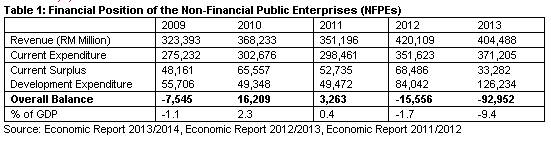
What is shocking about the figures in Table 1 is that the deficit position of the NFPEs, which have been in surplus for 2010 and 2011, is projected to reach RM93 billion in 2013!
This huge growth in the deficit has been driven by a massive spending spree in development expenditure, which increased by 70 percent from RM49.5 billion in 2011 to RM84 billion in 2012 and is projected to increase by another 50 percent to RM126.2 billion in 2013. In 2013, the NFPEs spent three times as much on development expenditure compared with the federal government.
It will be many years before some of this development expenditure that is being spent can start generating revenue, for example the MRT project. Some projects may never generate enough revenue to cover operating costs.
Expensive white elephants
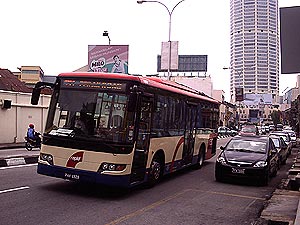
Prasarana, which runs the LRT as well as the Rapid bus systems in Kuala Lumpur, Penang and Kuantan is still making losses. Some projects may very well turn out to be very expensive white elephants, such as 1MDB's Tun Razak Exchange.
The massive increase in the deficit positions of these NFPEs also means that the government's exposures to these development expenditures have increased. If some of these projects do no bear fruit, the corporate taxes and dividends paid to the government by these NFPEs will decrease. In some cases, the government may be forced to step in to bail out these companies.
What is even more worrying is that the statistics and information pertaining to the development expenditure and financial standing of some of these NFPEs are not publicly available.
In a paper presented at the MyStats 2012 forum, the chief economist of Maybank Investment Bank, Suhaimi Illias, highlighted the ‘black box' nature of development expenditure in NFPEs and GLCs:
"Despite the significance of NFPEs and GLCs/GLICs in the Malaysian economy, end-users in the private sector have somewhat limited access to their capital expenditure data, other than the information available from major entities like Petronas and the large public-listed NFPEs/GLCs (eg Telekom Malaysia, Tenaga, Malaysia Airlines) that are used as proxies to impute public sector investment, in addition to the federal government's development spending.
"Even then, these NFPEs' development spending number reflects only the biggest 30 NFPEs with minimum annual sales of RM100 million."
 The government cannot continue to ignore the potential impact of the deficit position of the NFPEs. What is needed now is for the disclosure of the full accounts of all the NFPEs that are not publicly listed including Petronas, 1MDB, Prasarana and MRT Co, so that there is full transparency on the development expenditure of these companies.
What is needed now is for a full evaluation on the government's ability to absorb potential losses arising from their exposure to these NFPEs, perhaps in the form of a Stress Test that has been conducted by organisations such as the IMF for the banking system in the country.
Without concrete actions taken, the continued growth of the deficit position of the NFPEs is a ticking time bomb that may explode unexpectedly, with disastrous consequences for the government's fiscal position and the country's economy.
ONG KIAN MING is the Member of Parliament for Serdang.


Are you sure you want to delete this comment?
This action cannot be undone.