




A day at the UNHCR in Pudu
FOCUS A few days ago about 250 applicants for refugee status were at the office of the United Nations High Commission for Refugees (UNHCR) in Pudu. They were all members of the Mizo Association, a group bringing together many (though by no means all) Mizo refugees in Bukit Bintang.
The Mizo are often unknown even among other people from Myanmar. They are a relatively small ethnic group within the large, varied group of Chin peoples straddling the borders of India, Myanmar and Bangladesh. Both Hakha and Falam, two other Chin groups, are much more numerous in Kuala Lumpur. However, there are dozens of different Chin groups: so many that in fact the Chins are often strangers to themselves.
A friend once told me that there are probably almost as many languages and dialects as there are Chin mountain villages (some people put the number at around 50). Though no doubt a little exaggerated, his comment is apparently not too wide off the mark. In my experience, sometimes Chins have to resort to Burmese, the official language of Myanmar, to talk to one another. By comparison, the Kachin, the other mainly Christian minority from Myanmar in Bukit Bintang, speak merely half a dozen different languages...
FOCUS A few days ago about 250 applicants for refugee status were at the office of the United Nations High Commission for Refugees (UNHCR) in Pudu. They were all members of the Mizo Association, a group bringing together many (though by no means all) Mizo refugees in Bukit Bintang.
The Mizo are often unknown even among other people from Myanmar. They are a relatively small ethnic group within the large, varied group of Chin peoples straddling the borders of India, Myanmar and Bangladesh. Both Hakha and Falam, two other Chin groups, are much more numerous in Kuala Lumpur. However, there are dozens of different Chin groups: so many that in fact the Chins are often strangers to themselves.
A friend once told me that there are probably almost as many languages and dialects as there are Chin mountain villages (some people put the number at around 50). Though no doubt a little exaggerated, his comment is apparently not too wide off the mark. In my experience, sometimes Chins have to resort to Burmese, the official language of Myanmar, to talk to one another. By comparison, the Kachin, the other mainly Christian minority from Myanmar in Bukit Bintang, speak merely half a dozen different languages.
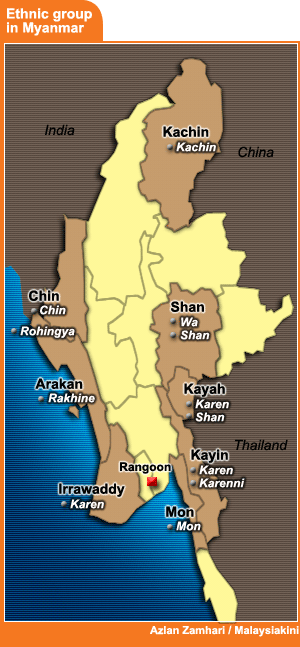 There are reportedly still a few 'animists', i.e. non-Christian Chins left, who are engrossed in traditional religious beliefs and practices, but I have never come across any in Bukit Bintang. Some of my Chin friends proudly tell me that the Chins are 100 percent Christian. I have discovered this is not entirely accurate.
In fact, in Mizoram - the Mizo ethnic state in the northeast region of India on the border with Myanmar and Bangladesh - there are even a couple of thousand Jewish Mizo (sic), some of whom have earned the right to emigrate to Israel.
Of course, as I am a ‘mat salleh', some people make a point of telling me they are Christian to indicate that we have a good deal in common. It turns out the Mizo are the first Chin group to have been Christianised over 100 years ago (they also got the first translation from the Bible into a Chin language made by British missionaries).
They belong to several different Protestant denominations. There are Catholic Chins, but I have never met a Catholic Mizo. The Catholics I know happen to belong to the Teddim, yet another Chin group with its own language and customs. By comparison, many Kachin, living on the border between Myanmar, China, and India, are still 'animists', as in the case of a friend of mine, whose family worshipped a local snake deity before they converted to Christianity, or practise Buddhism, the majority religion in Myanmar.
Question time
Carl is very articulate and quite well known among many of the young men of the Mizo community. He is also well liked, especially as he laughs at himself quite often. He has been in Malaysia for several years now, working at restaurants in Bukit Bintang.
He takes pride in his abilities as a chef. I find the term better and more accurate than the more common designation usually given to workers like him, namely, kitchen staff. Accordingly, the young men themselves often give each other the title of chef. Not that they have any certificates; only, they have acquired quite a good deal of experience on the spot.
In fact, in my experience (I often drop by for a chat), the kitchen where Carl works is entirely run by Myanmar staff. If there is a 'real' chef somewhere, she is making herself scarce. Carl prides himself in his abilities as a cook of dishes of Western cuisine, especially pasta. He is well educated. He is fluent in both spoken and written Burmese, Mizo and English.
He tells me he also often reads the Bible - usually the Psalms - in the three languages, one after the other, so that he can be certain of the meaning of the text. He therefore sometimes acts as an interpreter, for instance when the Mizo Association sends candidates for refugee status to the UN office in Pudu.
This time there are about 250 people, the overwhelming majority of whom are both young and male. Carl sees his friends sitting here and there; he is dressed for the occasion. He is clearly a figure of authority as the vast majority of his friends and acquaintances cannot act as an interpreter to save their lives. There are 10 UN officers, all of them Malaysian. The questions are simple and straightforward: name, birthplace, marital status. Yet there are snags.
Some people are shy and even terrified about answering questions, especially when the officers start asking what they think are awkward questions, and in public. Accordingly, Carl tells me some people whisper their answers in such a low voice that he has a hard time understanding what they are saying.
It must be embarrassing to have to officially declare such details in an audible voice in a roomful of people, many of whom know you, your family, are former schoolmates and childhood friends, or even relatives. In fact, almost every Mizo I meet seems to have some family in Malaysia: say, a cousin, an aunt, or even a brother.
For instance, you may be asked how you met your wife; how many people there were at your wedding; the full names of the 12 siblings (sic) whose existence you have just mentioned (in this case, the officer has to labouriously type the full version of the often long, somewhat strange-sounding Mizo names, such as Lalrintluanga, Laldinthanga, Lalnuntluanga, Lalnunmawia, etc); or, if the officer is in a particularly nasty mood, he may ask how exactly you came to Malaysia. This is a tricky question.
The enigma of arrival
You cannot say you came on an AirAsia flight: instead, you are supposed to have fled across the border for dear life, with the Burmese military in hot pursuit, until your reached Changkat Bukit Bintang; or else sneaked into a boat that happened to be bound for Lumut.
I notice from his spirited account that Carl clearly took pleasure in his role as intermediary, especially as he was carrying out his task in full view of many friends and acquaintances, and quite competently too.
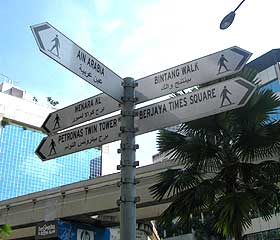 He tells me people often sat huddled together with others from the same village, neighbourhood, school network, or extended family. He adds that a common friend of ours, Herman, was surrounded by his friends from the same village. Some of them are people Herman lives with in cramped quarters on Changkat Bukit Bintang itself (others live on Jalan Alor or Jalan Sahabat, to mention but a few of the streets in the neighbourhood that have many Mizo residents). He also happens to work with some of them in a restaurant.
In reality, almost entire Mizo communities simply transfer themselves, lock, stock, and barrel, from the Chin hills, to Bukit Bintang, at least as far as many of its young members are concerned. At any rate, young men who used to know each other back home are now often living, working, socialising, and worshipping together in Bukit Bintang, in a way not entirely unlike what happened back home.
Only, Carl tells me, here they enjoy a much larger degree of freedom, as they have evaded the watchful eyes of parents and older relatives. Unfortunately, as he also adds, the very long working hours (easily nine, 10 or even 12 hours a day), and the fact that they are always in Bukit Bintang, means that their life in Malaysia is actually boring.
As a consequence, though he is a UN refugee, and in a few years' time he may therefore finally go the United States (where just like many other Mizo, he will be able to join friends and relatives already settled there), he tells me he plans to go back to Myanmar. I know that the thought of having to wait a few more years to get out of Bukit Bintang is too disheartening for comfort.
It virtually means accepting a restricted life of untold drudgery for years to come before reaching the safety of the US - where as a matter of fact, a life of toil in comparatively low paid jobs with few or no prospects for advancement, in a depressed economy, often awaits many Mizo and other Myanmar refugees.
Porous borders
Carl is young and cheerful. I am sure he knows what his prospects are. Through Facebook and phone calls, he, like many of his friends, keep in touch with the large, growing Mizo diaspora all over the United States, Australia, New Zealand, Sweden, Norway, Canada, and other countries.
Carl has also spent time in India, where he lived with relatives of his for a short while. In fact, the Mizo are a transborder, transnational people par excellence: many refugees are in reality from India, and cannot even speak Burmese. They have to hide the fact from the UN, as Indian nationals are not supposed to become UN refugees.
The issue of nationality is however a moot point, as no doubt even the UN knows: many, if not most Mizo have family on both sides of the India-Myanmar border - a border they cross without bothering about passports let alone visas. This is unsurprising, as on both sides people speak the same language and are moreover often related to one another.
The language issue is also interesting: though the rule of thumb is that someone who grew up or was born in Mizoram cannot understand Burmese, our friend Herman, for instance, though born and raised on the Myanmar side of the border, does not know the national language at all. In fact, when he came to Malaysia he was monolingual, namely, he could only make himself understood in Mizo.
As he lives, works and socialises with young men from the same village, this was not necessarily a serious hindrance. Fellow villagers can always step in as interpreters in case there is a need. He therefore lives and works in Bukit Bintang largely inside his own village community.
People in the Chin hills are not necessarily connected to the Internet (many people do not even have telephones or mobiles). However, the Mizo in Bukit Bintang, though they are part of an already dense local Mizo social network, nonetheless are often online most of the time.
In my experience, it is far easier to get in touch with Carl via Facebook than over the telephone. He answers almost instantly any of my messages. The frequency with which people post photographs of themselves also amazes me again and again. I am therefore getting daily visual reports.
'Likes' come by the hundreds, in some cases a mere couple of hours after a posting. It slowly dawns on me that in reality some of the young men who wear white kitchen staff uniforms or the mandatory black shirts, in case they are floor staff, are nothing short of celebrities or nearly so.
Say, they may be the sons of a well-known pastor (pastors and missionaries are usually revered figures among the Mizo); the cousin of a famous gospel singer; or even, on occasion, celebrities on their own right (say, a top model from Mizoram).
A couple of them seems to enjoy near-royalty status. After a while, it is easy to figure out who the 'in-crowd' is just by checking Facebook postings regularly. Little do Malaysians who go to Bukit Bintang know that they may in fact be waited upon by celebrities from the Chin hills.
Hanging on in BB
Carl is charming and good-humoured. He is clearly a well-known figure and just as clearly not royalty as such. As he is not a leader among the church youth (a role of high public visibility), nor is his father a pastor, a missionary or even a teacher, I think he also enjoys more existential freedom than several of his more famous friends.
He is fun to be with and is self-deprecating. For instance, he is a bad saver, and therefore every yearend he breaks his promise to his parents (and to himself) and stays on in Malaysia instead of going back to Myanmar. It is my impression, he readily capitulates if anybody as much as hints at his apparent incompetence.
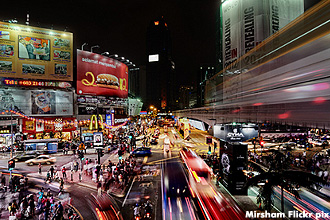 He enjoys himself heartily with his friends; and is not trying to put up pretences of any kind. He therefore undermines any notion of a refugee trajectory: he never mentions to me any bad experiences he may have had back home, say with the military, who reportedly kidnap young men like himself, especially those belonging to ethnic minorities such as the Mizo, to do forced labour or even become unwilling soldiers in one of the many stupid, long-drawn confrontations the central government seems to have nurtured all over the country, especially in the past.
Even when I press him, all I get is a dismissive chuckle: it is something so unimportant, so trifling, that it does not deserve even a passing mention. I find Carl's quiet, low profile quotidian heroism nothing short of remarkable.
In a way, on some level he does not take his own pain and suffering, real as these are, seriously. His mind is set on some far off goal that he is too coy to reveal openly, but wise enough to display almost as if his life was an open book. At least, this is clearly the impression I get from his Facebook page. Namely, he is not waving a flag, nor is he playing hide-and-seek.
I find it remarkable that someone so young - still in his early 20s - should be so savvy, and in such a fun, unpretentious way as well. Besides, most of his Facebook snapshots - taken with his mobile - show a smiling face. Yet, looking from the outside, all you see is a young man who leads a hand-to-mouth existence as a refugee from a near-bankrupt society (where the youth have almost no prospects), working long hours in dreary jobs in a country where he is on sufferance at the best of times.
His life history also gives the lie to public perceptions, in Malaysia and elsewhere, of who or what a refugee is. I do not really know his life history, as he is at best demure about it. However, it may be like that of many of his friends. He probably did not flee across any borders.
Instead, he may simply have moved away from his nondescript hometown together with a close childhood friend, to land in a place where he has no rights (but then at the end of the day did he really have any back home?).
At any rate, Carl now lives surrounded by many friends and acquaintances in Bukit Bintang, some of whom he has no doubt known for most or even all his life. Perhaps he has not exactly been compelled to become a refugee because he did not have a choice; however, nor is he completely free to come and go and do as he wishes.
It is possible that he originally came, as many other Mizo, as a worker; then at some point he threw his passport away and became an undocumented worker. Maybe he had even had the chance to become a legal refugee but decided not to as he did not fancy immigrating to the US. Now he has an official refugee card.
Yet he says all the same that he wants to go home because Malaysia is almost too boring for words. I find his forceful, convincing, and yet also playful invocation of existential ennui, a wonderful antidote to the some times real dreariness of his Malaysian life. Just as with other things in his life, this last is not something to be taken too seriously.
FRED ROSEN has been gallivanting around Southeast Asia for quite some time now. He is interested in foreign communities in Malaysia's large cities. He has also been writing about Malacca, both in the present and the past, as well as other ancient port cities in the Indian Ocean.


Are you sure you want to delete this comment?
This action cannot be undone.