




Travails of Johnny, the Myanmar refugee
Johnny is a refugee. However, he started his trajectory in Malaysia as a foreign worker from Myanmar.
The United Nations High Commissioner for Refugees (UNHCR) naturally enough works with a definition of refugee that excludes economic need as a reason for fleeing one's homeland.
The UNCHR therefore emphatically denies that its refugees are in any way economic ones.
Johnny is a refugee. However, he started his trajectory in Malaysia as a foreign worker from Myanmar.
The United Nations High Commissioner for Refugees (UNHCR) naturally enough works with a definition of refugee that excludes economic need as a reason for fleeing one's homeland.
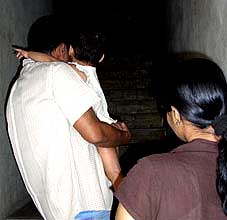 The UNCHR therefore emphatically denies that its refugees are in any way economic ones.
Though it is quite understandable that a legal and political definition has to be as clear cut and precise as possible, as well as acceptable to a broad spectrum of the international community, the situation on the ground is often much more complex, as Johnny’s life indicates.
Political and juridical categories, important and unavoidable as they may be, are hardly sufficient for understanding the lives of thousands of people around us. Likewise, 'economic refugee' is hardly a well-defined category. For instance, is a Malaysian working in Singapore or Dubai an economic refugee?
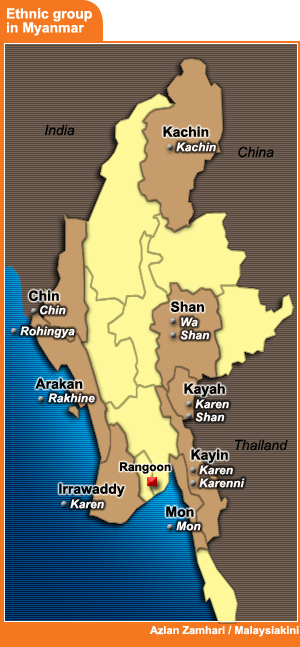
Johnny belongs to the ethnic majority in Myanmar. This in itself is already remarkable as, usually, Myanmar people are under-represented among refugee populations in Malaysia.
In Bukit Bintang - a neighbourhood with a very large population of Myanmar residents - they are a minority, especially among refugees.
Johnny is from the ethnic cauldron of Yangon. He has some Chinese ancestry and is therefore a kind of Peranakan. His family still keeps some Chinese customs and religious practices, and runs a small but thriving retail business in his home city.
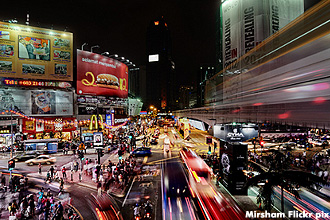 Visitors and night revellers usually do not realise it, but when they go to one of the venues in Bukit Bintang, the waiters who serve them are often economists, nurses, engineers and even former students of medicine. I have even met two refugees whose brothers are doctoral students in the UK.
Johnny studied economics at Yangon University (the oldest and most prestigious tertiary institution in the country and, before the military government undermined it for good, an internationally-acclaimed institution), but never finished his degree.
Instead, he got a job at a factory in Penang. He was very hopeful. He was then only eighteen. He told me his dream was to be “someone in life”.
 Little did he know what awaited him. His wages were considerably lower than originally promised by the 'agent' (they seem to work as a pair, namely, a Myanmar and a Malaysian agent, or even several people on each side, but workers usually refer to them as if they had to do business with a single individual).
As he discovered to his chagrin, his were hardly living wages for Malaysian standards. His dream of sending money home was at once shattered.
In fact, he barely eked out a living. The factory was a gruesome place. Not only was the work dreary, but he lived in a very large compound with other Myanmar male workers, right next to the lodging quarters of Bangladeshi workers.
He was almost completely isolated from Malaysian society. Besides, he did not know a single word of Malay, and had almost no English when he arrived.
Johnny kept his job for three long years. Eventually, he could not take it any more and found refuge at the Dhamikarama Buddhist Temple when he fell on hard times.
The monks would pay him to sweep the temple grounds, and do some cleaning as well. In fact, he could easily make more money there than at any factory. For a while, therefore, he refrained from finding other employment.
Finding Christianity
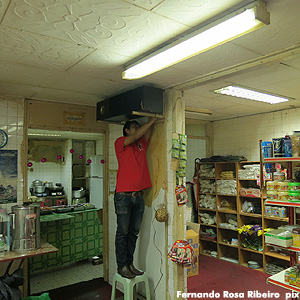
Johnny eventually found his way to Kuala Lumpur, together with his young Myanmar friends, where he started working at more posh restaurants in Bukit Bintang.
He also converted to Christianity. It is my impression that this was motivated at least in part by his comparative social isolation, and his harsh life as a foreign worker.
He socialises within a small group of Burmese converts and others who go to an evangelical church in a neighbourhood not far from Bukit Bintang.
 The church involved him in many activities, especially in the beginning. Johnny hardly had a Sunday to himself or was allowed much free time when he was not working.
He now lives in a condominium and has married another convert. He tells me his family back in Yangon is not exactly pleased with his conversion (they remain devout Buddhists).
However, they can hardly say anything as Johnny now lives far away and regularly sends money home to supplement the income of his ageing parents.
He has also become a UN refugee. Differently to other refugees I know, he does not keep a notebook containing his official history, for his own reference.
Candidates to refugee status often study their notebooks before an interview at the UNHCR office in Pudu.
It is important not to fall into contradiction in front of a UN officer as this can have potentially serious consequences for your application, and you are processed based on your personal file with the UN.
Johnny told me that when he was interviewed the last time, he had completely forgotten what he had first told the UN.
It turned out that he was the last person to be interviewed on a busy day. The officer in fact told him that there was no time left for questioning.
He, therefore, simply asked him whether he confirmed everything he had previously said. Johnny was relieved.
His church must have prayed strongly. He can now move to a third country. His wife is also a refugee. Nonetheless, neither of them has any intention of moving to the west. That is because they would then remain cut off from their parents too long for comfort.
Usually refugees cannot cross borders until they get papers in their country of settlement, a process that can take years in some countries.
Instead, they plan to work for another couple of years in Bukit Bintang, and then move back to Myanmar to start a business of their own, or else take over the family business from Johnny' parents.
Nonetheless, they are holding on to their UN cards just in case. It is always good to have more than one option.
FRED ROSEN has been gallivanting around Southeast Asia for quite some time now. He is interested in foreign communities in Malaysia's large cities. He has also been writing about Malacca, both in the present and the past, as well as other ancient port cities in the Indian Ocean.


Are you sure you want to delete this comment?
This action cannot be undone.