




MCA battle lines drawn - but allegiances stay unclear
ANALYSIS Candidates vying for top leadership posts in the MCA elections scheduled to be held in the coming weekend have finally made clear on which sides of the battle lines they stand on.
However, with just a day left before nomination day tomorrow, it remains to be seen whether these newly-minted alliances will last until polling day, which is Dec 21.
Last month, party presidential hopeful Liow Tiong Lai and the candidate for deputy president Wee Ka Siong revealed their cooperation and today, another candidate for the MCA No 1 post, Gan Ping Sieu, joined forces with MCA deputy president candidate Donald Lim...
ANALYSIS Candidates vying for top leadership posts in the MCA elections scheduled to be held in the coming weekend have finally made clear on which sides of the battle lines they stand on.
However, with just a day left before nomination day tomorrow, it remains to be seen whether these newly-minted alliances will last until polling day, which is Dec 21.
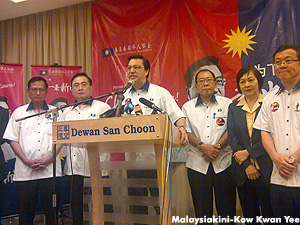 Last month, party presidential hopeful Liow Tiong Lai and the candidate for deputy president Wee Ka Siong revealed their cooperation and today, another candidate for the MCA No 1 post, Gan Ping Sieu, joined forces with MCA deputy president candidate Donald Lim...
This leaves former MCA president Ong Tee Keat, who is attempting to make a comeback as the party's chief, the sole candidate without a running mate.
Besides these three candidates vying to be MCA president and two going for deputy president, at least nine others are in the battle for the four posts of MCA vice-president, including current secretary-general Kong Cho Ha, who announced his entry yesterday morning.
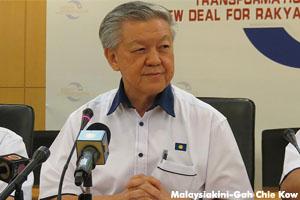 However, possible manoeuvrings by outgoing MCA president Dr Chua Soi Lek, who revealed a “peace deal” with Liow after earlier having slammed him as unsuitable, will have to be watched.
Under the deal, the factions linked to Chua and Liow have agreed to post two candidates each for the four vice-presidential posts.
Also, Chua's faction will get to contest 13 of the central committee posts, with the remaining 12 reserved for Liow's faction.
This peace deal has come as a surprise, especially after Chua's venomous attack against Liow, labelling him as "weak" and unsuitable to be the party president.
But notably, the Chua-Liow deal does not outline who will go for the positions of party president and deputy president.
Chua’s lingering influence
Whether Chua will follow through with the deal is unclear as he has on many occasions proven himself to be a masterful politician.
In 2009, Chua, then an MCA deputy president, joined forces with then MCA president Ong Tee Keat in a 'greater unity plan', after a protracted power struggle between the duo.
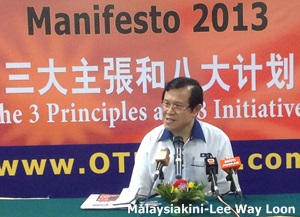 But in March 2010, Chua abruptly triggered fresh party polls after he got two-thirds of the central committee to resign, and he went on to oust Ong (right) and replace him.
As witnessed during the party's extraordinary general meeting (EGM) in October this year, Chua, even though having announced his retirement, garnered the support of almost half of the delegates through manoeuvrings against Liow, proving that he remains influential in the party.
But Chua, whose son Tee Yong is going for one of the posts of vice-president, is a man with an army but without a general. He wields sizeable support from delegates and can significantly improve the chances of any MCA presidential candidate, he appears to lack an obvious choice to back for the No 1 post.
Chua remains a bitter enemy of Ong, has chastised and ridiculed Liow's ability as future president and unceremoniously dropped Gan as a candidate for the 13th general election on May 5 this year.
Who stands the better chance for the party presidency will depend on how Chua plays his cards which are only likely to be revealed on polling day.
Similar manifestos
Of course, the coming Saturday’s party election results will not depend on only Chua, but another thing to note is that the manifestos of all three presidential hopefuls are largely similar, with little differentiation from one another.
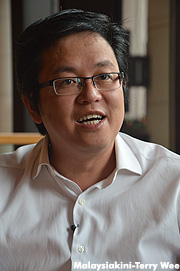 The manifestos of Liow, who launched his at the MCA headquarters on Dec 2 – and those of Gan (left) and Ong, who launched theirs at separate hotels a stone's throw away from each other yesterday morning – all carry similar messages: equal partnership in BN, equality and fairness in the economy, strengthening party organisation and engagement with the community.
As a matter of fact, these issues were echoed even in the last election cycle and indicate that the party is well aware of its challenges, but is unable to overcome them.
Ong put this situation very bluntly yesterday, raising an incident where a Chinese restaurant refused to allow customers clad in MCA uniforms into its premises. "We feel offended and humiliated by this," he said.
A key differentiating point will be the charisma and abilities of the individual candidates to elevate the party, which has suffered ridicule and vitriol from its own community since the 2008 general election.
Ong tried to pitch his international business connections during his manifesto launch yesterday, even receiving calligraphic art from a government-linked company (GLC) representative from China.
"The calligraphic characters are a form of encouragement and acknowledgement, not just from the GLC concerned but also from my overseas friends who have indicated their concern for us," he said.
Meanwhile, Gan, who is among the few BN leaders with good debating skills and has presented himself as a progressive, unveiled his manifesto which, among others, contained a photograph of him in a debate with the DAP's Petaling Jaya Utara MP Tony Pua.
Gan also took a more forceful stance, calling out to MCA delegates who would be voting whether they would prefer a firm leader like him or a flip-flop leader. He refused to point fingers when asked whether he was referring to Liow as the ‘flip-flop’.
Liow had been embroiled in a few embarrassing episodes when he was health minister, notably his fumbling over his WWW 15 car plate number and the Tung Shin Hospital tear gas incident during the Bersih 2.0 rally in 2011.
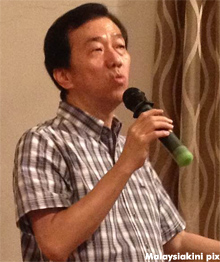 However, Liow insists he had delivered results as a minister and has been a staunch loyalist of the party. He also has the backing of party elders, including supporters of former MCA president and his mentor, Ong Ka Ting (left).
Liow also has sizeable support within the party, as was seen when he narrowly fended off an attempt by Chua to censor him at the EGM in October.
However, Liow's vote bank from the EGM may not necessarily be secure as all three presidential hopefuls were originally from the same camp and, generally, appeal to the same well-educated delegates.
In a situation like this, Chua's supporters, many of whom are from the grassroots, could serve as the tie breaker and the chances are that the candidates would lobby him for endorsement.
After tomorrow's nomination day, the four days left will see hard campaigning by one and all in the battle to win over the 2,386 delegates who on Dec 21 will decide on the new MCA leadership.
NIGEL AW is a member of the Malaysiakini team.


