




More serious efforts to fight corruption needed
COMMENT The Institute for Democracy and Economic Affairs (Ideas) welcomes the recent report titled ‘Illicit Financial Flows from Developing Countries: 2002-2011’ by Global Financial Integrity (GFI). The report records money passing in and out of 144 countries due to crime, corruption, and tax evasion.
COMMENT The Institute for Democracy and Economic Affairs (Ideas) welcomes the recent report titled ‘Illicit Financial Flows from Developing Countries: 2002-2011’ by Global Financial Integrity (GFI). The report records money passing in and out of 144 countries due to crime, corruption, and tax evasion.
We feel that this report has reinforced the message of the Corruption Perception Index (CPI) released earlier this month, that the government should be more serious in its efforts to combat corruption.
The GFI report places Malaysia as the fourth highest in the world of countries with the largest amount of illegal capital outflow. The GFI’s calculation shows that in 2011 alone, Malaysia lost over US$54 billion to illicit outflows and it lost more than US$370 billion (RM1.2 trillion) over 10 years since 2002.
 This amount does not even include illicit outflows as a result of criminal activities, such as drug trafficking and human smuggling. If money from these activities is added, the amount of lost capital due to illicit financial outflows could even be higher.
Ideas recognises that the government has raised several questions about methodology of the GFI report. Nevertheless, we urge the government to take the report positively, and use it as a leverage in the fight against corruption.
Malaysia’s ranking means that massive sums of money have been moved out from this country without record, which contravenes existing regulatory frameworks on capital controls.
If these funds did not leave the country, they could have been used as capital to develop the domestic economy and contribute to socio-economic benefits such as in education and healthcare.
The report’s summary shows that corruption is one of the key factors that facilitates illegal outflows, particularly though trade misinvoicing. Trade misinvoicing takes place when traders under-invoice or over-invoice imports or exports.
 It is usually “used as a tool to move capital in or out of a country in order to evade taxes and custom duties, to avoid quotas, for smuggling, to launder money or as a means of capital flight”. (Boyrie et all, 2007)
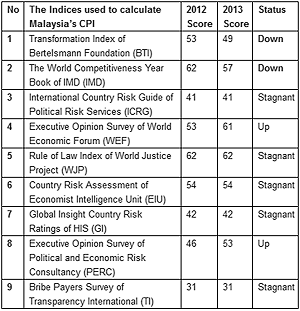
Although the overall score of Malaysia’s CPI has improved, corruption is still perceived to be problematic. Malaysia’s position only improved in two indices, is stagnant in five indices and is down significantly in two others.
Support from BN parliamentarians
The government’s good initiatives to combat corruption should be applauded, but we urge the government to do more.
First, there must be successful prosecution of cases involving government officers, particularly high-ranking ones. The decrease in the Transformation Index of Bertelsmann Foundation (BTI) should prompt the government to be serious about this.
 Second, the government should empower law enforcement institutions like the Malaysian Anti-Corruption Commission (MACC), the Royal Malaysian Police Force, the Customs Department, Immigration Department and the Road Transport Department to carry out their duties more efficiently and effectively.
If amendments to certain laws of the country are seen as necessary in empowering these institutions, swift action should be taken on this. The amendment to give MACC prosecution powers, for instance, is still being stalled.
Malaysia should be more proactive in regional cooperation in combating corruption. Such cooperation will be necessary to prevent Malaysians from offering bribes outside the country (as shown by the Bribe Paying Index of The Transparency International) and to stop the growing illicit outflow of capital.
We also urge BN parliamentarians to support the government in the fight against corruption. On Dec 3, 2013, Performance and Management Delivery Unit (Pemandu) supported Ideas to host an anti-corruption workshop for Pakatan Rakyat parliamentarians. We facilitated a very good discussion between the Pakatan MPs and Auditor-General Ambrin Buang and MACC Chief Commissioner Abu Kassim Mohamed.
BN parliamentarians should now follow the example set by Pakatan MPs and hold a similar workshop so that BN MPs are more aware of the government’s initiatives and to better support the prime minister in eradicating corruption.
WAN SAIFUL WAN JAN is chief executive of Institute for Democracy and Economic Affairs (Ideas).


Are you sure you want to delete this comment?
This action cannot be undone.