




Living in the shadow of extortion and harassment
COMMENT Fear of the police is pervasive among refugee and other communities of foreign workers. Besides the threat of prison, extortion is very common, too.
COMMENT Fear of the police is pervasive among refugee and other communities of foreign workers. Besides the threat of prison, extortion is very common, too.
Zenon is a small man, like many, but not all Chins, a people of the India-Myanmar-Bangladesh mountainous borderlands. He is also a Mizo, a Chin sub-group. He is however undaunted, particularly but not only when drunk. He tells me that he was once stopped by police on his way home from one of his drinking binges. He was unfazed and refused to give them anything.
Instead, he just stood his ground and talked to them in moderately fluent English (the police often require foreign workers to talk only in Malay, a language Zenon does not in fact know). They eventually just let him go.
Another friend, Carl, was also stopped by police in Bukit Bintang. He did not have his United Nations High Commissioner for Refugees (UNHCR) card on him. He told them he had no money on him, and his mobile was only a very old, plain one. They suggested that he call his friends. That is, he should call them so that they might bring the bribe. Carl simply told them, with a straight face, that he had no friends. He got away with it.
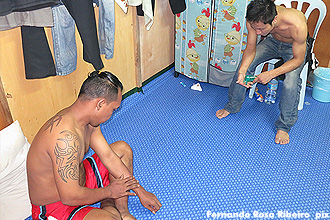
Though both Zenon and Carl were lucky, many people are not. Chris, for instance, was arrested. He took a picture of himself with cudgels on, which he shows everybody. He eventually called someone and paid the police off.
A week later, Chris finally got his UNHCR card, after living for years as an undocumented worker. Though some officers may still take the card holder to a police station, just to check whether the card is legitimate (there are many fake cards around), ultimately he cannot be kept under arrest.
 Conversely, should he be deemed to be in the country undocumented, he may then be sent to prison. In this case, UNHCR will then eventually free him and give him a card. This can take months, however.
Fear of the police is pervasive among refugee and other communities of foreign workers. Besides the threat of prison, extortion of various kinds is very common as well.
Documented workers are of course also liable to being extorted, and therefore try to avoid places in the evening where they think they may come across men purportedly to be officers (usually in twos or small groups, seldom alone). According to people I have talked to, even RM10 can be enough to bribe their way out, if there is nothing else to be had.
A young friend, Alfred, also a Chin but from the Teddim sub-group, once came to me in tears. He had not been accosted by police. Instead, he had been robbed by a group of local men as he was coming out of one of the several Myanmar shops in Bukit Bintang (a mix of restaurants, bars, and general stores, usually with a hairdresser included). It happened in the evening.
Robbed of a prized possession
It turns out that the highest incidence of such encounters is exactly in the evening, to the point that quite a few people simply avoid walking the streets or going out after dark if they can help it. Of course, drunken Chin men are a prime target. Alfred had been relieved of his newly-bought jazzy mobile. He was not drunk.
Losing a mobile is no small matter. It can take months to save the money required to buy one of the most prized models (in Bukit Bintang, salaries for refugee workers often seldom go beyond the benchmark of RM1,000-RM2,000). The mobile is not only a prized possession: it can be a vital resource to fight boredom.
For instance, when waiters or kitchen staff do not have much to do during long lulls, but all the same must stay on duty, a mobile is very useful. It is also important for accessing Facebook, a major way of keeping in touch with a vast transnational network of Chin friends and relatives.
Yet another friend, Zachariah, shows me the photographs he recently took on Dataran Merdeka on his day off with a friend. He adds that they both felt uncomfortable because of the drug addicts that roam there.
He says that the addicts may rob them. They therefore took the precaution of going there without any backpacks on. Even though Chins, in spite of being at times of short stature, are often good fighters, they cannot withstand an assault from several men at the same time, even if they are not drunk.
Typically, from what I have been told, two or even three men will immobilise the victim, whereas the other(s) will search his pockets or even his trousers, shoes, etc. David, a friend, was caught on his payday - he lost his entire hard-won salary. As refugees and other workers often do not have bank accounts, they can become easy victims, particularly towards the end of the month.
Many refugees and workers, in this way, prefer to live in densely packed neighbourhoods, such as Imbi, Pudu or Bukit Bintang, where there is a good deal of people on the streets at almost all times, and many acquaintances and friends as well. This means however that their life is often boring, as even on their day off they tend to stay very close to their workplaces and residences.
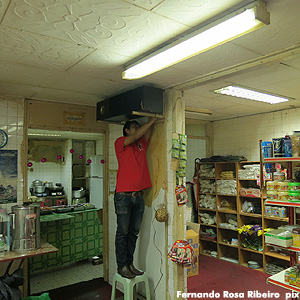 Another kind of extortion, now a covert one, is carried out by shop owners (usually small businesses) that are aware of the fact that refugees are fearful of venturing too far from home. Accordingly, some people prefer to pay higher prices rather than go out of their immediate neighbourhoods, and risk having an unpleasant encounter.
Women of course are particularly vulnerable. It is clear that even more than men they tend to circumscribe their movements as much as possible. Some seldom go out at all, particularly older women or women with small children or newborn babies.
Interestingly, refugees and workers may also attack each other. A friend in Imbi some times would ask me to accompany him to his home late at night. He was Chin and was afraid he might be attacked - and beaten - by some of his Burmese neighbours. It happened once, according to him.
As he was drunk, he could not fight back properly. Even if he could, however, he was entirely on his own.
In this case, of course, robbing the victim is not the main purpose.
Dressed like locals
I have also been told that clusters of officers will stand at well-known, much used passages and intersections, waiting to see if they can accost someone and extort him. They are usually lucky.
Funny incidents can also happen. It is not always possible to tell locals and people from Myanmar apart. One fortunate friend of mine, David, looks just like a local Chinese.
He also makes a pointing of dressing very much like a local youth would. His English is very good. Besides, he is a tall, strong-looking man. He is therefore not often bothered by anyone in his daily errands.
One friend, Nathan, has worked hard to increase his body weight and get bulging muscles. His work uniform (he is a waiter) by chance looks very much like a security personnel or even police uniform.
Also, he is given a walkie-talkie at work. He tells me he puts on an unfriendly, tough look, when walking down the streets, and makes sure he has the walkie-talkie on him, visibly hanging from his belt. Besides, he does not necessarily look like someone from Myanmar.
Many people therefore should be forgiven for believing that he is in the security business, and is in this way somebody one should not fiddle with. Nathan actually enjoys the look of slight apprehension he sometimes sees on people's faces as he struts by.
It is a pity that my two friends, David and Nathan, feel safe mostly because they do not look like they are from Myanmar, and besides give the impression of being perfectly able to defend themselves as well. One wonders what kind of society is being fostered here.
FRED ROSEN has been gallivanting around South-East Asia for quite some time now. He is interested in foreign communities in Malaysia’s large cities. He has also been writing about Malacca, both in the present and the past, as well as other ancient port cities in the Indian Ocean.


Are you sure you want to delete this comment?
This action cannot be undone.