




Penang after five years - changing and unchanged
FOCUS Over the past five years, Penang has been one of the most discussed and anticipated subjects, just as its Chief Minister Lim Guan Eng.
However, this also means exposure to more thorough inspection under the microscope...
FOCUS Over the past five years, Penang has been one of the most discussed and anticipated subjects, just as its Chief Minister Lim Guan Eng.
However, this also means exposure to more thorough inspection under the microscope. With the distinction between urban and rural regions, different levels of information dissemination and wide range of political spectrum, various groups may have very different views on how the Pakatan state government actually performs.
There are those who complain about the lack of political will to accelerate reforms and those who lament that the pace is too fast.
The change in regime didn't bring the state economic development backwards into a recession, instead it recorded the highest amount of investment, and tourism, arts and culture also flourished vibrantly, with people's expectations for the next five years to soar even higher.
The biggest challenge of the government is to translate the macro-economic growth and investment data into real high-income job opportunities, relieve the living cost pressure faced by the poor and create a liveable city.
Like it or not, the general public will be more rigorous in their assessment on whether the government has brought the changes they expected.
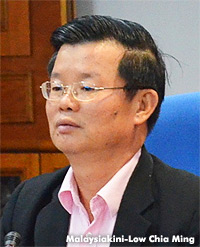 Penang State Executive Councillor for Local Government, Traffic Management and Flood Mitigation Chow Kon Yeow (
right
) said Pakatan has fulfilled its promised to become a clean, open and people-centric government.
Penang State Executive Councillor for Local Government, Traffic Management and Flood Mitigation Chow Kon Yeow (
right
) said Pakatan has fulfilled its promised to become a clean, open and people-centric government.
"Penangites realise that a government can actually be very good, close to the people and not arrogant. Sometimes, there is a fine line between currying favour with voters and taking care of them,"he told Malaysiakini during an interview.
‘New administration to clean state’s finance’
Penang Watch's coordinator Ong Boon Keong said Umno's influence over the civil servants drastically rolled back over the past five years. Counter service improved under a different regime of supervisors and is preferable to the previous culture of `longkang YBs'.
“The state finances have improved, partly due to the lack of federal funding and the space for corruption as had happened in the past had closed. There is also some will on the part of the new administration to clean the state's finance," he added.
Ong said the state government has also become more vocal to speak out on human rights and democracy compared to the previous regime.
Despite the improvements, Ong said the level of democratisation and good governance in Penang is still insufficient and limited.
"There has been no local government elections and the NGO quotas remain as appointed rather than following elections of NGO representatives.
At the 4th level of government, the Village Security and Development Committee (JKKK) and kampung chiefs, appointments have been made to the post as had been practised under the previous state government.
"There is not much opening of space for inputs from the public in many state government's areas of jurisdiction; only some academics and NGOs have been invited to sit on ‘consultative groups’, with little results to show," he added.
Democratisation is also hampered with no up-to-par assets declaration by YBs, limited or no freedom of information, small improvement in live broadcast of state assembly seating, and many state government development projects are still shrouded in secrecy, such as the undersea tunnel project, Ong said.
"Speakers' corner is a mockery of free speech, which should be permissible everywhere, not in a single spot. Appointing a member from the LGBT community into the state government admin is more symbolic, and more can be done to promote inclusive social policies," he added.
Ong pointed out that there is still no doable initiatives taken as the state government push forward democratisation as state leaders are not willing to debate with NGOs or the opposition Umno on many issues of public concern.
Commitment to public transport
During March 2013, Penang Institute has proposed The Penang Paradigm as a 10-year development plan for the Penang government with a vision for holistic progress en route to “the balanced society” towards year 2023.
With that, the Penang government aims to propel economic growth and the well being of the state by focusing on three main systemic properties, which are economic dynamism, liveability and sustainability, and social development and inclusion.
However, according to Ong, there is no vision in town planning for George Town and other parts of Penang. The state government still remains pro-developer, with approvals for developments, including hillside developments, being speeded up.
"Commitment to public transport remains dubious, for instance the undersea tunnel link to mainland has been started but there is no sign of special bus lanes, etc. In addition, there is little effort to help pedestrians, such as building connected sheltered walkways and improving the bus system," he added.
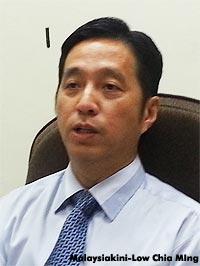 Penang Gerakan secretary Oh Tong Keong (
right
) shared a common experience with other private car drivers by getting stuck in massive congestion every weekend, especially within the town area.
Penang Gerakan secretary Oh Tong Keong (
right
) shared a common experience with other private car drivers by getting stuck in massive congestion every weekend, especially within the town area.
Even though the second Penang bridge is a federal government project under BN, Oh admitted it will definitely direct more cars to Penang island.
Oh supported the implementation of car-clamping policy and he and Ong both proposed there should be more cyclist friendly measures like car-free roads especially in the heritage core zone.
Ong reminded that cycling has been popular in Penang for a long time. However, increasing traffic with no specific or dedicated provisions for cyclists, is pushing out cyclists.
Diversifying housing programmes
Since housing demand has become a pressing issue in Penang, Oh also reminded the state government to diversify its housing programmes to fulfill the needs of different income groups.
"Other than low-cost and affordable housing, you need to build public housing to rent for the hardcore poor and also houses below RM50k for ‘rent to own’ policy to help those unable to get a bank loan to own a house in the long term."
He admitted that the previous BN government in the state has also failed to take appropriate measures in taking back low-cost units from owners who can afford to purchase other properties.
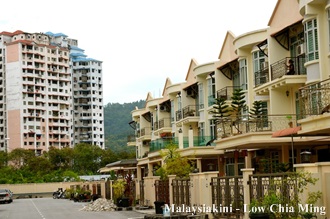 Ong said that a law stopping quick sales of low-cost houses has been enacted, but is not enforced. It is only fair that this is done and not credited as ‘new ideas’. Even on opening up public spaces, it should have been the case but this was suppressed under the previous regime.
While many people think that housing issue will be the number one challenge for Pakatan in Penang, Chow optimistically believed that Pakatan can deliver to the people by implementing new measures and building more houses in the next five years.
Ong said there are many other ways the state government can make Penang a better city to live in if the state government spend more time to establish a better mechanism for the public to provide inputs.
"The state government can give a prize for the best policy recommendation for every year and implement the best ideas.
"We need a comprehensive recycling program for Penang that can reduce waste and make money. We also need special bus lanes.
“The state government also needs to consider establishing an online Penang TV channel to showcase how a free media can function to change people's mind," Ong added.
Check-and-balance system
Chow agreed that the government needs to conduct more consultation to engage the people before making any decision, but admitted it is not easy to solve their livelihood issues in the short term as they would need a spur and constant monitor.
 "We don't have proper guideline and planning in various aspects of the local council. My impression is that my predecessor didn't do his job. Anyway, we are now trying to clean up everything like solving the problem of illegal telco tower, advertising billboards, hawkers, conversion of land use and licensing matters."
"If you want to create a rule-base society, you need to dare to do so. We need to cultivate the culture of accountability and let the civil servant understand that if you don't do your job properly, people will expose and criticise you on that."
Although a check-and-balance system is vital for democracy works, Ong said that opposition parties, who are mainly previous ruling parties, seem not to be showing much good performance given their experiences in running the state government.
"Many seem to be more engrossed in internal party struggles rather than monitoring the state government in policy areas.
"NGOs have not been very active in monitoring the state government due to various reasons. The heads of many NGOs have been absorbed into the ruling parties as staff members or into the state government, or sit on a few ‘consultative groups’.
"It will take some time for a new batch of NGOs to come out and become more effective to scrutinise the state government," Ong added.
Oh explained that BN has been ridiculed and insulted by Pakatan supporters when its representatives are playing their role in Penang, until they sometimes even decided not to intervene in certain cases, so that the complainants would not be seen as being affiliated to them and getting into trouble.
Short-term populist approach
Chow said DAP was under the cosh for so many years and wouldn’t oppress its political rival once in power. But he did not deny that the society, especially the Chinese community, is pretty much polarise in terms of their political stand.
Regarding the challenges for the next five years, Ong said that the state government will be running out of time if it is still unable to deliver some big items of reforms, such as a comprehensive recycling program or public transport reform, within the first half of its current term.
"For the opposition parties, if they don't transform their rejected racial politics, they will also face the outcome of being replaced by younger challengers to the state government.
"NGOs need to quickly reestablish their independence from the state government, or else it will take a long time for them to play much checking role on the state government, thus letting more mistakes and excesses to happen," he said.
Pakatan also realised the short-term populist approach does not works in the long run, Chow said. A government cannot just respond to a situation and needs to formulate a longer solution for two terms or more.
"Clean governance is still relevant. We have to consolidate and can't simply mark a full stop after five years. The people’s livelihood issue, cost of living, inflation, liveability are our real challenge now. Other than becoming a clean government, we need to perform and achieve certain results in those areas," he added.
LOW CHIA MING is a member of the Malaysiakini team.


Are you sure you want to delete this comment?
This action cannot be undone.