




Stop the blame game, IWK tells Penang gov’t
Indah Water Konsortium (IWK) has urged all parties to stop the blame game and work together to ensuring that the pollution along the Batu Ferringhi beach does not recur.
Indah Water Konsortium (IWK) has urged all parties to stop the blame game and work together to ensure that the pollution along the Batu Ferringhi beach does not recur.
IWK senior communications manager Shahrul Nizam Sulaiman said the famous beach is a tourist attraction that should not be “jeopardised by squabbles”.
Shahrul said it was unfortunate that an incident such as this calls attention to the importance of proper sewage treatment which IWK has been doing close to 60 years, reiterating the denial that the company was responsible for the situation at the beach.
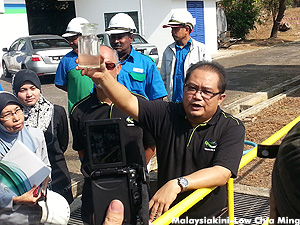 “The responsibility of IWK to treat waste water is a huge one as the company is stringently regulated by agencies entrusted by the government,” Shahrul (
right in photo
) said.
“The responsibility of IWK to treat waste water is a huge one as the company is stringently regulated by agencies entrusted by the government,” Shahrul (
right in photo
) said.
“Waste water, if not treated properly, is hazardous and thus IWK puts in place strict standard operating procedures to ensure public health and the environment is properly cared for,” Shahrul assured.
He S was referring to state Local Government, Traffic Management and Flood Mitigation committee chairperson Chow Kon Yeow, who had asserted that the discharge was the result of maintenance and flushing by IWK.
Chief Minister Lim Guan Eng has also urged IWK to be responsible for pollution, adding that he would be asking the federal government to allow states to act against culprits who “violate and pollute” the environment.
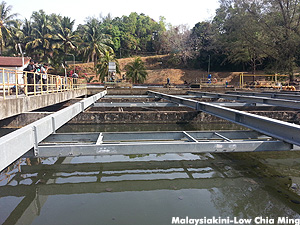 Today, the national sewerage company opened its Ferringhi treatment plant to the media, in an attempt to show that it was not the source of pollution on the beach, which grabbed media headlines on Monday.
The incident, where dark stinky water was found on a 100-metre stretch along the beach, sparked fears that the beach may be contaminated by the dangerous E. coli bacteria.
Shahrul today led a team of about 20 reporters and photographers, explaining the daily operations in the plant and how it was not possible for IWK to be responsible for the blackish water.
Particles found at beach don’t resemble sludge particles
The group was shown that the black solid particles discovered at the beach do not resemble the sludge particles from the sewage plant.
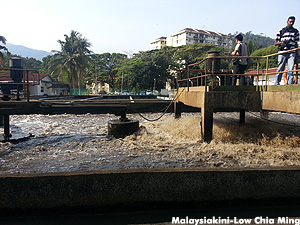 Shahrul explained that the particles from the sewage plant are hard, not sticky and muddy (cohesionless, similar as sand), solid black, settle very fast, do emit smell of sludge or waste water, and the grain size is about sand size or smaller.
Shahrul said IWK has sent sand samples to Universiti Sains Malaysia yesterday to identify the black particles in the sand.
“IWK will further trace similar particles upstream of the river (or effluent pipe and the hawker centre discharge point,” Shahrul explained.
He refuted allegations that the sewage treatment plant had been shut down, saying it is still operating as usual.
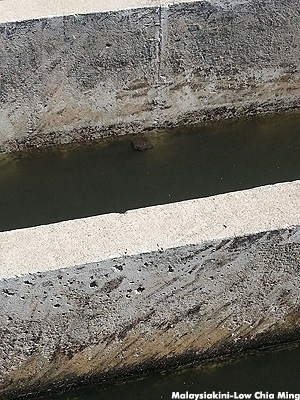 “The plant is operating as it should and its treated discharge comply with parameters set by the Environmental Quality Requirements,” said Shahrul Nizam.
Shahrul said IWK confirms that there was no abnormal discharge of sluge from the plant to the watercourse or river nearby.
“There are no piping, valves, leakages or incidence of public sewer line leakages or overflows reported in the Batu Ferringhi area since the past one week that could account for the black substance found in the water and beach,” he added.
However, he admitted a valve on the aeration tank was loose for 20 minutes, which resulted in discharge of “earthy” colored water, but continued to maintain that effluent is still safe.
“We will continue to carry out our duties and ensure requirements of the Department of Environment, particularly on final effluent discharge, are met and complied with,” Shahrul said.
“It will also cooperate with the clean-up, monitoring and participate in any discussion and efforts in providing a permanent solution in tackling beach pollution,” he added.
The Penang executive council meets today and has summoned IWK officials to attend the meeting and explain how they plan to address the issue.


Are you sure you want to delete this comment?
This action cannot be undone.