




Paul Low will stick his neck out for MACC
At least five of the country’s institutions must never be corrupt, Minister in Prime Minister's Department Paul Low said today, adding that he would risk everything to keep them clean.
At least five of the country’s institutions must never be corrupt, Minister in Prime Minister's Department Paul Low said today, adding that he would risk everything to keep them clean.
Low urged all Malaysians to rally behind him in the fight to keep the judiciary, Attorney-General’s Chambers, National Audit Department, the police force and the Malaysian Anti-Corruption Commission (MACC) free of political control.
Appointed as the country's first minister in charge of governance and transparency after the 13th general election last year, Low said safeguarding these institutions was his primary task now.
"Having been in government for some eight to nine months, thank God I've survived...
"I strongly believe, and I will put my reputation on the line and at all costs, that I will safeguard all these five institutions... especially the independence of the MACC," Low said at the MACC Academy in Kuala Lumpur.
He said this while giving an impromptu speech to a room full of officers from the police force and the MACC, knowing that they faced much scepticism about the MACC's power to fight corruption.
Proud of nation's good practice plaudits
Low, who was formerly president of Transparency International-Malaysia, said he has been “on the other side”.
But from the inside now, he said, he was proud that Malaysia earned 23 good practice plaudits, the most among any country reviewed under the United Nations Convention Against Corruption (UNCAC), in which Malaysia took part for the first time.
Under the peer-to-peer review system, crime and law enforcement in Malaysia, as well as its international cooperation standards were studied last year by Kenya and the Philippines.
Malaysia, Low said, earned the most plaudits among the countries reviewed so far, out of 167 countries that are part of the convention.
He said he got a chance to bond with the often misunderstood MACC chief Abu Kassim Mohamed ( right ) when they went together on an official trip to Panama City last November for a conference.
It was then that Low realised, he said, how much the international community valued Malaysia's reputation for fighting corruption, for he was upgraded to become a prime speaker among more than 70 speakers at the conference.
"People realise Malaysia has got something to show," Low said proudly. "While here, we are getting hammered left, right, centre by a cynical public."
'Don't view report negatively'
Abu Kassim was also at today’s event but ducked away from reporters before the press conference.
Low cited one example as to the risk he was taking for MACC, which was to make the full UNCAC report, completed in May last year, available to the public.
The report was put together by a UNCAC task force comprising the Bar Council, Foreign Affairs Ministry, Royal Malaysian Police Force, Anti-Corruption Court, Public Service Commission, Bank Negara and the Witness Protection Unit.
But he warned against the people being negative about the report.
"They can evaluate it and criticise it. I came from an NGO, I know... bang, bang, bang on the table and no constructive engagement and (the people) even ran down the credibility of an individual. But what we need is constructive criticism," Low said.
"We want a society where people who are not powerful have a chance to have their interests protected."
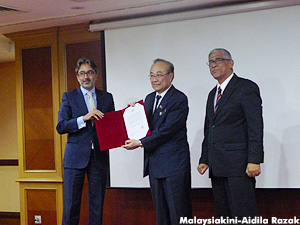 Later, at a press conference, Low said the government has also agreed to two key UNCAC recommendations.
One is to make the MACC as a separate service commission where it can choose its own staff, and the other, to enhance the position of the chief commissioner to be similar to a judge or attorney-general - where he or she cannot be removed except by an appointed tribunal.
Malaysia first joined the UNCAC in 2003 and ratified the convention in September 2008. Under the convention, countries are reviewed every five years based on chosen chapters by one or two peer countries.
The first review round lasts from 2010-2014 and Malaysia's review was completed within a year. It is now tasked to review at least three other countries.
Among the plaudits received by Malaysia was the institutionalisation of MACC, inter-agency cooperation, public-private initiatives and the Anti-Corruption Court.


Are you sure you want to delete this comment?
This action cannot be undone.