




All 1MDB has to show is mountain of debt?
COMMENT Having read the expose by The Edge Malaysia (Feb 17, 2014) on 1-MDB this morning, to say that the case of 1MDB is “troubling” is an understatement.
COMMENT Having read the expose by The Edge Malaysia (Feb 17, 2014) on 1MDB this morning, to say that the case of 1MDB is “troubling” is an understatement.
 If 1MDB is Prime Minister Najib Abdul Razak’s flagship of showcasing his success, this surely is extremely distressing. This report in The Edge focuses on the power sector and the property market.
The government-funded 1MDB was set up to drive investments in new strategic sectors with high productive outcome and impact on the economy.
But after five years, all that 1MDB is capable of showing is a mountain of debt, i.e. a multi-billion debt portfolio. It has a few signs of being able to succeed without the government giving it more sweetheart deals.
After what could be dubbed a shopping spree by 1MDB, its main challenge for is that ‘its current portfolio of power assets seems to generate minimal returns relative to costs’.
 In March 2012, IMDB acquired Tanjung Energy Holdings Sdn Bhd for RM8.5 billion from T Ananda Krishnan (
left
). In August 2012, it bought a 75% stake in Genteng Sanyen Power SB (now Kuala Langat Power Plant SB), at RM2.35 billion.
In March 2012, IMDB acquired Tanjung Energy Holdings Sdn Bhd for RM8.5 billion from T Ananda Krishnan (
left
). In August 2012, it bought a 75% stake in Genteng Sanyen Power SB (now Kuala Langat Power Plant SB), at RM2.35 billion.
However, “total cash flow generated from its plants is at RM1billion per annum. It is only adequate to service interest payment arising from bonds but not the bond in full”.
With the Energy Commission set to announce the winner of the bids for the new 2,000mW coal-fired power plant (Project 3B) and going by market talk, 1MDB is yet again expected to win over other competitors, including YTL Power International Bhd, despite a lower competing bid (25.23 sen per kWH as compared with 25.65 sen per kWh from 1MDB).
By comparing the cash flow streams of the power assets with the RM10.5 billion 1MDB paid, the implied IRR for assets acquired from Tanjung comes up to 5.2 percent, while the implied IRR for Kuala Langat fares much worse at just 0.5 percent.
In all, its entire portfolio generates a weighted average IRR of a dismal 4percent! It has clearly overpaid the acquisition of Tanjung and Kuala Langat.
Is this Najibnomics?
With that hanging on its head and the headwind could be anything but stronger, it is doesn’t take a pundit to tell the nation that the purchase of the cheap 70 acres of prime land in Jalan Tun Razak for its flagship Tun Razak Exchange (TRX) and 495 acres of the current military airport in Sungai Besi to build the ‘Bandar Malaysia’, it is obvious that to the collateral damage to the rest of the property sector of Kuala Lumpur ‘could be heavy’, as The Edge reported.
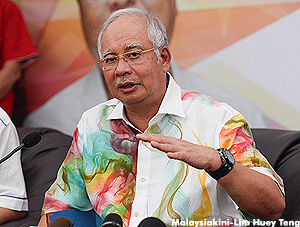 It is obvious that all efforts must be put in place to mitigate an imminent corporate disaster of ‘Najib-Style Corporate Malaysia’. Najib is acutely confused over which way he is going to take Corporate Malaysia as he is not only competing but in fact crushing them.
Is this Najibnomics? A set of economic ideas that are dependent on the realisation of speculative wealth through their monetisation in the stock market (a study now being undertaken by the Harvard Business School).
Its means including under-pricing of assets through privatisation of government land in high value areas (awarded to cronies) such as in Kuala Lumpur, and then flogging them off to property and retail investors at inflated valuation.
Najibnomics also applies the same principle to privatised infrastructural and utility projects.
Is this all that PM Najib can muster after being groomed for 30 years before helming this nation?
Time for real, real game changer, Umno! Please!
DR DZULKEFLY AHMAD is executive director of the PAS Research Centre.


Are you sure you want to delete this comment?
This action cannot be undone.