




More to depoliticising race than deleting column
COMMENT In a radical and bold statement seemingly depicting the position of a progressive government, federal minister Joseph Kurup suggested the removal of the need to state a person’s race on official forms.
There was almost immediate agreement by the National Unity Consultative Council (NUCC) deputy chairperson.
Indeed, there now appears to be quite substantial support by ordinary Malaysians for the proposal.
COMMENT In a radical and bold statement seemingly depicting the position of a progressive government, federal minister Joseph Kurup suggested the removal of the need to state a person’s race on official forms.
There was almost immediate agreement by the National Unity Consultative Council (NUCC) deputy chairperson.
Indeed, there now appears to be quite substantial support by ordinary Malaysians for the proposal.
Many feel that, at best, it is silly, a waste of time, and an invasion of privacy to state what race we are.
And, at worst, that it smacks not only of profiling, but also of some dark, underhanded, potentially discriminatory policy or strategy at work.
The wider assertion may be summarised as: ‘After 56 years of independence, we still have issues with other races and religions. Wouldn't it be great if race and religion just disappeared? Nothing would come out in the open and there will be no more conflict!’
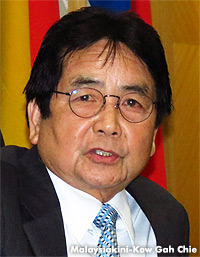 Clearly, Joseph Kurup
(right)
, Minister in the Prime Minister’s Department, has shown an admirable attitude with regard to the national dialogues he has led.
Clearly, Joseph Kurup
(right)
, Minister in the Prime Minister’s Department, has shown an admirable attitude with regard to the national dialogues he has led.
Speaking against racial divisions is no easy feat, especially for a minister who works within an obviously race-supremacist government.
Nevertheless, it does seem that the minister's proposition is over-simplification at best, and a severely problematic and flawed one at worst.
The nature of his argument is reliant on the idea that ethnicity groups and divides people into separate blocs and conflict occurs as a result.
Hence, if Malays, Chinese and Indians are one and the same - Malaysians - we would only have one interest (as opposed to three), we would no longer need to fight.
However, while his proposal to remove the need to state our race on all the forms is fine as a gesture, its wider assumptions and implications imply a compromise that Malaysians should consider seriously.
To solely attribute conflict to ethnic differences is to neglect the fact that our separate histories are also a sense of our pride, a nostalgic memory of our traditions - and most importantly, an inseparable part of our identities.
The complete removal of race, or other identifying categories then, can be construed as a dismissal of our histories (personal, family, ethnic and national).
But perhaps it may be countered that it is precisely this over-emphasis on personal identities that fuels the inter-ethnic, and inter-faith conflicts that we have.
Indeed, as appropriately questioned by that minister: "How do we build a united nation when the history is different to different people?"
After all, a Chinese might point to Ketuanan Melayu as an example of oppression, and a Malay might point to the Dong Jiao Zong and its claim as a treachery to citizenship.
Learning from Others
Jane Austen, in a beautiful quote, illustrates this issue with pride: “I could easily forgive his pride, if he had not mortified mine.”
Pride emphasises difference, and can destroy fickle relationships.
But there is a flipside to this quote , and that is the element of respect. As long as we acknowledge and respect the Other (ethnicity, gender, religion), conflict is far less likely to happen.
The superficiality of the idea of removing race from all formal documents is apparent - it is a move which will achieve nothing in educating our children to be respectful of Others. It merely sweeps the real issues under the carpet.
Worse, it can even become a tool for assimilation, at the cost of all our identities being suppressed.
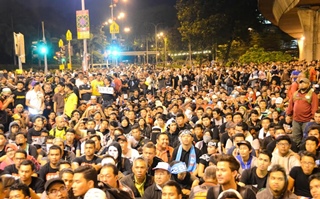 But genuine unity must not equate to assimilation or accommodation, for this implies a hierarchical structure where a certain trait is more desirable than others.
There is also one other question that we need to ask: is contestation based on difference really all that bad?
My answer to that is a clear ‘No, because it is through difference that we multiply frames of reference, learn new things about Others, which in turn can teach us something new about ourselves.
Indeed, for me as a Chinese Malaysian, there is as much (if not more) to learn from the collective histories of Malays, Indians, Kadazans, Ibans, and so many other Malaysians, as from my own lineage and ancestry.
The simple irony is that difference is a source of conflict, but it is also our only means to engage, and truly appreciate one another as fellow-Malaysians.
The real issue
The role of a true democratic nation within this framework is one which allows spoken controversies and contestations to occur. A good government (or, in this case, the Consultative Council) must ensure that action is taken against extremist factions that don't play by the rules.
The problem of ethnicity and faiths in Malaysia, as many news articles and analysis have alluded to, is mainly a problem of politicisation. The NUCC has to work on that before real change can be made.
The intertwining of politics, ethnicity and religion makes some groups more dangerous and vicious than others. The recent outbursts of Perkasa and other hate-filled organisations are illustrative.
These looming and malevolent threats put all possibility of conversation at constant risk of being hijacked.
We all know who the culprits are.
The question is whether the NUCC will be willing to go on the offensive and act against them. Or at least pressure this listless, minority government to spring to action and make this country a truly best-in-its-class democracy.
DOUGLAS TEOH is a postgraduate researcher in Media and Culture at the Centre for the Study of Communications and Culture in the University of Nottingham Malaysia Campus. He holds a first degree in psychology.


Are you sure you want to delete this comment?
This action cannot be undone.