




Foreign workers' plight exposes M'sia's underbelly
COMMENT Aung (no names in this piece are actual names) is from Myanmar. He is ethnically Burmese and has been in Malaysia with his wife for over a year now.
His contract runs for three years. They owe their employer money, as he paid all the agents' fees. The employer also holds their passports.
In case they want to have their passports, they have to pay back their boss. However, it is a good deal of money - more than RM2,000 or well over two months' worth of salary. They have a son back home who they support, in addition to a couple of adults.
Aung complains to me about the long hours - he works in a very busy, well-known tourist venue in Malacca. He sometimes starts at 8am and works until 1am. As usual, there are not enough staff...
COMMENT Aung (no names in this piece are actual names) is from Myanmar. He is ethnically Burmese and has been in Malaysia with his wife for over a year now.
His contract runs for three years. They owe their employer money, as he paid all the agents' fees. The employer also holds their passports.
In case they want to have their passports, they have to pay back their boss. However, it is a good deal of money - more than RM2,000 or well over two months' worth of salary. They have a son back home who they support, in addition to a couple of adults.
Aung complains to me about the long hours - he works in a very busy, well-known tourist venue in Malacca. He sometimes starts at 8am and works until 1am. As usual, there are not enough staff.
Everybody therefore not only works long hours, but is often also extremely busy. As a regular client, I can vouchsafe that service is bad, especially when it is busy (in fact, the service may simply break down altogether). I find it incredible that customers do not complain.
Myanmar employees at Aung's workplace also live in accommodation provided by their employers, about 15 minutes to half an hour away. They commute by bicycle - they have to buy their own.
Housing, food costs deducted from salary
A new, simple bicycle costs over RM200. Aung tells me his boss deducts both the cost of housing and the food he eats. In the end, though nominally his salary is RM1,200, he gets RM800.
In Kuala Lumpur and also elsewhere, food businesses often (but not always) provide simple fare for their workers. I check the staff food at Aung's venue, and there is never any meat, not even ikan bilis (which is part of nasi lemak on the menu but not available to workers): it is always vegetables, rice and eggs.
However, the workers have the luxury of one day off every week, unless there is a holiday and the bosses expect it to be very busy.
I have often noticed that if a day off falls on a public holiday in Malaysia, it is not necessarily given back later. It is simply lost. In many other countries, bosses would probably have been summoned to a labour court long ago.
Aung tells me he and his wife (who works at another business belonging to the same employer) wants to go back to their rural village not very far from Mandalay, where villagers plant beans.
He does not want to stay in Malaysia, but instead plans to try and go to Singapore, where salaries are much higher than in Malaysia (and working hours at times even longer and bosses reportedly even more strict). However, they cannot go as they owe money to their Malaysian emoloyer.
Drudgery of long hours
An Indonesian worker from Lombok, who has nonetheless never been there, told me that you make more money in Singapore, but you also get even more bored - boredom being a very common complaint, related to the drudgery of long hours of work in Malaysia.
According to him, Singaporeans do not even allow you to talk while you work. His name is Ahmad and he likes his boss, in spite of the fact that he works seven days a week starting early in the morning and, in the weekends, also manages a profitable parking lot for his boss until 2am.
By chance I meet his boss and his wife as they drop by in a large, very expensive-looking car (the workers later confirm to me they are very rich and own diverse businesses). They are obviously comfortable with foreigners - meaning Westerners - as they work with them; and are very chatty and informal in Malay with their Indonesian workers, to whom they offer cigarettes.
Adam used to work in a factory in Penang. As his boss held his passport, he simply left. Not a few workers in fact resort to that strategy. He fled from his factory and simply became undocumented.
He formerly worked in Singapore for a couple of years, where he learned Chinese. His English is excellent. He however disliked Singapore and therefore went back to Myanmar, and then came to Malaysia. He didn't like his factory job in Penang.
I first met him behind a counter at a convenience store next to my condo. He wanted a clerical job, but that is very hard to find in Malaysia, where Myanmar degrees are usually not recognised beyond the school level (no wonder, as education in Myanmar is simply appalling).
Later he will get a passport from his embassy, and then pay an agent a good deal of money to get a work visa stating that he is allowed to work for the restaurant industry, even though he also dislikes this last.
He will in fact eventually marry an old childhood acquaintance of his, settled in North America, and immigrate. I helped him with part of his paperwork.
Complex labour environment
Malaysia offers therefore a very complex labour environment. Rules and regulations exist but are reportedly openly flouted, especially through bribes of various kinds.
In a way, I find this admirable and not necessarily negative. Why should someone like Adam for instance have to leave the country so as to get another visa, especially after working at a back-breaking job in a factory?
I am not denying the widespread corruption in Malaysia. Nonetheless, the flexibility also impresses me, not to mention the porous borders. For all the huge inequalities of the region, and its generally lacklustre governance, there is clearly a Southeast Asian acumen in place, and an old one at that.
The downside is the incredibly skewed, not to say weird, labour market. Malaysia behaves as a couple of much wealthier countries do, as it imports very large numbers of foreign workers (and attracts large numbers of undocumented ones as well).
Yet, many of its own citizens can only find, at best, low-paying, uninteresting jobs with no prospects (in fact, not unlike the kind of jobs foreign workers usually take).
It is therefore a far cry from the Singaporean plutocracy or the Gulf countries. In last year's general election, the opposition, rather demagogically, promised to reduce the number of foreign workers in the country. I found that proposal incredibly short-sighted. It may win votes, but it does not in least, address the roots of the problem.
Though not a rich country, Malaysia has a lot of perks in place, at least for some of its citizens. For instance, very affordable loans for houses and cars are incredibly easy to obtain for, say, Brazilian standards (to bring up a country that is comparable to Malaysia in several regards), even with near-zero collateral.
The public service is one huge employment scheme, often mired in inefficiency. There are many other handouts too.
They are not necessarily bad: I find it a major achievement that Malaysia has more or less made sure that many, if not most, of its citizens need not fear they will find themselves in the streets, unable to afford basic groceries, without health care or education for their children. This is a real, important achievement, especially but not only from a Latin American point of view.
Nonetheless, the underside is glaring: business clearly has been given a free hand at the expense of workers, regardless of whether they are local or not.
I therefore find the much cherished and overworked Malaysian distinction between locals and foreigners, plus the almost endless hair-splitting among Malaysia's own citizens according to ethnicity and religion, mostly unproductive in a Southeast Asian context.
Back-breaking work
Many people do not seem to realise this, but the worst victims of Malaysia's fondness for giving in to the needs of business are in the end Malaysians themselves.
The distinction that seems more productive here is not one between various kinds of foreigners, on the one hand, and different varieties of Malaysians, on the other, but rather one between officially-backed rent-seekers, both small and big, on the one hand, and the rest of the population, on the other, regardless of whether they are locally born or not.
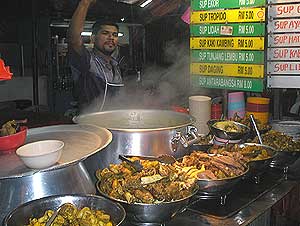 From this perspective, it is simply ridiculous that workers have to be brought in from India, for instance, for the restaurant business, when there are obviously many Malaysians in need of jobs.
But then not many Malaysians might be willing to do back-breaking work during long hours (12 hours a day) for low pay, and with no prospects of advancement, as the Indian restaurant owners' association itself candidly noted, in a public plea to the government for more workers to be brought in from India last year.
I have noticed that even the young supervisors of middle-class eateries and people working long shifts behind the counter of a convenience store drive new cars and motorcycles.
They may even own their own homes, besides taking a yearly vacation in Thailand or Indonesia with AirAsia, the famous local budget airline operating from a makeshift airport terminal. This would be unlikely to happen in Brazil, let alone in Indonesia or Thailand.
Paradoxically or not, Malaysia's economic success story (just look at Indonesia or worse, Myanmar, for a chilling but instructive contrast) has meant that most of its population is now practically condemned to living out mediocre, if often still moderately secure lives, with no prospect of change in the foreseeable future except perhaps for the worse (say when the world economic crisis finally hits the country).
This predicament - that no political party to my knowledge, whether in power or in the opposition, has bothered to address except fleetingly or demagogically - lies behind the apparent paradox of having multitudes of foreign workers even at comparatively modest businesses such as a kopitiam, while these same workers eventually may get reportedly accosted by both police and locals in need of ready cash and consumer valuables, such as mobile phones.
Until Malaysia is able and willing to resort in a more creative way to its ancient, entrenched, and effective cosmopolitanism, instead of employing the regular inanities, ultimately only useful to its rentier class, to address this predicament, the country will be known as a comparative success story - with no happy ending for its supposedly privileged foreign workers, let alone for most of its own citizens.
Part 1: We cannot be free if others are in bondage
FRED ROSEN has been gallivanting around Southeast Asia for quite some time now. He is interested in foreign communities in Malaysia's large cities. He has also been writing about Malacca, both in the present and the past, as well as other ancient port cities in the Indian Ocean.


Are you sure you want to delete this comment?
This action cannot be undone.