




Abdullah Badawi profited from Saddams oil scam: WMD report

 Several Malaysians, including one 'Abdullah Badawi', had gained illegal financial benefit from deposed Iraqi leader Saddam Hussein in an illicit deal involving the United Nations-administered oil-for-food programme some years ago, according to a report released on Wednesday.

 Several Malaysians, including one 'Abdullah Badawi', had gained illegal financial benefit from deposed Iraqi leader Saddam Hussein in an illicit deal involving the United Nations-administered oil-for-food programme some years ago, according to a report released on Wednesday.
The 918-page report , which is prepared by the United States' Iraq Survey Group (ISG), stated that this 'Abdullah Badawi' was one of hundreds of individuals, firms and governments that Saddam had bribed in an effort to undermine UN sanctions imposed against Iraq.
In the scam, Saddam gave oil vouchers to these entities in return for a minimum of 10-cent per barrel 'surcharge', which was prohibited under the programme.
Under the UN deal, the Iraqi government was allowed limited sale of its oil at below market price to pay for humanitarian goods.
In his testimony to US Congress, weapons inspector chief Charles Duelfer detailed how Saddam had devised the scheme to take advantage of the programme - by allocating oil vouchers to certain recipients, who could then sell them at huge profits.
He revealed that Saddam took advantage of the programme through the illegal 'surcharge' to generate an estimated $1.7 billion in revenue.
Pak Lah implicated?
According to the Duelfer report, 'Abdullah Badawi' was given vouchers in 2000 to sell two million barrels of Iraqi oil. It was estimated that the profit could be as high as 65 cents per barrel.
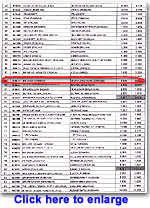 The report said that 'Abdullah Badawi' - through a company called Tradeyear - had sold 1,949,900 barrels, possibly making a tidy profit of as much as US$1.3 million.
Also named in the report is state-owned oil company Petronas and a former Malaysian ambassador.
Two other Malaysian companies and an Iraqi named Fariq Ahmad Sharif - who is described as an immigrant to Malaysia - are among those whom the report said had benefitted from the deal.
It is not clear whether the Malaysian prime minister, whose name is Abdullah Ahmad Badawi, was embroiled in the deal.
However, other notable world leaders who have been implicated by the report - former Indonesian president Megawati Sukarnoputri, French Interior Minister Charles Pasqua, former Russian presidential candidate Vladimir Zhirinovsky and former head of the UN oil-for-food programme Benon Sevan - have since denied their involvement in the racket.
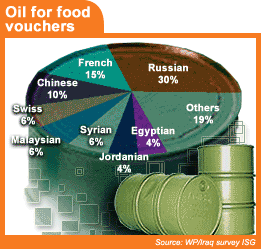 The Duelfer report said that Saddam had abused the programme to buy off influential governments since those benefitting from the scam are mostly individuals and organisations from Russia (30% of oil vouchers offered), France (15%) and China (10%) - all permanent UN Security Council members.
Malaysia was the fourth biggest recipient along with Syria and Switzerland. The three had been given six percent of the total oil vouchers on offer by Saddam.
It is believed Malaysia was targeted by the former Iraqi strongman because of the country's influence in the Muslim world.
While Malaysia became the chair of the Organisation of Islamic Countries (OIC) only last year, it has long been held with high regard by most of its 80-odd members.
The report said that companies or individuals from at least 44 countries received vouchers, including several US companies which were not named because of American 'privacy laws'.
Secret bank accounts
The oil-for-food programme was conceived in 1997 to help Iraqi population who were suffering from debilitating economic sanctions imposed on the country following the first Gulf War in 1990.
However, it had long been believed that Saddam had manipulated the programme to rake in huge profits for his government. The programme came to a halt with last year's US-led invasion.
The report, which was presented to the US Congress on Wednesday, confirmed this suspicion and revealed that Saddam had amassed billion of dollars in illegal profits.
The report explained that the most lucrative exploitation of the programme involved kickbacks from companies conducting legal sales of oil.
Buyers, who were attracted by the programme because the Iraqis were selling below market prices, had to secretly pay the 'surcharge' before the deals were sealed.
By this, both the buyers and the Iraqi government benefitted from the scam.
These buyers were then instructed to deposit the 'surcharges' in specific bank accounts held by Iraq in Jordan and Lebanon, or to deliver the cash to one of Iraq's embassies.
However, the accuracy of the report has been questioned as the details on the oil-for-food kickbacks was released to the ISG by Ahmad Chalabi - a discredited ex-Iraqi leader in exile - who seized the documents from the Iraqi oil ministry.
It is believed that the list of names were compiled from 13 documents kept by Saddam's vice-president Taha Yasin Ramadan al-Jizrawi and oil minister Amir Rashid Muhammad al-Ubaydi.
The Duelfer report also confirmed that its year-long investigation had failed to unearth any weapons of mass destruction, which had been cited by US President George W Bush as the key reason for the invasion of Iraq.


Are you sure you want to delete this comment?
This action cannot be undone.