




Court grants stay to Najib over RM2.6b suit
The High Court in Kuala Lumpur granted Umno president Najib Abdul Razak a stay today, pending the disposal of an application to strike out the suit filed by former Umno member Anina Saadudin.
Najib's lawyer Mohd Hafarizam Harun said the grounds for allowing the application were the 'special circumstances' that warranted a stay.
"One of (the grounds is) that not giving a stay would jeopardise the application to strike out," Hafarizam told reporters.
"Insofar to the question as what would be the grounds of the application to strike out, the plaintiff (Anina) lacks locus standi by virtue that she is no longer an Umno member and also not an office bearer and neither is she a public officer.
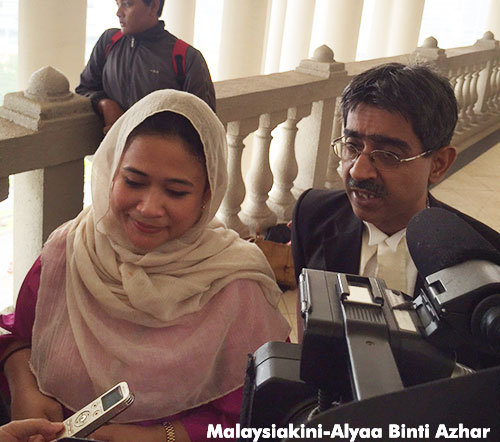 "Therefore, the suit she claims of bringing on behalf of Umno lacks in standing before the court.
"Any matters relating to political parties' decisions and affairs by virtue of Section 18C of the Societies Act cannot be challenged in court," he added.
High Court Judicial Commissioner Mohd Zaki Abdul Wahab granted the stay application in chambers today.
When asked what would be their defence if Najib were to be told to give his defence, Hafarizam said: "It's speculative. (But) the one and only defence is challenging the locus standi of this suit".
Met by reporters later, Anina said she respected the decision of the court to grant Najib a stay.
"(We'll) just move on to what's next," she said.
Repayment sought from PM
Anina's suit seeks that Najib return the balance of the RM2.6 billion that he was said to receive as a donation to Umno
She is also seeking an injunction against Umno or their agents in the disciplinary board, state liaison body, divisions and branches to be restrained from removing, suspending and taking disciplinary action on her, pending the disposal of this action.
She is also seeking a repayment amounting to US$650 million - the amount reportedly deposited by Najib into a Singapore bank - and an account of all monies that he has received in the form of donations.
Najib had admitted that the RM2.6 billion donation after the MACC made its findings as such to the public.
If a judgment on admission had been given, the matter need not be resolved through a proper trial where witnesses are called to testify.


