




Dismissed - Gerakan's bid to challenge Kelantan hudud
The Federal Court has dismissed a motion filed by Gerakan to challenge hudud that was passed by the PAS-led Kelantan legislative assembly last March.
The BN component party had sought leave (permission) to pose four constitutional questions to the apex court, which also serves as the constitutional court.
Federal Court judge Zaharah Ibrahim dismissed the leave application on grounds that the three applicants had failed to reveal how they are affected by the proposed law and to show whether they are indeed Muslims
"Hence, the motion is dismissed with no order as to costs," she said.
Justice Zaharah noted that while the applicants have indeed passed the first test, set in the Daud bin Mamat case challenging the constitutionality of the state law, they failed the second test on their legal standing to challenge the law.
 Gerakan members Tuan Mat Tuan Wil, Soh Hoon Lee and Chung Mon Sie filed a notice of motion on May 8 this year, seeking leave from the Federal Court to challenge the constitutionality of the Kelantan Syariah Criminal Code 11 1993 (Amendment 2015) Enactment.
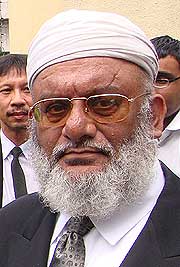
The trio were represented by former Federal Court judge Gopal Sri Ram, Harpal Singh and Andy Yong while senior lawyer Sulaiman Abdullah (photo) acted for the Kelantan government along with PAS secretary-general Takiyuddin Hassan and Kelantan state legal advisor Shahidani Abdul Aziz.
They named the Kelantan government as respondent where they claimed the Kelantan legislative assembly does not have the power to make laws penalising criminal acts that are punishable under federal law namely the Penal Code.
They claimed that the state legislative assembly’s approval for the amendments to the Penal Code was invalid and void as it was not in line with the Federal Constitution.
Syariah criminal code already gazetted
The Kelantan Syariah Criminal Code II Enactment was passed by the Kelantan state legislature on March 19 this year.
It was assented to by Kelantan ruler Sultan Muhammad V on April 24 and gazetted as law on Aug 24 this year.
Despite the law being passed, all depended on the challenge filed by four others namely Mansoor Saat, Azira Aziz, Hasbeemaputra Abu Bakar and Hazwany Jamaluddin against a Private Member's Bill to be tabled by PAS president Abdul Hadi Awang in Parliament to amend the Syariah Criminal Jurisdiction Act 1965.
The challenge will be decided on Nov 11 by the High Court in Kuala Lumpur.
 The amendments had to be sought as the Act currently limits the punishment of syariah offences to six strokes of the rotan, three years' jail and fine of up to RM5,000. Hudud seeks to impose punishments greater than those.
This was acknowledged by Takiyuddin (photo) , also a lawyer, who said it was unlikely the Private Member's Bill would be tabled during the current parliamentary session as it would be sub judice pending the court decision.
Gerakan Youth deputy head Andy Yong said they were disappointed with today's decision where leave (permission) to hear the merits was not granted.
“It is obvious the first applicant is a Muslim and despite this not being pleaded in the affidavit, the court should go ahead and hear this case on its merits before a full bench.
“We will seek further options and directive from the three on whether to file a review,” Yong said.
Commenting on today's decision, Takiyuddin said this would end the challenge mounted by Gerakan but Sulaiman acknowledged that anyone could still challenge the hudud enactment.
“Anyone can come in and challenge the constitutionality of it,” Sulaiman said.
British case laws
In his submission today, Sulaiman said the motion was a frivolous and vexatious application as the applicants failed to show in their affidavits how they were severely affected.
Furthermore, he added, while some of the provisions in the Kelantan Syariah Criminal Code II may cover offences under Penal Code, there were other specific offences under Islam, like zina, qazaf and apostasy, that fell under the state's jurisdiction.
Sulaiman further questioned whether the three applicants had the locus standii (legal standing) to challenge the law as hudud only applied to Muslims and they had not shown that they would do or had done such offences.
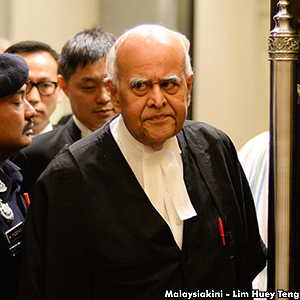 Sri Ram
(photo)
submitted that declaratory relief on a hypothetical issue (being Muslims or not and having a legal standing or not) can be sought under Article 4(3) and 4(4) of the federal constitution as this is allowed by British case laws.
Sri Ram
(photo)
submitted that declaratory relief on a hypothetical issue (being Muslims or not and having a legal standing or not) can be sought under Article 4(3) and 4(4) of the federal constitution as this is allowed by British case laws.
“This follows the constitution does not exclude the granting of such relief even if it is hypothetical,” he said, adding the first applicant was indeed a Muslim and residing in Kelantan.
He further told the court that one had to go back to the constitution on whether the Kelantan state legislative assembly had the powers to enact criminal laws which are under the jurisdiction of federal laws as in the Penal Code.


Are you sure you want to delete this comment?
This action cannot be undone.