



'Confused, muddled budget exposing country to danger'
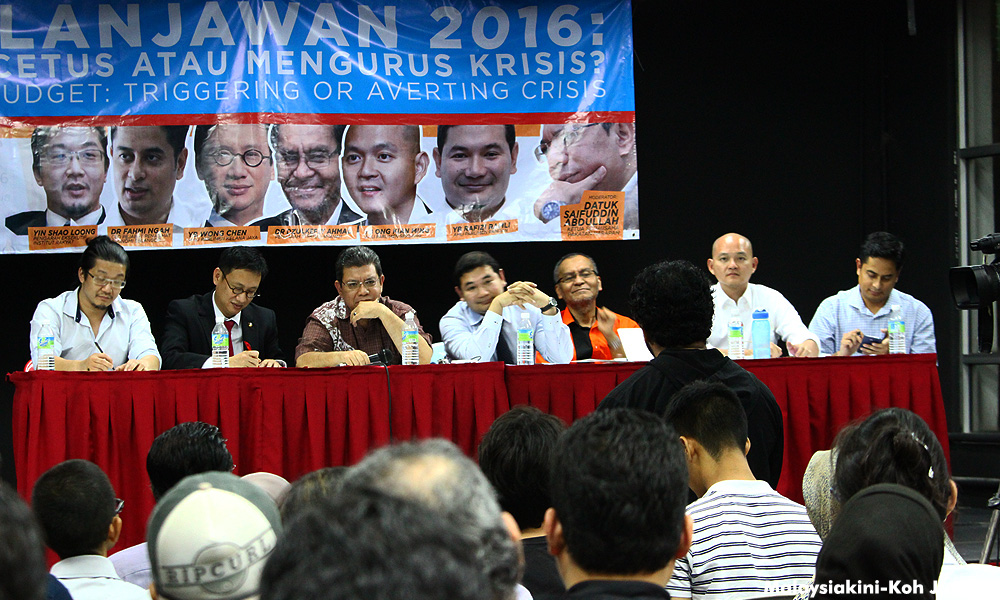
Several speakers at the Pakatan Harapan forum on the federal government's Budget 2016 last night criticised it as being ‘confused’ and ‘inconsistent’.
“When we create a budget, there must be a clear objective […] when I look at the budget, I fail to see the basis for it. What is the reason we spend and spend that much on certain items?
Several speakers at the Pakatan Harapan forum on the federal government's Budget 2016 last night criticised it as being ‘confused’ and ‘inconsistent’.
“When we create a budget, there must be a clear objective … when I look at the budget, I fail to see the basis for it. What is the reason we spend and spend that much on certain items?
“It is as though it is an election year. It is very populist,” said PKR trade and investment bureau director Fahmi Ngah.
Serdang MP Ong Kian Ming said that since Prime Minister Najib Abdul Razak had acknowledged that Malaysia is facing an economic crisis, the government budget must reflect this as well.
“When there is a possibility of this (economic crisis) happening, policies that are used to tackle this problem must be consistent.
“In our view at Pakatan Harapan, we do not need to cut the overall budget but we should cut where there are ‘leakages’ and increase aid to those who need it,” he told the forum in Kelana Jaya, Selangor last night.
 As examples of the government’s inconsistency, Ong
(photo)
said the Prime Minister’s Department is given an
increased allocation
from RM19 billion to RM20 billion, even as the allocations for most ministries are being slashed.
As examples of the government’s inconsistency, Ong
(photo)
said the Prime Minister’s Department is given an
increased allocation
from RM19 billion to RM20 billion, even as the allocations for most ministries are being slashed.
In addition, the government is removing RM10.1 billion in subsidies while collecting an additional RM4.5 billion with the Goods and Services Tax (GST) next year (compared to GST and SST collections this year).
However, it only increased BR1M payments by RM1 billion, from RM4.9 billion to RM5.9 billion.
On the other hand, toll concessionaires are getting an increase in compensation payments from the government by over RM100 million, despite the recent toll hike.
“There is a disconnect between what we say and what we do … this is what we call a budget that is confused and muddled.
“What is the outcome (in the outcome-based budgeting) that they want to achieve?” Amanah central committee member Dzulkefly Ahmad asked.
Economic reality
Pandan MP Mohd Rafizi Ramli (photo) said the process of formulating a budget is actually not too complicated.
 The process starts with identifying the problems that the budget should solve, and then finding the fiscal and monetary policies to tackle them.
“For us to judge this year’s budget, which, in my opinion, is the worst budget I’ve ever seen from a BN government, we need to start by understanding the economic realities of the Malaysian people.
“Only after we have understood the economic reality, can we then judge whether or not this budget has any relevance whatsoever to common Malaysians,” he said.
Rafizi quoted a report by last year which said that Malaysia has among the worst income inequalities in the region since 1990 and growths in wages have not kept pace with growth in productivity.
The savings of Malaysians are also among the lowest according to the report, with 53 percent of Malaysian households not having any savings at all even though they may have jobs. This is due to low wages and the high cost of living.
“This is the most important economic diagnosis that any responsible finance minister must have in mind, first and foremost …
“That’s why Pakatan Harapan has repeatedly said that the rakyat is currently facing daily economic pressures and the amount that you can push them is very limited.
“They hardly have anything left after paying for their rent, their food, their transport.
“That’s why when the government implemented GST, although it is said to cost only RM200 or RM300 a month, that can reduce a family from having disposable income to becoming poor immediately because that is the only space they have,” he said.
Printing more money
Speaking to reporters after the forum, MP Wong Chen said the government needed to “really consolidate” its financial position.
He pointed out that US quantitative easing (QE) measures since 2008 had created economic conditions that no one has seen before and no one knew what to expect.
He said in order to have a fighting chance against whatever that might come next, the government needed to save some money so that it could be used to stimulate the economy.
“The best you can do is to create (investor) confidence. Close down 1MDB and make sure the prime minister resigns as finance minister because that’s just basic governance.
 “Then you have to build your fundamental economics better. That means the government must try to accumulate some money in case it needs to pump-prime the economy in 2016 or 2017.
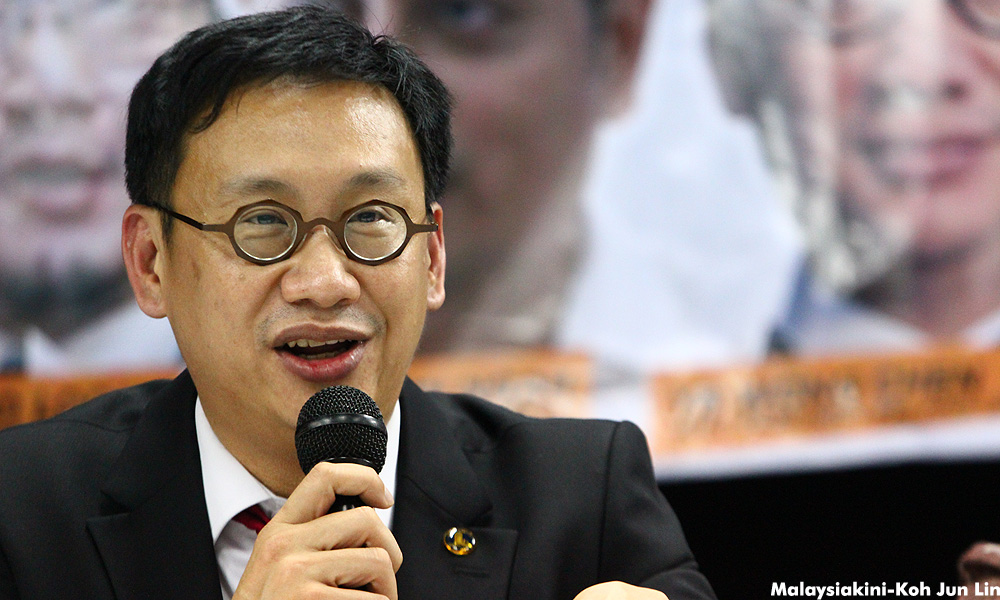
“But you need to really consolidate your positions now,” Wong (photo) said.
Quantitative easing, in this context, refers to the US Federal Reserve's move to increase the US money supply in response to the country’s subprime mortgage crisis. It is sometimes colloquially called 'printing more money'.
Wong said US banks were supposed to use the money to help revitalise the US economy but because of the lack of conditions imposed, the money was used to give low-interest loans to the ‘super-rich’ which used them for investments all around the world.
“All that money came here and it left. These were ‘hot money’ … the danger that we face is completely different. QE has opened up a whole branch of economics that nobody really knows,” he said.
Despite government assurances that there is little risk of another Asian Financial Crisis as in 1997, Wong said such a crisis remained possible albeit for different reasons.
Back then, Wong said the ringgit’s value went down at a time when corporations were saddled with debts used to invest in the stock market.
Assets parked overseas
Today, the ringgit’s value is down too but this time the people are saddled with household debt and the government has high levels of debt too.
In addition, commodity prices have slumped too, which is a fundamental threat to Malaysia’s economy.
“If you borrow a lot and you have a borrowing problem, then your fiscal space to defend anything, any crisis, whether it is internal or external, becomes weakened.
“Your banks may be well-stocked with money but if they (investors) start throwing the bonds, which are outside the banks' purview, it would drop the ringgit.
“If the ringgit drops, then we would have a problem in the real economy,” he said.
 He suggested that what may trigger a crisis would be a mishandling of the 1MDB scandal which would signal to investors that the government with is high debt is not a responsible in managing its companies.
This would then cause investors to dump their investments in Malaysia in droves.
“When the market believes that it is bad, behavioural economics takes over and then God knows what would happen.
“What we know is that all the rich tycoons here in Kuala Lumpur have already parked their assets (outside the country) back in December last year,” he said.


Are you sure you want to delete this comment?
This action cannot be undone.