




AI: Public awareness needed on Aceh
Public awareness and actions are necessary in addressing the escalating human rights situation in the war-torn Indonesian province of Aceh, said Amnesty International (AI) Malaysia's director Julian Jayaseela.
Public awareness and actions are necessary in addressing the escalating human rights situation in the war-torn Indonesian province of Aceh, said Amnesty International (AI) Malaysia's director Julian Jayaseela.
"The reason why we're here tonight is that there's a strong need to respond to the human rights violations that are occurring in Aceh and in order to do that we need to better understand the issue, the people and the culture," he added at AI's 'Aceh Night' bash at its office in Selangor last night.
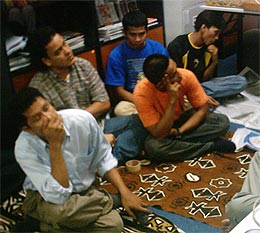 He described the event as an opportunity for Malaysians to learn about the Acehnese, their culture and their hardships, in a bid to eliminate discrimination towards the community, both in their homeland and those seeking refuge here.
A small group of 30 Malaysians and Acehnese - refugees with the United Nations High Commissioner for Refugees (UNHCR) - were treated to authentic Acehnese cuisine and music while being 'exposed' to details of injustices occurring in the province formally known as Nanggroe Aceh Darulssalam.
A documentary revealed how civilians in the land are subjected to killings, torture, harassment, rape, forced prostitution, hunger and an arbitrary judicial system, while the Indonesian military and the 'Free Aceh Movement' armed freedom-fighters or Gerakan Aceh Medeka (GAM) continued their armed conflict.
The current conflict dates back to 1976 when pro-independence movement, GAM, unilaterally declared independence. The insurgence was promptly crushed by the Indonesian government.
Since then, the Indonesian military and GAM's forces have been locked in a bitter struggle, with both sides accusing each other of human rights violations.
No access
Aceh, which is currently under civil emergency, had six months ago been a land shrouded under martial law. It is virtually inaccessible to humanitarian and human rights organisations as well as the international media.
"Amnesty is being denied access into Indonesia, let alone Aceh," said AI Malaysia's campaign coordinator Josef Roy.
He added that human rights violations continue to occur with impunity while the land is closed to the international community.
A participant at the event, who heads an international humanitarian and medical organisation based in Jakarta, invigorated the night's discussions by revealing that the new government had recently asked for a meeting with UN agencies and international NGOs.
Indonesian welcomed its new president Susilo Bambang Yudhoyono last month after the term of former president Megawati Sukarnoputri, in which he was security minister. During his tenure, peace-talks failed and massive military operations in Aceh were renewed.
In view of this, participants at the discussion last night were not convinced that the situation will change under the new leadership.
"Currently, only selected world health authorities are allowed into Aceh and even then stringent bureaucratic procedures have to be passed and that limits the number of organisations getting in," said the participant, who wished to remain anonymous.
 She added that when organisations do eventually get into Aceh, it is always under military escort.
Apart from UN agencies, local officers from the International Committee of the Red Cross (ICRC) are allowed to administer humanitarian aid to civilians in Aceh.
Fleeing to Malaysia
Many of those fleeing the persecution and cruelty in Aceh, which has a population of 4.2 million, often end up in Malaysia.
According to the United Nations High Commissioner for Refugees (UNHCR) office in Kuala Lumpur, there are currently over 10,000 registered Acehnese asylum seekers in Malaysia.
Another highlight of yesterday's event, was the rendering of an Acehnese song by a representative of the community regarding the struggle and suffering faced by the civil society as a result of the conflict and martial law.
Meanwhile, activist and refugee worker Alice Nah told the crowd that efforts such as charitable aids, letter-writing lobby work and voluntarism in mobile clinics are some of the small ways in which Malaysians can get involved.


Are you sure you want to delete this comment?
This action cannot be undone.