



Maqasid syariah - game changer for a new opposition?
COMMENT | Most non-Muslims probably do not notice that three events themed ‘maqasid syariah’ are being organised in a span of eight days, from 24th to 31st of October, let alone appreciate their significance.
The term ‘maqasid syariah’ however may potentially be the game changer for the opposition parties to forge an ideologically more in-sync coalition of governance, rather than another coalition of convenience to win elections.
Why did past opposition coalitions fail?
COMMENT | Most non-Muslims probably do not notice that three events themed ‘maqasid syariah’ are being organised in a span of eight days, from Oct 24 to 31, let alone appreciate their significance.
The term ‘ maqasid syariah ’, however, may potentially be the game changer for the opposition parties to forge an ideologically more in-sync coalition of governance, rather than another coalition of convenience to win elections.
Why did past opposition coalitions fail?
From the 2-in-1 formation of Gagasan Rakyat-Angkatan Perpaduan Ummah led by Tengku Razaleigh Hamzah, Barisan Alternatif led by Anwar Ibrahim in jail, to Pakatan Rakyat led by Anwar Ibrahim as a free man, Malaysia's opposition coalitions had failed thrice in two aspects.
First, except for the 1999 election, the opposition has failed to convince the majority of the Malays that the end of Umno - which would likely bring about the end of the New Economic Policy (NEP) paradigm - is in their interest.
The hesitation of Malays in supporting change has denied the opposition coalition power by denying them previously a majority in votes and by 2013, a majority in seats. And without power as the glue, coalition members are prone to pursue their own interests and strain their relations with allies.
Second, they always failed to hold - if there was one - the coalition's consensual position on Islamisation.
In all three episodes of coalition disintegration, PAS would pursue Islamisation in the states they govern - such as syariah criminal law (hudud and qisas) in Kelantan in 1993 and 2015, and the proposed kharraj (land tax on non-Muslims) in Terengganu in 2001 - and DAP would subsequently walk away.
If these two issues are not addressed, one should not be surprised if the fourth opposition coalition fails again to win federal power or disintegrates soon after, should it succeed.
Daulah Islamiyah
Put in the historical context, PAS' persistence in constructing an Islamic state or implementing syariah criminal law was a legacy of the Muslims’ reaction to Western colonisation.
In 1924, the Ottoman Caliphate - the fifth and the last - officially ended. The empire's dismemberment, however, had happened earlier in the First World War, with its territories transformed into Muslim nation-states, Christian nation-states, and Muslim colonies of Western power.
The shock, however, went beyond the former Ottoman lands. With the abolition of the Caliphate, the Muslims lost the symbol of their political unity.
For some Muslims, most notably Mustapha Kemal Ataturk of Turkey, and to a lesser extent, Sultan Abu Bakar of Johor, Muslims must emulate the West to survive the colonial power’s encroachment.
For some others, Muslims' weaknesses lie in abandoning their own spiritual and cultural roots.
Returning to the fundamentals is both the end and the means. The revival of Muslims lies in the creation of Islamic states ( Daulah Islamiyah ) that would be pure and based on a textual interpretation of Quran and sunnah .
In its most radical version, there should be only one Islamic state under a caliph. All Muslim nation-states should be dissolved and merge under a single caliphate, a view shared by the Islamic State militants and also non-militant groups like Hizbut Tahrir.
Amanat Hadi
In Malaysia, such restorationism is best captured by the ‘amanat Hadi’ (Hadi's message) in 1981, which said: "We fight BN not because they have been long in power, but because they preserve the colonialist constitution, the infidels' laws and the pre-Islamic rules."
From this perspective, like other post-colonial states, Malaysia is actually ‘illegitimate’. The secular polity needs to be replaced by an Islamic state .
At the very least, if the entire nation-state cannot be Islamised, at least Muslims should live under syariah laws - a Muslim core-state - within the larger and plural nation-state, if you like.
The commonly-used term ‘hudud law’ is most misleading as ‘hudud’ is actually the label of a class of punishments - which most Muslims believe to be divinely imposed - not a law.
The Syariah Criminal Enactments in Kelantan and Terengganu did not just introduce the ‘hudud punishments’ on crimes like theft, robbery, sexual misconduct, and blasphemy.
The codes also provide for qisas (retaliatory) and takzir (discretionary) punishments for murder and bodily harm, which are covered by the Penal Code.
More importantly, there is an Islamic alternative to the Criminal Procedure Code. After all, the idea is to free Muslims from the laws left behind by the colonialists.
This counter-vision of nationhood electrified the spirit of PAS members, who were much demoralised by the loss of Kelantan to Umno in 1978 and later, the Malay party's recruitment of Anwar Ibrahim in 1982.
Through amanat Hadi, PAS members found a strong sense of purpose and identity, leading some of them to denounce Umno as kafir (infidel), with families and communities split along partisan line.
As Anwar steered Umno’s Islamisation efforts into building the International Islamic University and Islamic banking, Islamic state and syariah criminal law became PAS' defining goals in Islamisation.
While PAS tried to move aggressively to the centre after 1998 and 2007, the alternative nation-of-intent painted by amanat Hadi was never challenged by the ‘mainstreamers’ or pragmatists in PAS.
When Kelantan PAS collaborated with Umno to implement the Syariah Criminal Code last year, the pragmatists found themselves caught in between.
Externally, they tried defending Kelantan on the grounds that it was a democratic decision, knowing well such defence was futile.
Internally, they only dared to argue against Kelantan's move on the ground of priority but not challenge the paradigm of amanat Hadi.
However, avoiding the ideological battle failed to stop the game of syariah expansion or save the pragmatists from annihilation in party election.
The game changer?
If the opposition parties want to stand a chance in dislodging BN, what they need the most is not a straight-fight arrangement, but an ideological reconciliation on the old legacy of amanat Hadi.
Islamist voters will not abandon the syariah project and secularist voters will not abandon the secular federation formed in 1963. So, how can Islamists and secularists form a genuine coalition? Can syariah and constitutionalism co-exist?
This is why maqasid syariah may potentially be a game changer.
Maqasid is actually the plural form of Arabic word maksud, long borrowed by the Malay language to indicate meaning or purpose.
maqasid syariah hence means the purposes of syariah. The classical interpretation refers to the protection of faith, life, reason, property, lineage, and prosperity.
Contemporary Muslim scholars like Al-Qaradawi, however, extend it to cover social welfare and support, freedom, human dignity, and human fraternity. Maszlee Malik of the International Islamic University subscribes to the school that interprets maqasid syariah as ‘the pursuit of human well-being’.
Based on a consequential paradigm, the emphasis of maqasid syariah means the de-emphasis of form.
As the attainment of maqasid syariah may be done through secular laws, hence, there is no need to build an elaborate parallel legal system for Muslims.
Lessons from Tunisia
Here, Tunisia may serve as a good reference point for Malaysia.
Last January, under the government of Islamist party Ennadha, the Tunisian Parliament passed a secular constitution that affirms the country as a ‘civil state’.
In 2012, Rachid Ghannouchi, president and founder of Ennahda, defended the government decision of not implementing syariah rule, because '90 percent of Tunisia’s existing legislation was already in line with the precepts of Islamic law'.
While many in Malaysia believe that all Muslims must support syariah law, Ghannouchi proved that even an Islamist can support secularism.
More interestingly, with a 98 percent Muslim population, Tunisia's choice of secularism is in no way a concession to the non-Muslims, a misperception that turned off Muslim nationalists.
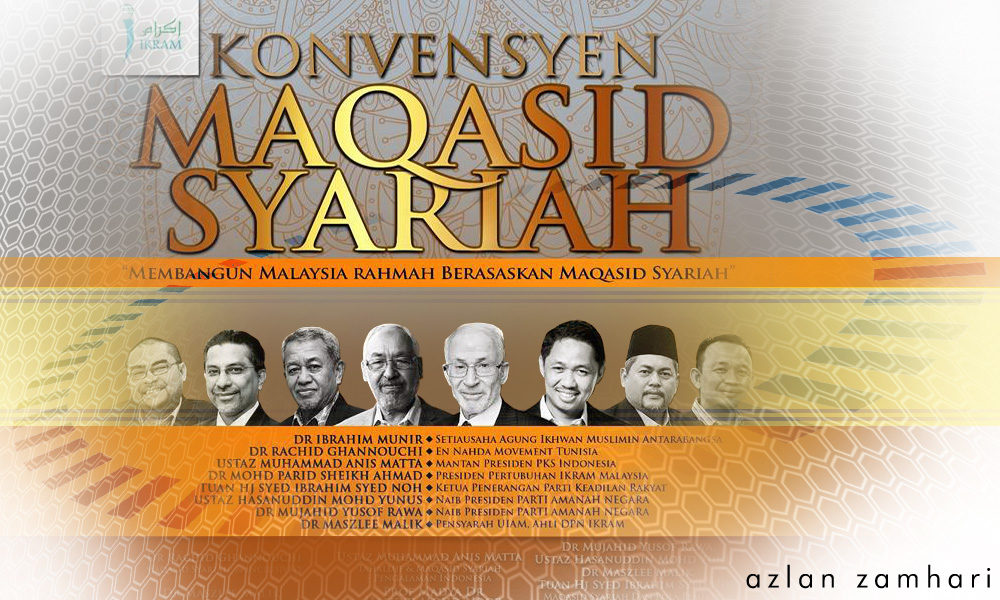
The two events on maqasid syariah last weekend were organised by Ikram, an influential Islamist professional group that has thrown its weight behind Amanah.
The Sunday event featured Amanah leaders like Dzulkefly Ahmad, Mujahid Yusuf Rawa, and ustaz Hasannuddin Mohd Yunus (who resigned as Ikram's deputy president to be Amanah's vice-president).
Not surprisingly, Ikram also invited Ghannouchi, who however could only deliver a pre-recorded speech after an unexpected change of schedule due to events in Tunisia.
Is Amanah now ready to lead the Islamist constituency to leave amanat Hadi behind and embrace maqasid syariah ? Are we seeing swallows that precede the spring?
Organised by Penang Institute and G25, a public forum themed ‘ maqasid syariah in a Constitutional Democracy ' in Bayan Lepas this Saturday, may be an event to watch for those who care about opposition coalition-building.
This forum, which requires registration , features Dzulkefly Ahmad as the final discussant.
WONG CHIN HUAT earned his PhD on the electoral system and party system in West Malaysia from the University of Essex. He is a fellow at the Penang Institute, and a resource person for electoral reform lobby, Bersih.


Are you sure you want to delete this comment?
This action cannot be undone.