




Q&A: Quran is an article of faith, but not Islamic state
'Although I don't believe that the Islamic state, as it is, is an article of faith, but the Quran is an article of faith!' says Anwar Ibrahim. He tells malaysiakini his dilemma on the issue of Islamic state in the second of a three-part exclusive interview.
'Although I don't believe that the Islamic state, as it is, is an article of faith, but the Quran is an article of faith!' says Anwar Ibrahim. He tells malaysiakini his dilemma on the issue of Islamic state in the second of a three-part exclusive interview.
There is a lot of hopes that you could help DAP and PAS overcome their differences on certain contentious issues such as the Islamic state. How do you plan to do it?
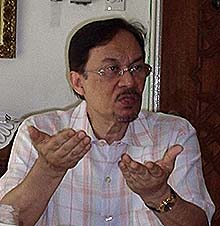 I am so exhausted talking on the issue (of Islamic state) [laughs] but I told Opposition Leader Lim Kit Siang that contrary to some of his perception and that of the general public, my discussions with PAS leaders Ustaz (Abdul) Hadi (Awang) and Ustaz Haron Din have been positive.
I was very frank with them. I asked them, 'Do you seriously want me to assist and they said 'yes'.' I asked them, 'Do you believe and are you convinced that you need a cohesive opposition and they said 'yes'. So I told them, we would have to work on the parameter.
Are there any plans to bring the two parties together for a meeting?
I think that will come at a later stage when some of the contentious issues are resolved. The general view is, of course, that PAS is not willing to concede on the major points and contentious issues like Islamic state. I don't believe that is correct. But I am not saying it's easy.
I think (PAS) party leaders feel that they shouldn't be given an ultimatum because this is an issue they have been talking about for the past 50 years. My argument has always been that because of the media, and the way the issue was articulated by PAS, the issue had allowed or created greater uneasiness (among some Malaysians).
Whereas my view is this (Islamic state) is not a major issue. Of course, PAS and DAP would disagree with me on that. I say this is not a major issue because this is the same position (PAS had taken) when they were in BN. And it never became an issue then.
If you read some of the speeches of PAS presidents when they were still in BN, they said, ' Kita akan bina negara Islam... ' (we will form an Islamic state) and they would go on and on. The rhetoric on the issue was since then. But it was not attacked by the media. Even the DAP then did not hang it up as a major issue. But now, of course, it is different.
I am not saying that this is not an issue, but I feel substantively and factually it (should not) be a contentious issue. Politics is, after all, an issue of perception. So I have to deal with it and it is a bit difficult. I can tell them that when PAS was in BN, it said the same thing but the BN policy remain the same. What makes people think that if they are in BA together with DAP, the policies cannot be the same.
And your own view on Islamic state...
If people ask me about it, I will say don't ask me about Islamic state, ask me about the BA agenda because I am committed to the BA agenda. The situation would be the same if you were to ask me on DAP policies, I am not prepared (to answer) because DAP has too many policies, and some I agree, some I don't. Same goes to PAS. But we can work on a common agenda - the BA agenda. That is what alliance is all about.
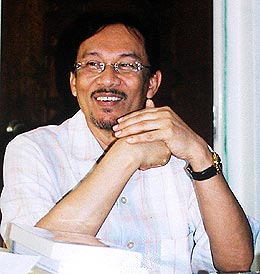 Many people have wanted to know (my stand on Islamic state). Like (what had happened during)
the dialogue I had with the Malaysian Bar
the day before. I was repeatedly asked whether I agree or disagree with Islamic state. And my answer is, 'What do you mean by Islamic state? If you mean by Islamic state, you agree with the democratic, constitutional framework, that you are just, you have the syariah but it is only in areas on personal and family matters. But if it covers or intrude into the Criminal Procedure Code, then you must have consensus (before implementing it)...'
Many people have wanted to know (my stand on Islamic state). Like (what had happened during)
the dialogue I had with the Malaysian Bar
the day before. I was repeatedly asked whether I agree or disagree with Islamic state. And my answer is, 'What do you mean by Islamic state? If you mean by Islamic state, you agree with the democratic, constitutional framework, that you are just, you have the syariah but it is only in areas on personal and family matters. But if it covers or intrude into the Criminal Procedure Code, then you must have consensus (before implementing it)...'
They then asked me, 'Do you agree with hudud?' And I said as a Muslim, I believe the Quran and therefore I believe (in hudud). But (then they asked me) do you think it can be implemented now, I said I don't think so. (They also asked me) do you think you would want to do it (in the future) and I said I am not completely convinced that I can do it, so why do you want to ask me whether I want to do it or I cannot do it. But then, they said that it was a political answer!
I also told them, 'Okay, I can make you - or some of the liberal crowd - satisfied but how do I address the rural heartlands?' You must also think of them. But to go to the mosque like in Permatang Pauh and tell them that we will continue with the agenda for reform subject to a consensus on the federal constitution and they understood - if I can do that, I think that should be considered a success.
Can PAS and DAP reconcile?
It will take time. The problem is we have no trust (with each other) which we have to cultivate. It's not easy because there are strong characters - you have (PAS president Abdul) Hadi (Awang) and (DAP leaders) Kit Siang and Karpal (Singh).
Like in the case of the (Dewan Rakyat) speaker. I made a statement disagreeing on how the matter was handled by BA and even argued with Azizah (his wife and Parti Keadilan Rakyat president) openly yesterday at a meeting with about 70-80 reformists. Of course, Azizah's argument was that they (DAP) didn't even discussed with us (to nominate Tan Seng Giaw as candidate for House Speaker). But I said just because they don't discuss with you does not mean you should support a corrupt candidate (BN's Ramli Ngah Talib)!
But I think I was a bit too rough on her yesterday [laughs]. However, I was very impressed because it was the first time that she had stood her ground and argued with me in public, which she had never done in the last quarter of a decade I've been married to her. Times have changed! [laughs].
Some political analysts argued that PAS lost badly in the elections due to its Islamic state issue and hudud policies. Do you think the party should change its focus?
The political framework was there in the 'reform agenda' in 1999. Why can't PAS work and expand on this framework? I told PAS all the ingredients in the Islamic state you want to incorporate, you can incorporate into the framework ... like human rights, dignity of men, economic justice, prevention of corruption and maksiat (social ills). But the ingredients which are difficult like hudud laws or things like that, where consensus is needed, we put hold and we can discuss. This is politics, you can't put the entire agenda into the framework.
 Similarly with the DAP. Don't expect PAS to withdraw their views on Islamic state. I don't expect them to do that and I am not advising them that they should withdraw their position. I think that would be too much because many Muslims see it as an article of faith. There is a very grey and dangerous line (on what you can accept or reject). For example, if you talk about say my replies on the issue at the meeting with the Malaysian Bar, I think some strict fundamentalists would reject me because of this grey area.
Although I don't believe that the Islamic state, as it is, is an article of faith, but the Quran is an article of faith! So how do you draw the line? But if you believe the Quran, you believe in His law. Then how do you implement the laws if you are not part of the government? So this is how politics is fused into the religion.
But if you are not able to apply three or four of these provisions, does that mean you fail as a Muslim? I said 'no' because even in your daily life you try to live up to the aspirations and the ideals but you are not able to achieve everything.
If you ask me whether I am convinced (of the Islamic laws) I said 'yes'. But if you have ask me about Islamic state, then I have to ask you whether I believe or not depends on what you mean by Islamic state. Islamic state is a term that has been so much abused. And you ask scholars, their interpretations are different. So why do you insist that we use that label?
And if I can persuade the DAP, I can say, 'Look, while this is going on, you reduce your rhetoric against (Islamic state) because this is seen by many Muslims as an anti-Islamic position.' Which is wrong, because Kit Siang said 'no' and Karpal said he (too) is not anti-Islam. But again they are experienced and senior politicians - they know politics are about perception.
There are Islam-based non-governmental organisations which claimed they are apolitical, and all they want is to preach religion. What do you think of that?
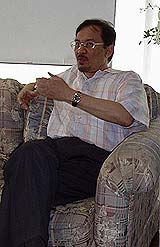 They want to find a safe avenue. I guess that is OK. But I don't think any Muslim or non-Muslim NGO can say they are apolitical. Like
malaysiakini
, for example, it can't say that it is only a media organisation and it's apolitical. Politics is part of our life. We can say that their focus would be on
dakwah
(to preach), we try to reduce our political tension, that we will not be affiliated with any political party. That's OK.
They want to find a safe avenue. I guess that is OK. But I don't think any Muslim or non-Muslim NGO can say they are apolitical. Like
malaysiakini
, for example, it can't say that it is only a media organisation and it's apolitical. Politics is part of our life. We can say that their focus would be on
dakwah
(to preach), we try to reduce our political tension, that we will not be affiliated with any political party. That's OK.
But I cannot accept the position of some old colleagues, for example in Abim (Malaysian Muslim Youth Movement), who try to impress to me that they are apolitical. I told them that it is untenable under the Islamic percepts because if you talk about ideals, you talk about a society of morally upright people - which means no corruption.
No corruption means what? It means you cannot tolerate corruption. So how do you deal with that? Through education, tarbiyyah (training) and a legal framework. How do you get the legal framework? You have to get your members of parliament to do it. If you don't want to elect an MP but you want to influence the MP, that is political. I told them that when we met the other night.
What was their reaction?
Three who had dealings with the old man (Dr Mahathir) remained silent but the young leaders seemed to agree. Things look quite promising.
Tomorrow: Are southern Thais terrorists?


Are you sure you want to delete this comment?
This action cannot be undone.