



Zahid, get it right first at the top level
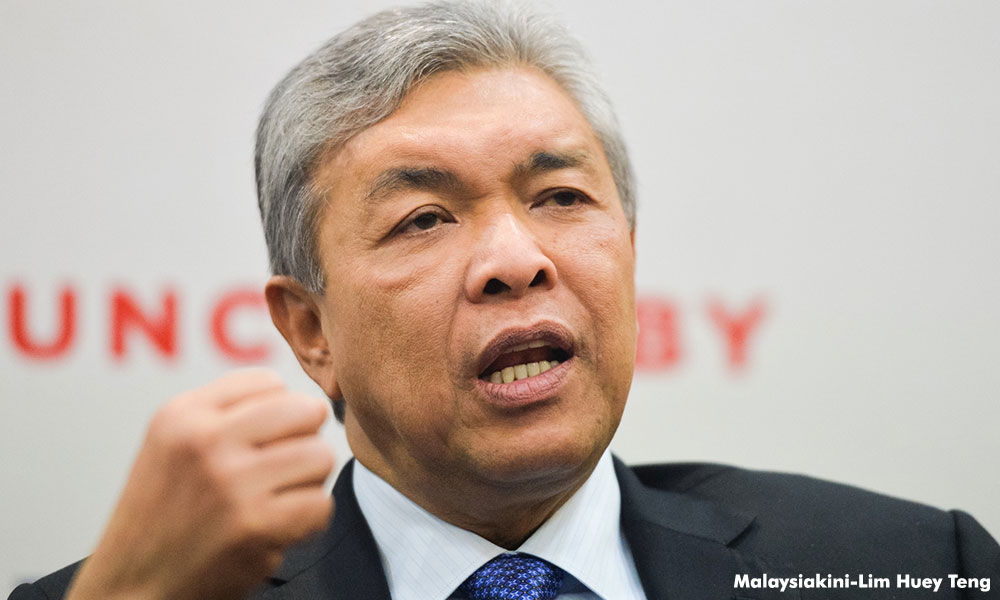
COMMENT Deputy Prime Minister and Home Minister Ahmad Zahid Hamidi hit the bull’s eye when he said he wants the police force to improve its reputation .
I am with him, to say that it is not only the police but nearly every government department needs to improve their reputation, especially those that are having elements of corruption within the system for far too long.
COMMENT Deputy Prime Minister and Home Minister Ahmad Zahid Hamidi hit the bull’s eye when he said he wants the police force to improve its reputation .
I am with him, to say that it is not only the police but nearly every government department needs to improve their reputation, especially those that are having elements of corruption within the system for far too long.
Indeed, praise to whom praise is due, credit to whom credit is due, but when ordinary people like me are saying, “Enough is enough!” how do you expect us to offer praises when people do not behave in an honourable manner?
Since I am no-nonsense person when I write, although I am gentle in person and have every good intention, allow me to elaborate. My question is how can anyone expect the lower level officers to behave, when the senior people are not always clean?
Bad reputation, whose fault?
In a recent article, I wrote about a Nepali restaurant worker who is having a good time working in Langkawi. When he was in the Klang Valley, he told me that he was often stopped by the police who openly asked for some ‘coffee money.’
In Langkawi, he said, the police are more ethical and friendly. They do not ask for bribes. “If someone commits a traffic offence, he gets the ticket and pays it at the police station. It is the end of the story!” he confided to me.
Why is it that such a foreigner can have a negative impression of the police force when he was working in the Klang Valley?
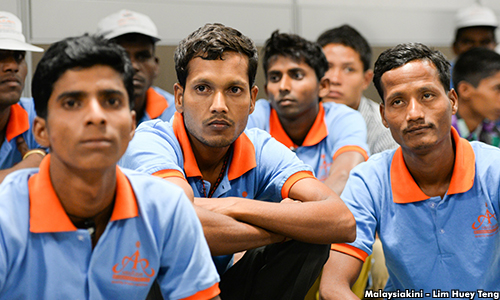 Zahid has to just send his men on the ground to make some observations why policemen are fond of setting up road blocks or stop foreigners. Instead of doing it as part of their crime prevention, the boys in blue are also telling motorists and motorcyclists that they have committed a traffic offence. Nothing wrong, but why?
Just yesterday morning, I noticed three police constables stopping a young man who appeared like an Indonesian, and he was riding on his motorbike. If it was part of crime prevention, I would give them the thumbs-up, but we all know what happen to foreigners who are being stopped by the police every day.
There was one occasion when I happened to be at a certain place and had a little time to spare. Two police constables stopped three African students to check their passports. One of them was trying to contact the Immigration Office to check the authenticity of the student visa application.
After observing that something was not right, I politely asked, “What’s wrong? Is there a language problem?” When I looked into the passport, it carried a valid sticker which said that the student’s application for his student visa was being processed.
Now, looking at it from the perspective of someone who had done international marketing to recruit foreign students, I was truly upset with the way how our constables are harassing even the students.
Because of my intervention, the students were allowed to go without being harassed further but I can vouch this is happening every day. The student later told me that his mother was so worried, when she heard that her son was being stopped by the police. He conveyed the mother’s gratitude, and I dutifully forwarded to the police chief in charge of the police station.
But how many cases can I intervene, especially since I am not the type who will put a grain into someone’s rice bowl, but the rot is what Zahid and inspector-general of police Khalid Abu Bakar have to look seriously into.
More stories to tell
A Nepali security guard told me that everything here in Malaysia is fine. The weather is fine, the food is fine, the people are friendly. The only problem is that they are not free to move around without being harassed.
If Zahid does not believe this, I will tell yet another story of two police constables who stopped me because I was kind enough to give shelter to two Indonesian workers in my old jalopy. They had completed a job, and they were waiting for their taxi. The sky was dark and they would end up soaked wet in a heavy downpour.
Under such circumstances, no one would ask if they had their work permit. Because one of them had an expired permit, the two workers were being ‘detained’ after I left the scene.
Later that night, I was told by their Indonesian boss that the police constables had taken all the cash in his workers’ pocket, leaving behind only a RM50 note for them to pay the taxi.
After nearly two weeks, and raising the matter with some senior officers, finally part of the money (RM1,050) was recovered. I only wished that the situation would improve, but a month later, some contractor workers faced the same problem where the boss had to fork out RM500 for god-knows why!
Honestly, I doubt if Zahid or Khalid are unaware of the state we have descended into.
It does not have to be anyone lodging a police report against the police themselves, as the proverbial saying goes, “We do not want to destroy their rice bowl.” The police have to set up their internal investigations and apply strict discipline to their own officers.
If Zahid and Khalid do not believe me, they can send men as runners who have to deal with police sergeants investigating into accidents.To generate an investigation report, the standard fee is RM150, which runners will pay on behalf of the mechanic workshops. This is often charged back to the owners or the insurance companies.
Still don’t believe me? I do not know what else to say. As home minister and as IGP, both have a moral duty to ensure that the force is in tip-top performance. It only takes some efforts to police the unscrupulous police officers and stop the rot from within.
Weird questions being asked
When someone contacts the police on an emergency, weird questions are being asked which take up a lot of precious time.
Imagine the policeman asking over the phone, “Is the burglar a Malay, Chinese or Indian?”. The caller, if a woman, would be shivering by the time the call gets through the 999 emergency line to the nearest police station.
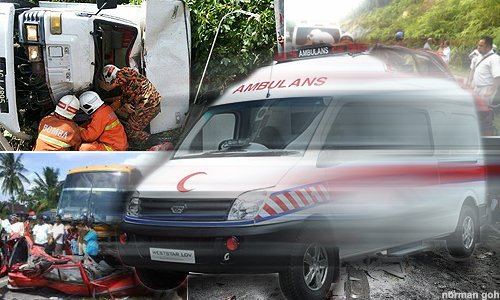 This happened more than 10 years ago. An old Malay gentleman had collapsed and passed out while walking home in the morning. He was a security guard in his sixties and had apparently developed a sudden heart attack. After contacting the ambulance, I had to call the police to help with traffic control.
The question asked was: “Is it Malay, Chinese or Indian?”
My answer to the police constable on the line was point-blank: “Encik, I am Chinese, this gentleman we are trying to help is an elderly Malay gentleman, but everyone around here are Indians, Chinese and Malays. Does that answer your question?”
It is true that this is not only happening in the police force. More than 20 years ago, I was on the North-South Expressway helping a Malay family who were travelling in two or three cars to Kuala Lumpur to watch a football match. They were from Johor.
Instead of helping, most onlookers were only interested to ask: “Is is Malay, Chinese or Indians?” And, a popular question was: “Ada orang mati?” (anyone died in the accident?), not to mention that people stopped by just to find out what happened.
No one offered help to ferry the family to the hospital. I had to double up as a ‘private ambulance’ to ferry some of the family members to Seremban Hospital. Unfortunately, one of the victims died due to brain concussion.
At around the same time, I also came across an overturned lorry near Sungai Besi. Because it took so long for the ambulance to arrive, I decided to ferry the Bangladeshi worker who was on the roadside to the hospital. Apparently, he was a lorry attendant.
On arrival at the hospital, the man died due to brain concussion. Although I do not blame the ambulance for their slow response, generally I find that weird questions being asked as simply being obnoxious. In emergency situations, why should the emergency worker be bothered with the amount of melanin on the skin?
To solve the bad reputation that the police and other government departments are facing, politicians themselves have to clean up their acts first. The top brass officers have to set up their internal teams to check on their own staff and see if they will agree with me on my personal observations as a fellow Malaysian who wants the country to become a developed nation by 2020.
We have some of the most modern facilities, but our mindset is still from the third world. This is what needs to be transformed, if we want to move forward instead of politicising race and religion.
STEPHEN NG is an ordinary citizen with an avid interest in following political developments in the country since 2008.


Are you sure you want to delete this comment?
This action cannot be undone.