




Suu Kyi's victory heralds winds of change in SEA
COMMENT The landslide victory of Aung San Suu Kyi in the recent general election in Myanmar is predictable.
For the past five decades, Myanmar has been under the rule of a corrupt military regime, after his father Aung San was assassinated by his own rival. The murdered Aung San was the founder of the modern Burmese army who negotiated Burma’s independence from the British empire in 1947.
COMMENT The landslide victory of Aung San Suu Kyi in the recent general election in Myanmar is predictable.
For the past five decades, Myanmar has been under the rule of a corrupt military regime, after his father Aung San was assassinated by his own rival. The murdered Aung San was the founder of the modern Burmese army who negotiated Burma’s independence from the British empire in 1947.
Although rich in natural resources, Myanmar has a lot to catch up with the rest of the world. It is considered one of the least connected countries in the world, where internet connectivity is slow by comparison.
Aung San Suu Kyi’s win probably has the world smiling. In fact, the international community has always been with this iconic democracy champion.
In this part of the world, she stands out as a prominent figure in very much the same manner that jailed opposition leader Anwar Ibrahim is, with a growing majority of Malaysians wanting to see the birth of a new nation.
Whether one likes it or not, the domino effect of what happened in Myanmar will surely snowball into the other nations in the region. It is just a matter of time.
A number of countries in Asean have been ruled by one party for more than half a decade, and often impoverished by either a corrupt individual leader or the entire regime.
In the case of the Philippines, the regime under president Ferdinand Marcos and his flamboyant wife, Imelda, fell when ‘People Power’ swept across the Philippines in 1986. I remember some Filipina maids were exuberant when they heard the news.
According to analysts, this was triggered by three major causes: the murder of opposition leader Benigno Aquino Jr in 1983; the corruption of the Marcos regime; and alleged fraud during the 1986 presidential snap elections. That was the Philippines.
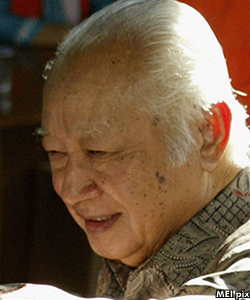 Ten years later, it was Indonesia. The ever once so powerful president of Indonesia, Suharto (
photo
), who boasted an accumulated wealth worth at least US$40 billion, was also removed during the people’s Reformasi movement in 1998.
Ten years later, it was Indonesia. The ever once so powerful president of Indonesia, Suharto (
photo
), who boasted an accumulated wealth worth at least US$40 billion, was also removed during the people’s Reformasi movement in 1998.
I suspect that former prime minister Dr Mahathir Mohamad had sensed that his wind of change was coming, too. That could be the only reason for him to relinquish his post for his more amicable deputy Abdullah Ahmad Badawi, but even after one term, the people decided that change was inevitable for the 2008 general election.
In short, it is normal for people to want change when they are dissatisfied with a ruling party which has been in power for far too long.
Even Thailand has seen several rounds of changes, with its prime ministers and the entire cabinet being changed from time to time.
No one is indispensable
Removing an entire government through the votes is not the same as toppling the government using violence or bloodshed.
There is no need to go to war or resort to the same threat as issued by former Umno leader and former Malacca chief minister Mohd Ali Rustam, in his capacity as chief of the Olympics-sanctioned National Silat Federation (Pesaka).
Or for Malaysians to threaten each other in the same manner that Mohd Ali Baharom, president of the Malay Armed Forces Veterans Association, did when he appeared in front of Low Yat Plaza and was captured on a video clip that went viral.
In Malaysia, whenever there is a need to deal with a corrupt individual or regime, it has to be done through the ballot box, with only about 30 months more to go before another general election would have to be called.
In my opinion, we have all the symptoms of another wind of change. Anwar is the icon of a jailed opposition leader. We have the unresolved 1MDB scandal which runs into the billions and where investigation appears to be getting nowhere.
We have the rights of the minorities being violated by the so-called leaders of the ruling parties. Among the Malays, we also sense a great deal of dissatisfaction with Najib Abdul Razak himself. Generally, all Malaysians are unhappy with the way how the cost of living has escalated within the past 12 months.
The Goods and Services Taxes (GST) has been oppressive for both the lower and middle-class society, despite BN lawmakers giving it the thumbs-up, while corruption appears to be a black hole that continues to grow bigger by the day.
While Umno division leaders are propping up Najib, there are signs that the grassroots themselves are raising their dissatisfaction with their own leaders.
Surely things cannot continue the way it has been. Like a woman in childbirth, I suspect deep within every Malaysian heart is the desire to see the birth of a new nation.
This time, it may be more than a political tsunami. In 2008, while the tsunami did not hit Putrajaya, parts of the peninsula, and Sabah and Sarawak, and five states fell into the laps of an ill-prepared Pakatan Rakyat.
Its victory was riding on the Anwar factor, the same as what happened in 1999 where Barisan Nasional’s majority dropped to only 56 percent.
Now, with a political earthquake, even the most interior areas of the nation may be shaken up. The people’s voices will be heard through the ballot box once again.
However, because the general elections have not always been clean and fair, there is therefore the need for the Bersih movement to push for clean and fair elections. Failure of the Election Commission to be transparent with the people will only lend more support towards the Bersih movement.
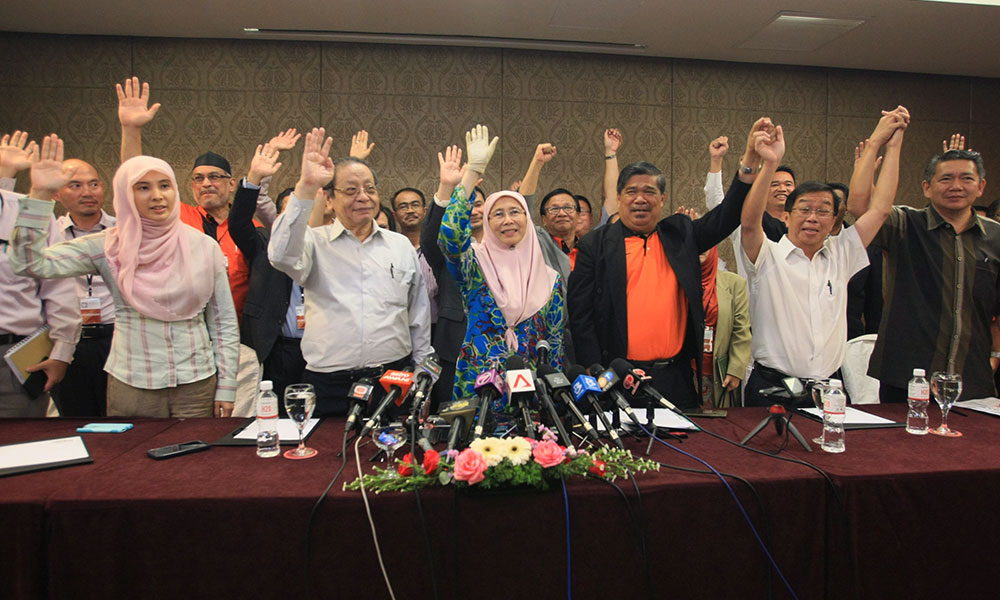 Najib, as the country’s sixth prime minister, should realise that he is not indispensable. If he continues to live in oblivion, and his men under him continue to behave in the manner that is unbecoming of senior government officials, the 14th general election may see a landslide victory for the newly-minted Pakatan Harapan.
Thereafter, justice would have to be upheld whenever it was being abused. Those who sow seeds of wickedness and injustice now will have to reap from their own actions. God is just.
Whatever a man sows, that he shall also reap. What goes around comes around.
The impending change is what Mahathir is fully aware of when he wanted Najib removed. We know that Mahathir prefers to have Barisan Nasional still in power although Najib may be gone, but even Mahathir knows that Najib cannot be removed if he decides to stay on.
As the rakyat watch the political developments, we will allow Najib to continue to ‘hang on to his last straw’, as some say. If anything, it will be the ballot box - and the people who cast their votes - that will determine the future of this nation.
If the people cannot have their vote of no-confidence this time around, they will do it in the coming general election.
STEPHEN NG is an ordinary citizen with an avid interest in following political developments in the country since 2008.


Are you sure you want to delete this comment?
This action cannot be undone.