



NGO: TPPA will increase cost of medicines, studies show
While proponents of the Trans-Pacific Partnership Agreement (TPPA) claim the agreement would not lead to an increase in the cost of medicines, the Bantah TPPA group said the claims run contrary to the findings of numerous academic studies.
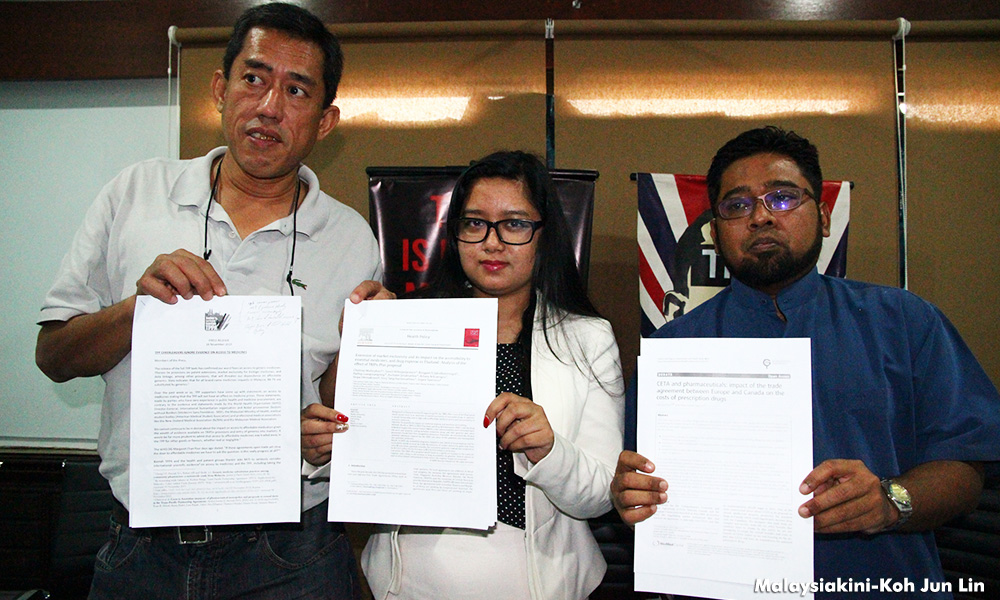
Malaysian Aids Council policy manager Fifa Rahman said that studies in Thailand, Canada, and Jordan have all found that provisions similar to those in TPPA’s intellectual property chapter lead to an increase in the cost of medicines.
“There is a lot of proof that has debunked everything that all the pro-TPPA people have said in the past week, and all of these are by medical professionals.
“Everything that they (TPPA proponents) are citing that (price of) medicine is not going up is not referring to anything that the medical professionals are saying. You’ve got to ask why are they producing misleading information. It doesn’t make sense [...]
“It’s just bewildering how they are not referring to health professionals, and there is so much evidence on medicines, and they are going out there on Twitter and in op-eds saying ‘no’,” she told a press conference in Kuala Lumpur today.
She cited a study conducted in Jordan, which found that from 1999 to 2004, the annual expenditure on medicines had gone up by 17 percent.
This followed a 2001 trade agreement with the US that increased intellectual property protection for the pharmaceutical industry.
“Delayed market entry of generics due to enhanced intellectual property protection is estimated to have cost Jordanian private consumers RM78.85 million in 2004,” the report said, after adjusting the figures to account for inflation and increased sales volume.
As for the Thai study, it is estimated that a then-proposed trade deal with the US would increase medicine expenses in the country by RM27.16 million in the first year of the deal, rising to RM22.78 billion by its tenth year.
Meanwhile in Canada, a study predicted that the Comprehensive Economic and Trade Agreement (Ceta) between Canada and the European Union would increase Canadian drug costs by 6.2 percent to 12.9 percent starting 2023.
This is due a provision in Ceta that would delay the entry of generic medicines into the market by two years.
The Jordan, Thailand, and Canada studies were respectively published in the Journal of Generic Medicines in 2012, the journal Health Policy in 2009, and the journal Globalization and Health in 2014.
Copies of the journal articles have been circulated to the press.
Exclusivity period doubts
Of TPPA’s 30 chapters, the chapter on intellectual property proved to be among the most controversial due to its impacts on drug patents and data exclusivity.
The issue has drawn concern from various health groups including the WHO, Doctors Without Borders (MSF) and the Malaysian Medical Association (MMA).
Drug patents and data exclusivity work differently but both delay the entry of cheaper generic alternatives for branded drugs into the market, which would otherwise drive prices down due to competition.
Drug patents last 20 years under current Malaysian law and under the TPPA and the clock starts from the moment the patent is granted, which could be at any time during or even after a drug’s development.
Health advocates including Bantah TPPA had raised concern that the TPPA would allow patent extensions for frivolous changes to existing drugs, although International Trade and Investment Minister Mustapa Mohamed has dismissed such concerns.
Data exclusivity lasts for five years and starts when governments grant permission for a drug to be sold which would be at the end of the drug’s development cycle.
If there are no patents in force at the time of the data exclusivity period, a generic drug manufacturer may still sell the same pharmaceutical.
In applying for government approval to do so, however, it may not use the original manufacturer’s test data to do so and will have to conduct their own tests, which will be both time-consuming and expensive.
Malaysia currently already has a five-year data exclusivity period for conventional drugs, but the TPPA would require Malaysia to also provide the same protection for a new class of drugs known as ‘biologics’ for eight years.
Alternatively, Malaysia may opt to provide only a five-year period for biologics but add other measures that would lead to an equivalent of an eight-year protection.
Meanwhile, at Bantah TPPA’s weekly press conference, Fifa chastised the Institute for Democracy and Economic Affairs (Ideas) and its CEO Wan Saiful Wan Jan for supposedly making misleading claims in a report the latter released this morning.
The report claimed that after Canada introduced an eight-year data exclusivity clause, its spending on medicines had not changed substantially and had in fact decreased.
“I spoke to (the Canadian researcher) Joel Lexchin [...] who is an expert on Canadian healthcare and he said Wan Saiful and Ideas have distorted the facts,” she said.
Fifa said she was told by Lexchin today that Canada’s healthcare costs had remained low despite the data exclusivity clause because it only came into effect this year and it will be a number of years before its effects are felt.
The same would also apply to Malaysia if it signs the TPPA.
In addition, she said she was told that there is a greater awareness about the importance of generic medicines in Canada and advocacy groups and provincial governments there have been increasingly aggressive in ensuring their availability.
Coincidentally, in Canada, a number of ‘blockbuster drugs’ were just coming off-patent and generic versions were starting to become available.
“He (Lexchin) talked about Lipitor. When it was on-patent, the province of Ontario paid C$316 million. When they went for generics, they paid C$133 million. So this is a massive reduction,” she said.
Lipitor is a popular drug for lowering cholesterol levels.
'Innovation crisis'
Lexchin is based at the University of Ontario’s School of Health Policy and Management and is also one of the authors of the study about Ceta that Fifa had cited.
Fifa also challenged claims that strong intellectual property protections were needed to encourage pharmaceutical companies to innovate and produce new drugs.
She said despite such protections being available in countries such as the US, the pharmaceutical industry there was suffering from an ‘innovation crisis’ where there was an increasing trend of making small modifications to existing drugs and passing them of as ‘novel’ products for the purposes of patent applications.
On the contrary, she said studies had found that intellectual property protections do not encourage innovation and, in some cases, appeared to have backfired.
As an example of the ‘innovation crisis’, she said the patent for the lung cancer medication Alimta had been extended by 20 years after the manufacturer changed the medicine’s product leaflet to recommend that the medication be taken together with folic acid and some vitamins.
She added there is also no evidence to support the claim that stronger intellectual property protections would encourage pharmaceutical companies to bring their products to a new market sooner, which supposedly meant that a generic version would also become available sooner.
Instead, she said the size of the market and other factors would be the main consideration of these companies.
As for Mustapa’s statement that Malaysia is extending data exclusivity protections for biologics so as to not discriminate against it, Fifa countered that there was no international legal requirement to do so.
If discrimination was indeed a concern, then Malaysia should remove the existing protections for conventional, small-molecule drugs instead.


Are you sure you want to delete this comment?
This action cannot be undone.