




UNHCR: Refugee legalisation won't lead to massive influx
The United Nations High Commissioner for Refugees (UNHCR) has rubbished claims that legalisation of refugees would lead to a massive influx of people in the country.
Its representative in Malaysia Richard Towle believes that registering refugees and allowing them to work is an “irresistible argument” as it would ultimately benefit all parties.
The United Nations High Commissioner for Refugees (UNHCR) has rubbished claims that legalisation of refugees would lead to a massive influx of people in the country.
Its representative in Malaysia, Richard Towle, believes that registering refugees and allowing them to work is an “irresistible argument” as it would ultimately benefit all parties.
“Such a scheme would be a win-win all round if the government was to give it a go.
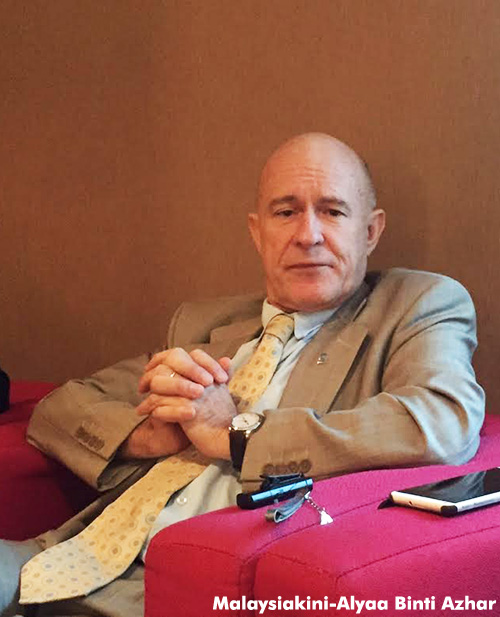 “Governments are concerned that the scheme regularising refugees would lead to massive influx of people (but) we don’t think that would be the case,” he said at a press conference in Kuala Lumpur today.
Towle ( photo ) questioned whether the country is simply going to ignore the three to four million people who are already here just out of fear that more may come.
“More may come anyway and they are coming into an unregulated labour market. So we don’t actually think that’s a good reason for doing nothing about this issue,” he added.
Towle, however, said the UNHCR and the Malaysian government have been having online discussions on the matter over the last nine months.
“The discussions are to see whether the government would agree to such a scheme, and if so what would be the scheme. Those discussions are ongoing,” he said.
Commenting on the fear of an influx of migrants into the country, Towle pointed out how the reality here is that migrants and refugees are working in jobs that Malaysians do not want to do.
“If the public understood the reality that refugees are not taking jobs and conversely are actually contributing very importantly to the vitality of the society, then I think it would be the start of a different view on refugees.
“Which of you hasn’t come across a refugee serving you in a restaurant or sweeping the streets or doing an important job that keeps your society clean, tidy and functional?" he asked.
Towle believes it is important to recognise the social and economic contribution being made by refugees.
“That’s why we think regularisation and legalisation of refugees would even further strengthen that,” he said.
Rohingya refugees allowed to work
As for Home Minister Ahmad Zahid Hamidi’s announcement that Rohingya refugees will be allowed to work, Towle said it was a positive statement on the government’s part.
“But of course beneath that lies a lot of work and discussions as to how that might work.
“Of course we are very interested in discussing. We think that giving refugees the right to be here legally will be transformational in terms of their protection,” he said, adding that the UNHCR has been proposing for this to be extended to all refugees who hold the UNHCR cards.
Earlier this year, Malaysia had to deal with the issue of illegal migrants from Myanmar and Bangladesh, agreeing to offer temporary shelter to 7,000 of them, provided that the resettlement and repatriation process would be done in one year by the international community.
Zahid had announced in Parliament two weeks ago a proposal to allow Rohingya refugees to seek employment through a pilot project.
Meanwhile, Towle disagreed when asked whether that government was being selective in its announcement that it will allow 3,000 Syrian refugees into the country.
“I don’t see it that way. Let’s take it as a generous offer.
“Let’s not devalue what is actually a very generous offer to help 3,000 people escape from war zones and get some kind of temporary protection in Malaysia," he said.
Towle expressed hope that should this becomes successful, then it should therefore be reproduced.
“The gesture of the prime minister is a very important statement of solidarity to the countries that are really bearing the greatest burden in the Middle East," he added.
He also believes that Malaysia would be able to provide adequate care to the refugees.
“I believe so, if you enlist the support of NGOs, and (with) the apparatus of the state then we think they can comfortably be looked after,” Towle said.
Prime Minister Najib Abdul Razak had in October pledged that the country will open its doors to 3,000 Syrian migrants over the next three years to help alleviate the refugee crisis.
The prime minister said Muslim countries were partly responsible for ensuring the well-being of the marginalised Syrians fleeing their country in massive numbers, causing social and economic stresses in Europe.
It was reported that some four million Syrian refugees fled into neighbouring countries over the last four years, and slipped inexorably into poverty.


Are you sure you want to delete this comment?
This action cannot be undone.