


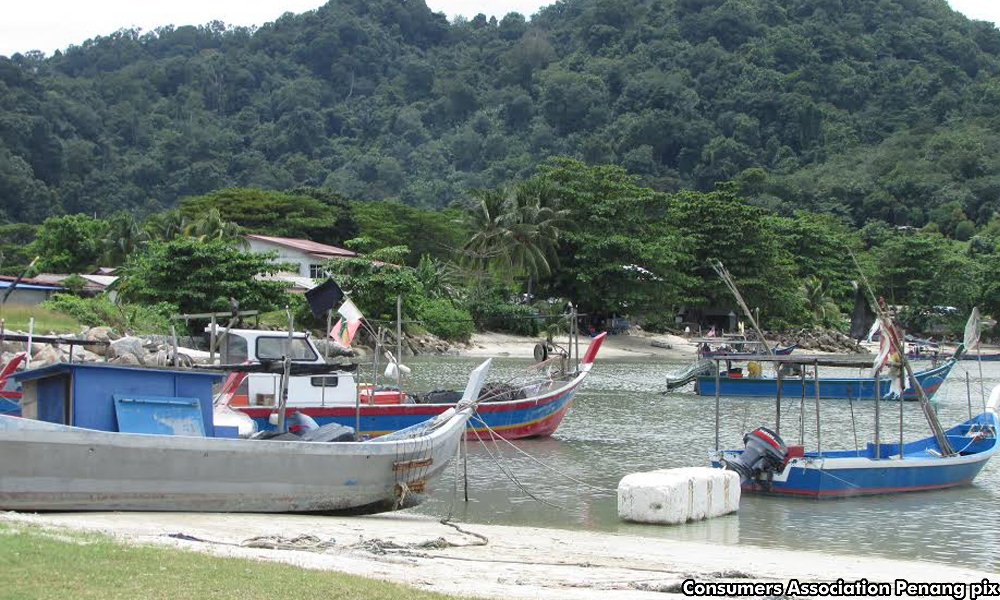

To reclaim or not, that's the question in Penang
ANAYLSIS A motion on sea reclamation in Penang was filed by Muhammad Farid Saad (BN-Pulau Betong) on Nov 20 at the state legislative assembly. The move shook the House and caused a rift between DAP and PKR.
What is the content of the motion that seems to open a can of worms in the Pakatan Harapan camp?
At first glance, the motion was nothing more than a normal call for more transparency and accountability in the approvals of reclamation projects...
ANAYLSIS A motion on sea reclamation in Penang was filed by Muhammad Farid Saad (BN-Pulau Betong) on Nov 20 at the state legislative assembly. The move shook the House and caused a rift between DAP and PKR.
What is the content of the motion that seems to open a can of worms in the Pakatan Harapan camp?
At first glance, the motion was nothing more than a normal call for more transparency and accountability in the approvals of reclamation projects.
This is the second motion filed by an opposition member in the state assembly, which was allowed to be debated.
The first was filed by Danny Law Heng Kiang (Batu Lanchang) on the Penang Outer Road Ring in 2006, which showed cracks between Gerakan and MCA, both parties in the ruling BN coalition then.
The motion on reclamation is divided into two parts: 1) For a comprehensive study or detailed environmental impact assessment and public consultation be conducted before the project is approved; and, 2) To suspend all new reclamation plans until the comprehensive study on the impact of reclamation on the ocean, environment and society is carried out or public hearings are conducted, and to cancel those that have negative effects on Penang.
The motion called on the state government to implement Pakatan Harapan’s CAT (competency, accountability and transparency) governance, and refers to reclamation projects undertaken for the purpose of payment for the cost of infrastructure development or public transport.
 The motion covers the entire state of Penang and is meant to propose a state policy for all reclamation projects and not for any specific one.
We gathered from the debate that the assemblypersons were not against development or reclamation per se, but were trying to seek more transparency and accountability in the process of approval and awarding of concessions to private companies that are appointed to carry out the reclamation exercise.
A vote based on conscience or politics?
The motion proved that not all Pakatan Harapan (previously Pakatan Rakyat) assemblypersons were on the same page as Chief Minister Lim Guan Eng, who defended the need for reclamation to support the state's infrastructure development.
Seven DAP representatives, including Lim, state executive councillors Chow Kon Yeow (Padang Kota) and Phee Boon Poh (Sungai Puyu), assemblypersons Yap Soo Huey (Pulau Tikus), Wong Hon Wai (Air Itam), RSN Rayer (Seri Delima), and Teh Yee Cheu (Tanjung Bungah) debated the motion.
On PKR's side, only state executive councillor Abdul Malik Kassim (Batu Maung) shared his views on the subject.
The motion was eventually rejected as it failed to obtain enough votes, from at least 21 of the 40 assemblypersons.
Umno obtained 10 votes to support its motion, while 23 Pakatan Harapan representatives opposed it.
 Teh (
photo
), who voted to support the Umno motion, has since apologised for his mistake and quit his post as DAP state organising secretary. He continues to remain a party member.
Teh (
photo
), who voted to support the Umno motion, has since apologised for his mistake and quit his post as DAP state organising secretary. He continues to remain a party member.
The episode took a turn for the worse when out of 10 PKR assemblypersons, four rejected the motion, while five abstained from voting. House speaker Law Choo Kiang (PKR-Bukit Tambun) was not allowed to vote.
The four who rejected the motion were Deputy Chief Minister I Rashid Hasnon (PKR-Pantai Jerejak), state executive councillors Abdul Malik Kassim (Batu Maung) and Dr Afif Bahardin (Seberang Jaya), and deputy speaker Maktar Shapee (Sungai Bakap).
The five who abstained, incurring the wrath of the chief minister, were PKR whip Ong Chin Wen (Bukit Tengah), Cheah Kah Peng (Kebun Bunga), Dr T Jayabalan (Batu Uban), Norlela Ariffin (Penanti), and Lee Khai Loon (Machang Bubok).
Their move opened a can of worms and led to several days of verbal war between DAP and PKR.
What did PKR do wrong?
Ong said the five decided to abstain from voting due to their conscience, taking into account the current political scenario.
But Lim accused the five of “sabotage, betrayal, and mutiny” within the party, even suggesting that there is an internal power struggle within PKR, where Ong was planning to topple Rashid for the deputy chief minister's post.
Rashid has denied the alleged plot, while PKR has stood by its assemblypersons, saying they were allowed to vote according to their conscience on matters related to public interest.
Below are some of the arguments for and against the motion:
1. Redundancy:
The call to conduct comprehensive studies (DEIA) and public consultation is “redundant” as these are provided by federal laws which states have to comply with.
According to Lim, Penang has always complied with this legal requirement before approval of any projects.
Public consultation and a detailed EIA report as required under the law for coastal reclamation projects over 50ha is stated under the Environmental Quality (prescribed activities) (Environmental Impact Assessment) Order 1987 to be read together with the Environmental Quality Act 1974.
2. It creates misunderstanding and wrong impression:
Lim said the motion creates “misunderstanding” as it gives the impression that the Penang government has failed to consult the public over reclamation projects.
3. Motion can result in Penang being bankrupt:
The chief minister argued that cancelling projects has consequences, including being slapped with legal suits by companies involved in the reclamation works.
Such compensation can run into billions of ringgit. This move has the potential to bankrupt Penang. Lim said he was willing to be criticised (for rejecting the motion) to save Penang from being bankrupt.
The BN representatives argued that this would not happen as only projects which are yet to be approved need to be cancelled.
4. BN reps should “man up and apologise”:
Lim demanded the BN assembly representatives apologise for being part of the previous state government led by Gerakan’s Koh Tsu Koon before 2008, which approved 3,241 acres for reclamation. He claimed that only 744 acres were carried out while the remaining 2,497 acres have yet to be reclaimed.
The BN representatives, including Jahara, who was former state executive councillor under Koh, remained mum when asked to apologise. To Lim, this gave the impression that they were not sincere in wanting to reform the state's policy on reclamation but merely had a sinister plan to bankrupt the state.
5. Why the fuss when Lim’s government only approved 60 acres of land reclamation?
Lim insisted and announced when presenting Penang's Budget 2016 that his administration has only approved 60 acres, which entails two projects - Bayan Mutiara (35 acres) and Bayan Bay (25 acres).
However, questions arise over the several projects which are ongoing under Harapan's watch:
Permatang Damar Laut in Batu Maung and Bayan Lepas - 1,500 acres (607ha) as part of the Transport Master Plan, a RM27 billion initiative by the state government to address the state’s ongoing traffic woes and lack of public transport.
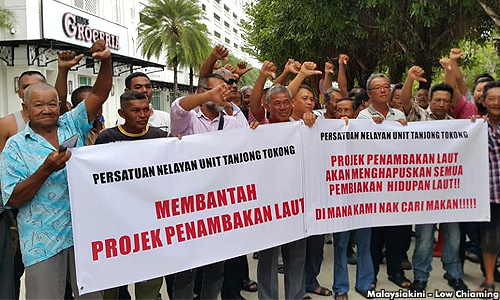
The Consumers Association of Penang (CAP) claimed that earthworks have begun in the area although government departments were in the dark about the matter.
CAP also claimed that 300 people whose livelihood is threatened by the project were not consulted as required by law.
But the state government insists that the plan is yet to be approved.
 Penang World City:
1. Farid accused Lim of “conveniently” selling a parcel of reclaimed land totalling 103 acres to Ivory Bhd for RM1.02 billion.
Ivory went on to have a joint venture with Tropicana Bhd to develop the land with a gross development value of RM10 billion, which is now known as Penang World City.
Lim's response: Only 35 out of the 103 acres for Penang World City (in Bayan Bay) are reclaimed land, and was originally meant for residential development and not industrial land as claimed by Farid.
At this point, it is important for us to know that there are several different stages or status of reclamation projects in Penang:
Those projects approved by BN but not yet reclaimed (Lim's estimation is around 2,497 acres);
2) Those which were approved by Pakatan government but yet to commence (for instance, Bayan Bay);
3) Those identified by Pakatan government but yet to be approved (4,000 acres in Permatang Damar Laut);
4) Future potential reclamation sites which have been identified by Penang Structural Plan (gazetted in 2007), for instance the middle bank , a large seagrass bed off the coast of Penang, dubbed an ecological wonder for its biodiversity.
Conclusion:
A state policy on reclamation is much needed as several NGOs, as well as Teh and DAP assemblypersons, have sounded the alarm on the controversial projects, warning that uncontrolable reclamation would only spell disaster for the state’s environment in the future and cause the loss of livelihood to hundreds of fisherfolk affected by the plans.
NGOs that have been vocal on the issue are Consumers Association of Penang, Chant Awareness and The Penang Forum. The issue has been used by the state opposition, including Gerakan and MCA, to score political points with their supporters.
At stake is the island's once pristine geological front. The questions for Penangites remain: Are they in favour of reclamation on the island's coastal front? Can the state government find other forms of revenue to support its infrastructure or traffic dispersal plan, other than selling or swapping land for reclamation with private companies?
These are the questions Penangites will have to ponder come the next general election, slated for not later than June 2018.


Are you sure you want to delete this comment?
This action cannot be undone.