




Are we heading to become another Zimbabwe?
COMMENT Back in 2008, during the political tsunami which took most Malaysians by surprise, my wife and I were still living in Mozambique. She was on a contract job, while I was the househusband.
Although Mozambique was a poor nation, corruption was a major problem. Foreigners like us were constantly being harassed by the customs officers at the airport and the local police constables.
It was common that our luggage would go missing for a few days or things were removed from the bags. Or we would be asked to take our luggage into a separate room, where we had to spend time talking to officers who wanted to know what they could get from us.
COMMENT Back in 2008, during the political tsunami which took most Malaysians by surprise, my wife and I were still living in Mozambique. She was on a contract job, while I was the househusband.
Although Mozambique was a poor nation, corruption was a major problem. Foreigners like us were constantly being harassed by the customs officers at the airport and the local police constables.
It was common that our luggage would go missing for a few days or things were removed from the bags. Or we would be asked to take our luggage into a separate room, where we had to spend time talking to officers who wanted to know what they could get from us.
I, too, had several encounters myself with the Mozambican authorities, but according to friends who have worked in other parts of Africa, corruption was far worse in the ‘bankrupt’ nation of Zimbabwe under President Robert Mugabe. Someone mentioned about Zimbabwe again, and this triggered old memories.
Will the real Malaysian Mugabe please stand up?
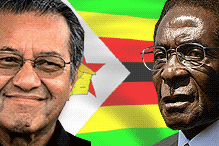 In the past, we have always likened Mugabe to Dr Mahathir Mohamad, but with the new National Security Council (NSC) Bill being passed with lightning speed in the Dewan Rakyat, I cannot help but to agree to a certain extent that Prime Minister Najib Abdul Razak deserves the ‘honour’ more than Dr Mahathir.
Of course, in the case of Zimbabwe, the situation was stretched to extremes, but concerns are valid that Malaysia may be heading in that direction, if things do not improve. Still one of the longest serving presidents, Mugabe, who has been the president of Zimbabwe since 1987, is still in power.
In December 1987, Mugabe consolidated his power to become the executive president. This was done with the endorsement of the so-called parliament. As executive president, Mugabe was holding all three-roles-in-one - head of state, head of government, and commander-in-chief of the armed forces, with powers to dissolve parliament and declare martial law.
This is how Mugabe is still the president of the country, despite the fact that he is the man who has allegedly bankrupted the nation. Being the former wife of an air force pilot, Grace Mugabe is allegedly also a big spender who can afford all the luxuries in life, while most of the citizens in Zimbabwe are suffering from the poverty created by the president and his first lady.
On all counts, certainly Dr Mahathir did not meet the conditions as the Malaysian Mugabe, as Dr Siti Hasmah Mohd Ali is a woman of great stature herself. According to WikiLeaks which released some US diplomatic cables in 2010, the flamboyant First Lady, Grace Mugabe, and some well-connected elites and high-ranking Zimbabwean government officials were generating millions of dollars in personal income by mining diamonds from the Chiadzwa mine in eastern Zimbabwe.
Grace Mugabe sued a local Zimbabwean newspaper, The Standard, over the exposè.
And, despite his iron rule for 22 years, Dr Mahathir did not grab the power to declare martial laws, a power that has been always been vested upon the Yang di-Pertuan Agong himself under the federal constitution.
Perhaps, with the passing of the National Security Bill, it is time that the Bar Council look into using the courts to challenge the bill. It is unlikely that the senators in the Dewan Rakyat would have the audacity to block the bill at this juncture unless there are enough Pakatan Amanah-linked senators in the upper house.
Hyperinflation and freefall of the Zimbabwean dollar
Under Mugabe’s rule, the Zimbabwe dollar suffered from a free fall in 2008, when it was ruined by hyperinflation which hit 500 billion percent between 1997 and 2008. By 2009, the country had to start using foreign currencies including the US dollar and South African rand as the Zimbabwe dollar was worthless.
According to sources, among the normal causes of hyperinflation include the excessive or rapid increase in money supply, supply shocks often caused by natural calamities and wars, and rapid depreciation of currency due to other economic factors. The economic situation was so bad that The Zimbabwean frontpaged the story, ‘Thanks to Mugabe this money is wallpaper’.
It is mind-boggling when I refer to the olds news that Zimbabwe was offering the new exchange rate: US$1 for 35,000,000,000,000,000 old Zimbabwe dollars. Most people can only count up to nine zeros (in the billions), but a 15-zero figure is simply beyond one’s imagination!
Although this may be an extreme case, are we heading in that direction? Honestly, this is a question that the Barisan Nasional leaders have to ask their own conscience, when they supported the National Security Bill.
Apart from the new bill, since early this year our cost of living has gone up so much that the lower-income group is facing a big squeeze in their disposable income. Tell me if we are not heading to some crisis in the near future, especially since the 1MDB scandal has raised concerns that we could be in a huge debt.
Subsidy cuts, escalation of toll charges, public transport fares, Goods and Services Taxes (GST) and free fall of the ringgit have already badly affected consumers’ confidence. The SME Association of Malaysia, for example, has claimed that many small and medium enterprises are badly affected, with their sales dropping between 30 to 50 percent.
2016 may be another tough year, but I certainly hope that we will not reach the heights of economic troubles experienced by Zimbabwe.
I dread to think that a chicken in Malaysia will cost several hundred of US dollars!
STEPHEN NG is an ordinary citizen with an avid interest in following political developments in the country since 2008.


